Products · Water filters · Aquasana
Aquasana HealthShield Whole-House Water Filter (WH-HS)
Reader ratings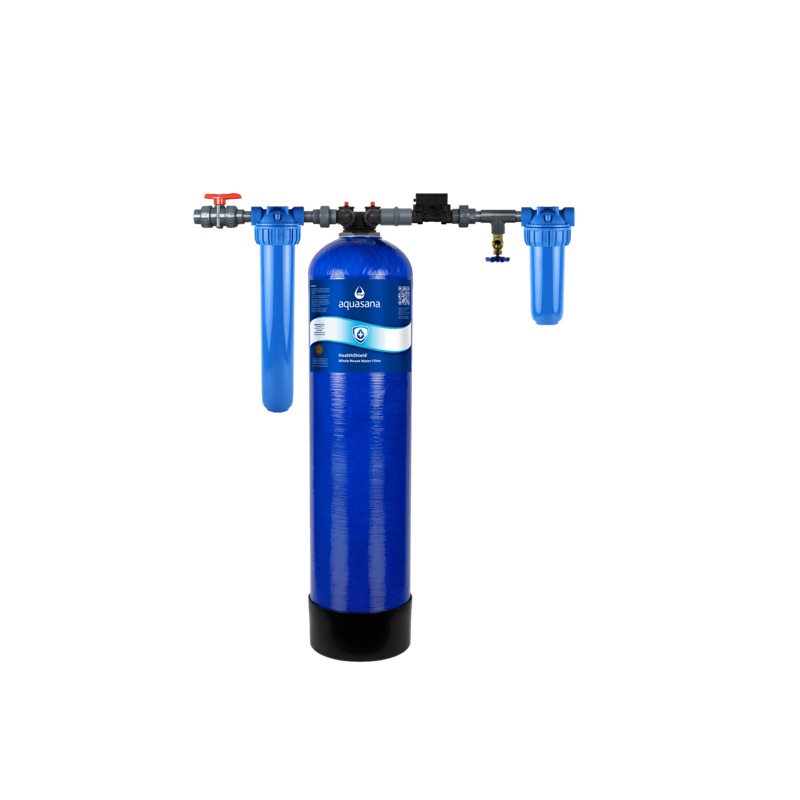
Whole-house filter with PFAS and VOCs on a WQA listing (NSF/ANSI 53), rated 165,000 gallons. $4,198 plus a $3,498 tank every two years (half price in the fall sale). Chlorine is Aquasana’s own test, and WQA sets an aluminum condition.
Best for Homes with PFAS or VOCs documented in their water supply that want every tap treated and can pay for it.
- Our rating
- Fair (3.0 of 5)
- Price range
- Premium
- Verified marks
- WQA Gold Seal: NSF/ANSI 53 and 401 (point of entry), WQA listing: CSA B483.1
- Size
- Single tank, 57 in tall and 12 in wide; rated 5.7 gpm; 165,000 gallons or about two years; cold water only (40 to 100°F); needs a 120 V outlet; no drain line
approx. $4,198 list; approx. $2,099 in Aquasana’s fall sale
See it on Aquasana’s site → (opens in a new tab)We are not affiliated with Aquasana. This link goes to the maker’s own page, with no tracking code. How we're funded.
Reader ratings & reviews
– out of 5
Loading ratings…
Rating breakdown
- 5 stars 0
- 4 stars 0
- 3 stars 0
- 2 stars 0
- 1 star 0
Have this product? Please rate it.
Check your email
We sent a sign-in link to . Click it and you’ll come straight back here, signed in. It expires in 15 minutes; check your spam folder if it doesn’t show up. Thank you for helping the community!
Your review
Reviews are personal experiences, not research, and they never change our quality ratings. Every review is read by our team before it appears.
How we evaluated it
How it scores Our rating, metric by metric
- Proven reduction 35% of the rating 4 of 5
WQA lists this model for PFOA, PFOS, PFHpA, PFHxS and PFNA (tested to 20 ng/L, 6 for PFNA), VOCs, BPA and ibuprofen. No lead claim, and chlorine and chloramine are Aquasana’s own tests.
- What touches the water 20% of the rating 3 of 5
Carbon in a tank that Aquasana does not describe, with disposable pre- and post-filters, and the whole tank is replaced at capacity. No silver is mentioned. Lead content is certified.
- Independent testing 15% of the rating 3 of 5
A paid WQA certification with a strict PFAS test and a published data sheet. We found no independent test of this model, and WQA’s note says incoming aluminum must be reduced first.
- Trust 10% of the rating 3 of 5
No recall or Prop 65 notice found. But it is new, the “penny a gallon” claim is about two cents on Aquasana’s own numbers, chlorine results are internal, and Aquasana pays affiliates at least 10%.
- Running cost & value 20% of the rating 1 of 5
$4,198 list up front ($2,099 in the fall sale), then a $3,498 tank ($1,749 on sale) about every two years plus $74 of pre-filters and $74 of post-filters a year: near $1,900 a year at list prices, near $1,000 on sale. That is about five times Pentair’s PFAS cartridge cost per gallon at list, and about two and a half times on sale.
The rating, 3.0 of 5, is the weighted average of these scores. See how we rank water filters and our standard.
What it’s made of What touches your food, water, skin or air
- One tank of granular activated carbon, rated 165,000 gallons; the tank material is not stated
- 20-inch sediment pre-filters (replaced every two months) and a 10-inch post-filter (every six months); materials not stated
- Touchscreen flow meter and a 120 V outlet; the electronics do not touch the water
- Aquasana says “nothing added” and mentions no silver or antimicrobial. WQA also lists the system for lead content (NSF/ANSI/CAN 372)
- At capacity the whole tank is replaced, not just the media (WQA’s listing note)
Who tested it What each test found, and who paid for it
- Paid certification Water Quality Association (WQA)
Lists WH-HS (replacement WH-HS-R, 165,000 gallons at 5.7 gpm) under NSF/ANSI 53 for PFOA, PFOS, PFHpA, PFHxS, PFNA and VOCs as chloroform. Aquasana’s data sheet shows each PFAS cut by more than 99.9% against limits of 20 ng/L (6 ng/L for PFNA) and VOCs by 99.8%. WQA’s notes say the incoming water must have its aluminum reduced first and the whole system is replaced at capacity. The maker pays for the program. Open ↗ (opens in a new tab)
- Paid certification Water Quality Association (WQA)
Lists WH-HS under NSF/ANSI 401 for BPA and ibuprofen only, under CSA B483.1 (the Canadian standard for drinking water treatment systems) and under NSF/ANSI/CAN 372 for lead content of its parts. Open ↗ (opens in a new tab)
- Maker’s own test Aquasana’s own testing
Reports chlorine cut by more than 97.4% and chloramine by 97.49%. The data sheet says these were internal tests and that WQA did not evaluate them. Open ↗ (opens in a new tab)
Who paid, and why it matters
- Independent The tester took no money from the maker for it: a consumer group, a journalist, a university or a regulator.
- Paid certification An outside lab or certifier tested or listed it, and the maker paid for that.
- Maker’s own test A lab report or certificate of analysis the maker commissioned and published.
A certification is a floor, not a verdict: it checks what its program checks and nothing else. We weigh tests by someone with no stake in the result most.
What people ask Worries raised online and elsewhere, and what we found
- Do whole-house carbon filters let PFAS back through?
- In the one in-home study of whole-house carbon systems we found (Duke University, North Carolina homes), PFAS levels in the filtered water went up for four of eight systems (abstract (opens in a new tab)). The abstract does not name the systems or say whether any was certified for PFAS. HealthShield is certified for five PFAS compounds when new, but we found no study of this model, and a carbon filter run past its rating can give back what it caught. Change on schedule and test your water.
- Is it really “a penny a gallon”?
- On Aquasana’s own numbers, a $3,498 tank for 165,000 gallons is about 2.1 cents a gallon, before the pre-filters and post-filter. The system is rated for about two years of use, so the figure assumes that you replace on that clock.
- Are the chlorine and chloramine claims certified?
- No. The data sheet says Aquasana tested them internally and WQA did not evaluate them. Chlorine is the main reason most people buy a whole-house filter, so treat the 97% figures as the maker’s word.
- Is there any track record?
- Little. Aquasana’s page tags it “New Product” and gives a two-year warranty. We found no independent review, and Consumer Reports’ water-filter ratings do not include whole-house systems.
- Who gets paid to recommend it?
- Aquasana’s affiliate program pays commissions “starting at 10%” through Rakuten’s LinkShare, so a list that recommends the HealthShield may earn money when you buy (program page (opens in a new tab)). A. O. Smith, the water-heater maker, has owned Aquasana since 2016.
Trade-offs What to weigh before you buy
- It is new, with a two-year warranty and no long track record.
- The cost is high: $4,198 list ($2,099 in the sale that was on 2026-10-23) plus installation by a plumber, then a $3,498 tank ($1,749 on sale) every 165,000 gallons or about two years, plus pre- and post-filters. That is about 2 cents a gallon for the tank alone at list price, or about $1,900 a year. Aquasana says “a penny a gallon”, which holds only at sale prices.
- WQA did not evaluate chlorine or chloramine, so Aquasana’s 97.4% and 97.49% figures are its own tests. WQA’s listing also says the incoming water must have its aluminum reduced first, and that the whole system is replaced when capacity runs out.
- It needs a 120 V outlet within ten feet and cold water only. For drinking water alone, a certified filter at the kitchen tap costs far less.
What to know Details worth knowing first
Most whole-house filters are sold on chlorine and taste. HealthShield is sold on PFAS and VOCs, and WQA’s directory backs that for this exact model under NSF/ANSI 53. It is one of two whole-house filters we found on sale with PFAS on a certifier’s listing. The other is Pentair’s FloPlus Protect 20BB, a cartridge system at about $325. Our note on what PFAS are explains why that line matters.
Three things hold it back. It is new, so there is little field history. It costs $4,198 up front and $3,498 for each replacement tank, about every two years. And the certificate has conditions: chlorine and chloramine were not evaluated, and WQA says the incoming water must have its aluminum reduced first. The one in-home study of whole-house carbon filters, from Duke, found PFAS rising after half of them, so change on schedule.
If your goal is PFAS in drinking water, a certified tap-level filter or reverse osmosis system does that for a fraction of the price. A whole-house system makes sense if you also want treated water for showers and cooking and your supply has documented PFAS or VOCs. Check your utility’s report and test your water first.
What we checked Each claim, and how sure we are of it
- Third-party tested
- Yes
- Tested by
- WQA (Water Quality Association), paid for by the maker
| What we checked | What we found |
|---|---|
| Certified, not just claimed Verified | WQA’s own directory lists WH-HS (replacement WH-HS-R) under NSF/ANSI 53 and 401, and also under CSA B483.1 and NSF/ANSI/CAN 372. Opened 2026-10-23. Chlorine and chloramine are not certified. |
| Matched to your water Not verified | Not something we can check for you. WQA’s note says the influent water must have its aluminum level reduced before treatment. Aquasana’s manual also limits incoming water to pH 7 to 8, hardness under 10 grains, iron under 0.3 mg/L, aluminum of 50 µg/L or less and no hydrogen sulfide, and PFOA no higher than 500 ng/L. Read your utility’s report or test your tap. |
| The contaminants you care about Verified | Under 53: PFOA, PFOS, PFHpA, PFHxS, PFNA and VOCs (as chloroform). Under 401: BPA and ibuprofen. No lead claim, no fluoride claim. |
| Data sheet results Maker’s claim | PFOA, PFOS, PFHpA, PFHxS and PFNA above 99.9% against limits of 20 ng/L (6 for PFNA), VOCs 99.8%, BPA and ibuprofen 94.7%. These are Aquasana’s published numbers. Its chlorine (97.4%) and chloramine (97.49%) results were internal tests. |
| Independent test of this model Not verified | None found. |
| Flow and waste Maker’s claim | WQA’s listing gives 5.7 gpm. Aquasana’s sheet adds a peak of 11.2 gpm, tested at the rated flow, and says there is no drain line and no backwash. |
| Replacement cost Maker’s claim | Replacement tank WH-HS-R $3,498 list ($1,749 in the fall sale) every 165,000 gallons or about 2 years; 20-inch pre-filter 3-pack $36.99 every 6 months (replace every 2 months); post-filter $36.99 every 6 months. Prices from Aquasana’s site, 2026-10-23. |
What the labels mean
- Verified We opened an independent record that confirms it: a certifier’s listing, a regulator’s list or a lab report. It is linked under Sources.
- Maker’s claim The maker says so on its own page or label. We read it but found no independent record.
- Not verified We looked and could not confirm it, or the maker does not say. Treat it as unknown.
Sources Where our facts come from
- Aquasana HealthShield product page. Maker’s page. Specifications and claims as seen on 2026-10-23, when the page showed $2,099 in a limited-time sale against a $4,198 list price. Open ↗ (opens in a new tab)
- HealthShield (WH-HS) performance data sheet. Maker’s page. States that WQA did not evaluate chlorine or chloramine, and that the filter is only for cold water. Open ↗ (opens in a new tab)
- HealthShield replacement tank page. Maker’s page. $3,498 list; $1,749 in the fall sale on 2026-10-23. Open ↗ (opens in a new tab)
- Aquasana 20-inch replacement pre-filters, 3-pack. Maker’s page. $36.99. Open ↗ (opens in a new tab)
- Aquasana 10-inch post-filter replacement. Maker’s page. $36.99. Open ↗ (opens in a new tab)
- WQA directory: Aquasana, NSF/ANSI 53 (health effects). Certifier or regulator listing. Lists WH-HS as point of entry, 5.7 gpm, 165,000 gallons, with the aluminum and replace-at-capacity notes. Open ↗ (opens in a new tab)
- WQA directory: Aquasana, NSF/ANSI 401 (emerging compounds). Certifier or regulator listing. Open ↗ (opens in a new tab)
- WQA directory: Aquasana, CSA B483.1 (drinking water treatment systems). Certifier or regulator listing. Lists WH-HS as point of entry. The same directory lists it under NSF/ANSI/CAN 372 for lead content of its components. Open ↗ (opens in a new tab)
- Assessing the Effectiveness of Point-of-Use Residential Drinking Water Filters for Perfluoroalkyl Substances (PFASs) (Duke University, 2020). Test report. Abstract read via Crossref. Reports PFAS rising after four of eight whole-house carbon systems. The publisher blocks automated access, so we could not read the data tables. Open ↗ (opens in a new tab)
- HealthShield (WH-HS) installation and owner's manual. Maker’s page. Influent water limits (pH, hardness, iron, aluminum, hydrogen sulfide, PFAS). No Prop 65 warning in it. Open ↗ (opens in a new tab)
- Aquasana affiliate program. Maker’s page. Commissions starting at 10%, a 30-day cookie, run through LinkShare. Open ↗ (opens in a new tab)
Alternatives Other options to compare
- Pentair FloPlus Protect 20BB whole-house PFAS filter IAPMO lists it for PFOA, PFOS, PFHxS, PFNA and PFHpA under NSF/ANSI 53. About $325, but only 40,000 gallons per $169 cartridge, and its chlorine claim is Pentair’s own.
- Delta Clarifi tankless reverse osmosis system For drinking water only: total PFAS, lead and fluoride on its IAPMO listings, about $800.