Products · Water filters · AquaTru
AquaTru Classic Countertop Reverse Osmosis Purifier
Reader ratings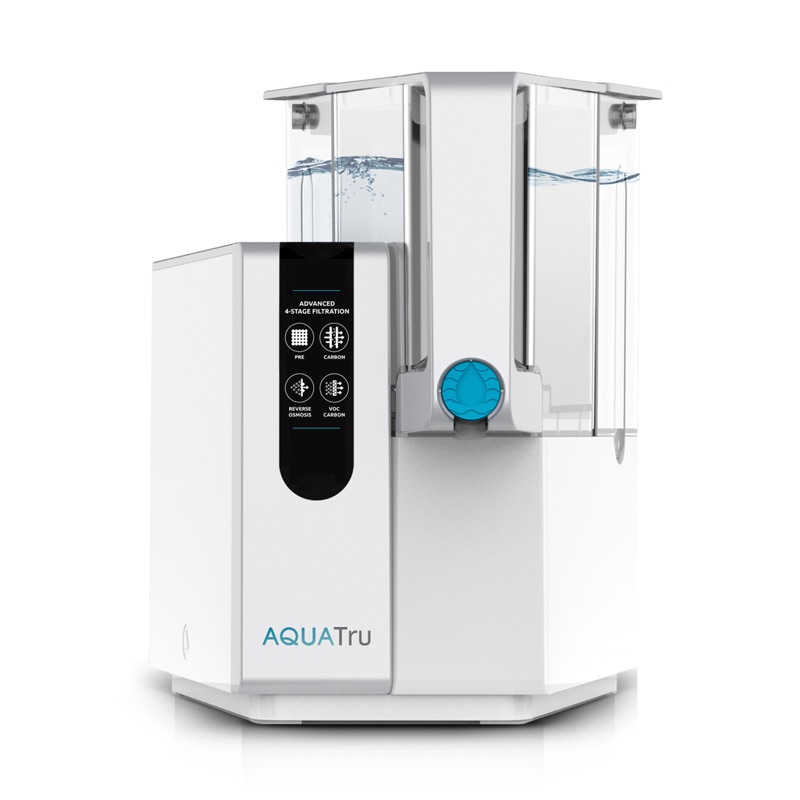
A plug-in reverse osmosis purifier that IAPMO R&T lists for lead, fluoride, PFOA/PFOS, arsenic and nitrate. It wastes about a third of a gallon per gallon made, strips minerals and costs about $1,125 over five years.
Best for Renters, or anyone who wants lead, fluoride and PFAS reduced without plumbing work and wants more water per day than the Carafe makes.
- Our rating
- Good (3.9 of 5)
- Price range
- Premium
- Verified marks
- IAPMO R&T: NSF/ANSI 42, 53, 58, 372 and 401
- Size
- Countertop unit with a push-button dispenser and a 0.75-gallon purified-water tank; no plumbing; rated 54 gallons a day
approx. $475
See it on AquaTru’s site → (opens in a new tab)We are not affiliated with AquaTru. This link goes to the maker’s own page, with no tracking code. How we're funded.
Also sold at Amazon ($475), Home Depot ($475), Walmart ($475) .
Reader ratings & reviews
– out of 5
Loading ratings…
Rating breakdown
- 5 stars 0
- 4 stars 0
- 3 stars 0
- 2 stars 0
- 1 star 0
Have this product? Please rate it.
Check your email
We sent a sign-in link to . Click it and you’ll come straight back here, signed in. It expires in 15 minutes; check your spam folder if it doesn’t show up. Thank you for helping the community!
Your review
Reviews are personal experiences, not research, and they never change our quality ratings. Every review is read by our team before it appears.
How we evaluated it
How it scores Our rating, metric by metric
- Proven reduction 35% of the rating 5 of 5
IAPMO R&T lists the Classic under five standards for lead, fluoride, arsenic, nitrate, PFOA/PFOS, chloramine, chlorine and microplastics, the widest list of the drinking-water filters here. A reviewer’s lab test agreed.
- What touches the water 20% of the rating 3 of 5
Plastic tanks of unnamed type hold both the tap and the purified water, with lead-free certification and no silver mentioned. The Carafe’s glass carafe scores one point higher.
- Independent testing 15% of the rating 4 of 5
A broad paid IAPMO certification plus a reviewer’s before-and-after lab test that removed every health-related contaminant it found. That test was one sample from a site that earns affiliate income; no consumer group has tested it that we found.
- Trust 10% of the rating 3 of 5
No recall, lawsuit or Prop 65 notice found. AquaTru pays affiliates up to 22% with approved claims, and its page quotes its own chief medical officer as an expert on how many contaminants it removes.
- Running cost & value 20% of the rating 3 of 5
$475 plus about $130 a year in filters, about $1,125 over five years, with about a third of a gallon sent to the drain per gallon made. It wastes less water than the Carafe but costs $100 more.
The rating, 3.9 of 5, is the weighted average of these scores. See how we rank water filters and our standard.
Where to buy Stores and the prices we saw
- Amazon (opens in a new tab) approx. $475. The base Classic, listed as the AquaTru Water Purification Unit. Shipped by Amazon and sold by Ideal Living Direct (AquaTru’s logo reads “AquaTru by Ideal Living”). In stock on 2026-10-23.
- Home Depot (opens in a new tab) approx. $475. The standard Classic (model 90AT204AT01 on the page), $475.00. Free delivery on Nov 3 to 4 as of 2026-10-23.
- Walmart (opens in a new tab) approx. $475. The standard Classic with pre-filter, reverse osmosis filter and VOC filter. Sold by Ideal Products LLC; add to cart available on 2026-10-23.
Prices as we saw them on October 23, 2026. They change often. These links carry no tracking code and earn us nothing.
What it’s made of What touches your food, water, skin or air
- Tap-water tank, purified-water tank, dispenser and housing: plastic that AquaTru does not name
- Filters: a carbon pre-filter, a reverse osmosis membrane and a VOC carbon filter (or the Alkaline Mineral Boost version). AquaTru does not name the membrane material
- IAPMO also lists the system as lead-free (NSF/ANSI/CAN 372). No silver or fragrance is mentioned
Who tested it What each test found, and who paid for it
- Paid certification IAPMO R&T October 2026
Lists the Classic models AT2000 to AT2050 under NSF/ANSI 42-2022 (W-10188), 53-2021 (W-10193), 58-2022 (W-10194), 401-2020 (W-10195) and 372-2022 (W-14617). The 58 listing names lead, fluoride, arsenic, nitrate/nitrite and 8 more; the 53 listing names VOCs and PFOA/PFOS; the 401 listing names microplastics and 15 drugs and chemicals. AquaTru pays for the listings. Open ↗ (opens in a new tab)
- Independent Water Filter Guru (earns affiliate income; lab kits from Tap Score by SimpleLab) July 2026
Two before-and-after tests of the Classic on a Colorado home’s tap water. In the first, all 11 health-related contaminants fell to zero, including fluoride (1.5 ppm), lead, uranium and nitrate; dissolved solids fell from 112 to 12 ppm and calcium and magnesium by 97% and 94%. Open ↗ (opens in a new tab)
- Independent North Carolina DHHS filter list, mostly from Duke University’s 2020 home study June 2022
Lists an AquaTru countertop reverse osmosis system among those with PFAS removed below detectable levels; Duke’s study of 73 homes found reverse osmosis and under-sink dual-stage filters removed PFAS near completely, while other carbon filters removed about 40% to 70%. The list does not say which AquaTru model or year was tested. Open ↗ (opens in a new tab)
Who paid, and why it matters
- Independent The tester took no money from the maker for it: a consumer group, a journalist, a university or a regulator.
- Paid certification An outside lab or certifier tested or listed it, and the maker paid for that.
- Maker’s own test A lab report or certificate of analysis the maker commissioned and published.
A certification is a floor, not a verdict: it checks what its program checks and nothing else. We weigh tests by someone with no stake in the result most.
What people ask Worries raised online and elsewhere, and what we found
- How much water does it waste?
- About a third of a gallon per gallon made. The data sheet gives 75% efficiency and 80% recovery, and TapWaterData records a 1 to 3 waste ratio (TapWaterData (opens in a new tab)). Most under-sink systems waste more; EPA’s WaterSense limit is 2.3 gallons per gallon treated (our article).
- Does it take out the good minerals too?
- Yes. In the reviewer’s test calcium fell 97% and magnesium 94%. With the mineral-boost filter, pH rose from 7.3 to 10.7 and calcium still fell 97.5%, while magnesium rose from 7.32 to 9.78 mg/L (the review’s text says 33% lower, its table shows 34% higher) (review (opens in a new tab)). Our article on reverse osmosis water finds this unlikely to matter for most healthy adults who eat a varied diet.
- Who gets paid when people recommend it?
- AquaTru’s affiliate page offers up to 22% commission, looks for partners with strong social followings and supplies “approved claims” (AquaTru (opens in a new tab)). Its page quotes its own chief medical officer, and the sites that rank it first, including the reviewer we cite, earn commissions on their links.
- Why isn’t it listed by NSF itself?
- AquaTru uses IAPMO R&T, which tests to the same NSF/ANSI standards; NSF’s own directory had no AquaTru entry when TapWaterData checked on 2026-08-30 (TapWaterData (opens in a new tab)). We read IAPMO’s record, which is the one that matters.
- Is the customer experience good?
- Mostly, but not always. AquaTru’s page shows 4.6 out of 5 from about 2,900 reviews, with a one-star review about a unit that did not work and customer service that offered $37 back (AquaTru (opens in a new tab)). TapWaterData saw 4.1 out of 5 on Amazon (checked 2026-08-30).
- Do any of its parts contain PTFE or other PFAS-type plastics?
- We could not tell. AquaTru names no fluoropolymer, but it also does not list the materials of its tubing, seals, fittings or membrane, so we cannot rule it out. The certification listings name what the filter removes, not what its parts are made of. If you want to avoid these plastics, ask AquaTru for a materials list before you buy.
Why we chose it What put it on our list
- IAPMO R&T’s public listing covers the Classic models AT2000 to AT2050 under NSF/ANSI 42-2022, 53-2021, 58-2022, 401-2020 and 372-2022, all active to 2028 or 2029. It names lead and fluoride (58) and PFOA and PFOS (53).
- The data sheet shows results, not just claims. Under the NSF/ANSI 58 protocol it reports at least 97.5% lead reduction (99.1% on average) and at least 91.8% fluoride reduction (93.5% on average). PFOA and PFOS appear in the NSF/ANSI 53 table, with at least 97.5% reduction from a 1.5 µg/L challenge.
- A reviewer’s before-and-after lab test found it removed all 11 health-related contaminants in its tap water, including lead, fluoride, uranium, nitrate and copper.
- Filter schedule and price are published: pre-filter every 6 months or 600 gallons, RO membrane every 24 months or 1,200 gallons, VOC filter every 12 months or 600 gallons. A two-year filter set is $259.65.
Trade-offs What to weigh before you buy
- It wastes water. The data sheet gives 75% efficiency, which works out to about 1 gallon sent to waste for every 3 gallons of purified water.
- It takes minerals out along with contaminants: total dissolved solids fall by 87.1% on average in the data sheet, and in the reviewer’s test calcium fell 97% and magnesium 94%. A VOC filter with a pH and mineral boost (part AT2004) is available.
- It is built for drinking and cooking water, not volume: the data sheet rates it at 54 gallons a day. The reviewer found dispensing slow.
- It needs water under 10 grains per gallon (171 mg/L) of hardness, or softened water, or scale will clog the membrane.
- $475 up front, plus about $130 a year in filters if you follow the schedule.
What to know Details worth knowing first
Reverse osmosis (RO) pushes water through a membrane that blocks most dissolved contaminants, which is why it is the most thorough home option for lead, PFAS, fluoride and arsenic. Our guide to choosing a filter compares it with carbon filters. The AquaTru Classic is a countertop version: you fill one tank, it filters into a second, and nothing connects to your plumbing.
What we liked is the paper trail. IAPMO R&T’s own public listing names the Classic models AT2000 to AT2050 under NSF/ANSI 42, 53, 58, 372 and 401, including lead and fluoride (58) and PFOA and PFOS (53). The data sheet names the standard behind each result, and a reviewer’s lab test of the Classic found every health-related contaminant in its water removed.
Three practical points. RO removes minerals and wastes water: about a quarter of what goes in is rejected. A filter you forget to change stops working, so put the changes in your calendar. And AquaTru pays affiliates up to 22%, so many glowing rankings earn money. Before buying any filter, check what is in your own water: see what’s in your water.
What we checked Each claim, and how sure we are of it
- Third-party tested
- Yes
- Tested by
- IAPMO R&T, paid for by the maker
| What we checked | What we found |
|---|---|
| Certified, not just claimed Verified | IAPMO R&T’s public listing names the Classic models AT2000 to AT2050 under NSF/ANSI 42-2022 (W-10188), 53-2021 (W-10193), 58-2022 (W-10194), 401-2020 (W-10195) and NSF/ANSI/CAN 372-2022 (W-14617), all active (checked 2026-10-23). The data sheet (rev. 10.24.R4) names the same models and standards. We found no WQA listing, and TapWaterData reports no NSF International listing (checked 2026-08-30). |
| Matched to your water Not verified | Not something we can check for you. Look up your utility’s water report or get a lab test first. |
| Lead, PFAS and fluoride Verified | IAPMO’s 58 listing names lead and fluoride, and its 53 listing names PFOA and PFOS, for AT2000 to AT2050. The percentages come from AquaTru’s data sheet: minimum lead 97.5% (99.1% average), PFOA and PFOS at least 97.5%, fluoride at least 91.8% (93.5% average). These are lab-test figures, and real results depend on your water. |
| Independent test Verified | Water Filter Guru’s lab sample agrees on lead, fluoride and nitrate. It was a single sample from a site that earns affiliate income. We found no consumer-group test. |
| Flow and waste Maker’s claim | 54 gallons a day. 80% recovery and 75% efficiency, which is roughly 1 gallon of waste for every 3 gallons purified. |
| Replacement cost Maker’s claim | Pre-filter $29.95, VOC filter $39.95, membrane $59.95. Two-year pack $259.65 (maker prices, seen 2026-10-23). Intervals: pre-filter 6 months or 600 gallons, RO membrane 24 months or 1,200 gallons, VOC filter 12 months or 600 gallons. |
What the labels mean
- Verified We opened an independent record that confirms it: a certifier’s listing, a regulator’s list or a lab report. It is linked under Sources.
- Maker’s claim The maker says so on its own page or label. We read it but found no independent record.
- Not verified We looked and could not confirm it, or the maker does not say. Treat it as unknown.
Sources Where our facts come from
- AquaTru Classic product page: price, filters and claims. Maker’s page. $475, tank size and the quoted chief medical officer, seen 2026-10-23. Open ↗ (opens in a new tab)
- AquaTru Classic performance data sheet, rev. 10.24.R4. Test report. Published by AquaTru. Carries the IAPMO R&T mark; lists test results by standard. Open ↗ (opens in a new tab)
- IAPMO R&T listing W-10194: NSF/ANSI 58, AquaTru, LLC. Certifier or regulator listing. Countertop section lists AT2000 to AT2050 with lead, fluoride, arsenic, nitrate and more; 54 gallons a day. Open ↗ (opens in a new tab)
- IAPMO R&T listing W-10193: NSF/ANSI 53, AquaTru, LLC. Certifier or regulator listing. AT2000 to AT2050: VOC and PFOA/PFOS; 600 gallons. Open ↗ (opens in a new tab)
- IAPMO R&T listing W-10195: NSF/ANSI 401, AquaTru, LLC. Certifier or regulator listing. AT2000 to AT2050: microplastics and 15 drugs and chemicals. Open ↗ (opens in a new tab)
- IAPMO R&T listing W-10188: NSF/ANSI 42, AquaTru, LLC. Certifier or regulator listing. Open ↗ (opens in a new tab)
- IAPMO R&T listing W-14617: NSF/ANSI/CAN 372 lead-free, AquaTru, LLC. Certifier or regulator listing. Open ↗ (opens in a new tab)
- AquaTru affiliate program. Maker’s page. Commission of up to 22%, partners chosen for social following, approved claims supplied. Open ↗ (opens in a new tab)
- Water Filter Guru: AquaTru review (Classic, Alkaline Classic and Connect). Independent source. A reviewer that earns affiliate income. Before-and-after lab tests, mineral and pH changes, cost. Open ↗ (opens in a new tab)
- North Carolina DHHS: PFAS water testing and filtration resources. Test report. State list of filters by PFAS removal, compiled mostly from the Duke University study. Open ↗ (opens in a new tab)
- Assessing the Effectiveness of Point-of-Use Residential Drinking Water Filters for PFASs (Duke University, 2020). Test report. Abstract read via Crossref. The publisher blocks automated access, so we could not read the data tables. Open ↗ (opens in a new tab)
- TapWaterData: AquaTru Classic certification summary. Independent source. An affiliate-funded directory check of IAPMO and NSF listings, waste ratio, reviews and litigation, as of 2026-08-30. It found no NSF International listing and no recall or litigation. Open ↗ (opens in a new tab)
Alternatives Other options to compare
- AquaTru Carafe The smaller, cheaper sibling: about $100 less, listed by IAPMO R&T for the same kinds of claims, with a glass carafe for the clean water. It makes 35 gallons a day and wastes more water (63% efficiency).
- An under-sink reverse osmosis system certified to NSF/ANSI 58 Out of sight and faster, but it needs installation and often sends more water to the drain. Ask for its data sheet and compare the lead, PFOA/PFOS and fluoride lines.
- A carbon-block pitcher certified to NSF/ANSI 53 for lead Cheaper and wastes no water, but it will not reduce fluoride or dissolved minerals, and PFAS results vary by model.