Products · Biological age tests · TruDiagnostic
TruDiagnostic TruAge
Reader ratings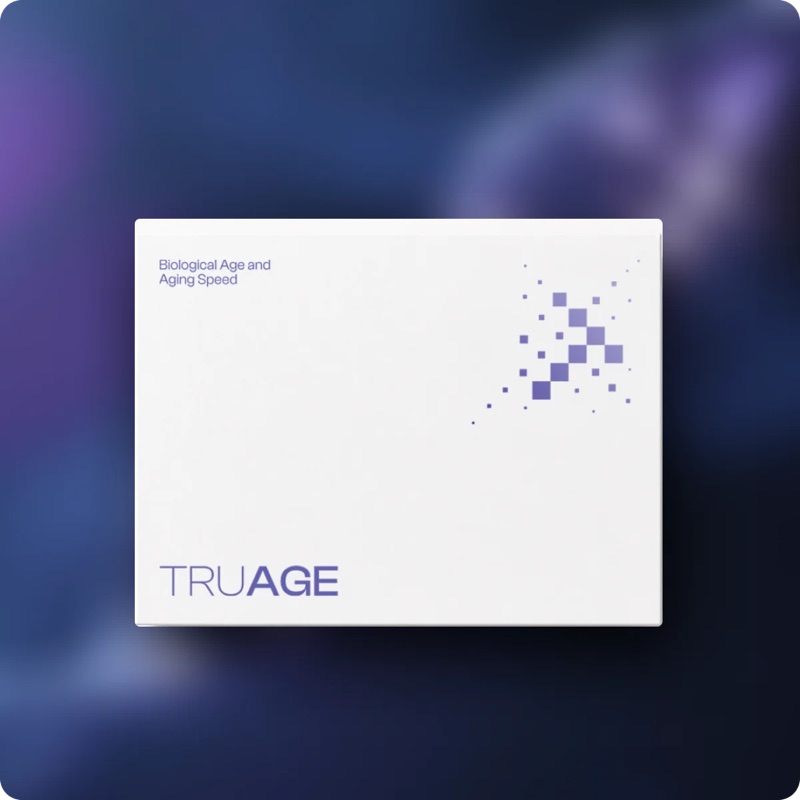
An at-home DNA methylation test with named, published clocks and a CLIA-certified lab. No clinician is involved, its “75+ markers” are estimates, and its terms let it sell de-identified data with a consent you cannot withdraw.
Best for Readers who understand it is a research-grade estimate, want to track one number over time and accept the data terms. It does not replace standard blood tests or a doctor.
- Our rating
- Fair (3.1 of 5)
- Price range
- Premium
- Verified marks
- CLIA certificate of compliance: TruDiagnostic, Lexington, KY (CLIA 18D2183496, valid to 2026-12-28)
- Size
- At-home finger-prick kit, mailed back as a dried blood spot; the report arrives 3 to 4 weeks after the lab receives it
approx. $499 for TruAge (TruHealth $499; both kits $849; a four-test annual subscription is $998 for TruAge); trudiagnostic.com advertises free shipping in the continental U.S.
See it on TruDiagnostic’s site → (opens in a new tab)We are not affiliated with TruDiagnostic. This link goes to the maker’s own page, with no tracking code. How we're funded.
Also sold at Amazon ($499 plus $4.49 delivery) .
Reader ratings & reviews
– out of 5
Loading ratings…
Rating breakdown
- 5 stars 0
- 4 stars 0
- 3 stars 0
- 2 stars 0
- 1 star 0
Have this product? Please rate it.
Check your email
We sent a sign-in link to . Click it and you’ll come straight back here, signed in. It expires in 15 minutes; check your spam folder if it doesn’t show up. Thank you for helping the community!
Your review
Reviews are personal experiences, not research, and they never change our quality ratings. Every review is read by our team before it appears.
How we evaluated it
How it scores Our rating, metric by metric
- Validated measures 30% of the rating 4 of 5
The report names its clocks: DunedinPACE (eLife 2022, built at Duke and Columbia), OMICmAge (Nature Aging 2026, built with TruDiagnostic and tested in its own samples and in Generation Scotland) and organ ages it says come from Yale’s clocks, but its 75+ “biomarkers” are methylation estimates, not measurements, and a 2026 study put DunedinPACE near the low end for stability across repeat samples.
- Lab & method 15% of the rating 4 of 5
CMS lists TruDiagnostic’s own Lexington, KY lab (CLIA 18D2183496) with a certificate of compliance to 2026-12-28, with no CAP accreditation and clinical cytogenetics as its only listed specialty; it names the Illumina arrays it runs but not which one TruAge uses.
- What you get 20% of the rating 3 of 5
The report explains each score and a sample is public, but the sales page calls the test “medical-grade” and leads with “98% test-retest reproducibility” while its own terms call the service research and educational, and we found no raw-data download.
- Your data 20% of the rating 1 of 5
Its 2026 terms let it license or sell de-identified data for any lawful purpose, call your consent perpetual and irrevocable, and give no right to delete de-identified data, while its Amazon listing says “No third-party data sharing”.
- Value 15% of the rating 3 of 5
$499 buys three named clocks, organ ages, telomere length and immune cell estimates, against $299 for one older clock at myDNAge, or $998 for four TruAge tests on its annual subscription (about $250 a test).
The rating, 3.1 of 5, is the weighted average of these scores. See how we rank biological age tests and our standard.
Where to buy Stores and the prices we saw
- Amazon (opens in a new tab) approx. $499 plus $4.49 delivery. Sold and shipped by TruDiagnostic itself, listed as “Truage Complete Collection”. The listing was first posted in July 2022 and its text does not mention OMICmAge or the organ ages, so confirm the report contents with the maker before buying here. Amazon shows a 30-day return, while TruDiagnostic’s own policy says kits bought through third parties are not refundable unless the sale says otherwise.
Prices as we saw them on November 5, 2026. They change often. These links carry no tracking code and earn us nothing.
Who tested it What each test found, and who paid for it
- Paid certification CMS CLIA program (certificate of compliance) December 2024
CMS lists TruDiagnostic (CLIA 18D2183496) with a certificate of compliance from 2024-12-29 to 2026-12-28, facility type “epigenetics laboratory”. The certificate lists one specialty, clinical cytogenetics, and no chemistry or immunology. CLIA covers lab quality, not whether the clocks are clinically useful. Open ↗ (opens in a new tab)
- Independent Belsky and colleagues (Duke, Columbia and Otago universities) January 2022
Built and tested DunedinPACE on the Dunedin cohort and five other datasets. It showed high test-retest reliability and tracked disease and death in groups. Funded by the U.S. National Institute on Aging and the UK Medical Research Council, not by TruDiagnostic. Several authors are inventors on a Duke and Otago invention licensed to a company, and TruDiagnostic says it uses the exclusively licensed DunedinPACE algorithm. Open ↗ (opens in a new tab)
- Independent Higgins-Chen and colleagues (Yale University and others) July 2022
Found technical noise produced deviations of up to 9 years between replicates of the same sample for six common clocks; principal-component versions agreed within 1.5 years for most replicates. A test of the clocks, not of TruDiagnostic’s reports. Elysium Health, a rival test seller, supplied replicate data and licenses clocks built by two authors, but did not fund the study; its lead author is listed as a TruDiagnostic employee in the 2026 OMICmAge paper. Open ↗ (opens in a new tab)
- Independent Sehgal, Higgins-Chen and colleagues (Yale; TranslAGE platform, Aging Cell); two authors report consulting fees from TruDiagnostic August 2026
Tested 18 methylation clocks. Replicate assays agreed well, but repeat samples taken within short intervals under different conditions (meals, stress) showed only low to moderate stability, and technical reproducibility did not predict that stability. DunedinPACE, one of TruAge’s three clocks, was “technically excellent but biologically unreliable”; OMICmAge did somewhat better but still fell short of its technical precision. Paid for by the National Institute on Aging, an Impetus grant and Yale fellowships, not by TruDiagnostic, but the two authors are also co-inventors of Systems Age, a clock that scored well. Open ↗ (opens in a new tab)
- Maker’s own test Chen, Dwaraka and colleagues (Nature Aging), under a sponsored research agreement with TruDiagnostic March 2026
Introduced OMICmAge and tested it in 14,213 TruDiagnostic samples and in Generation Scotland (18,672 people). Eleven authors are named as TruDiagnostic employees, and TruDiagnostic generated the methylation and protein data. Shows group-level links to disease and death, not individual diagnosis. Open ↗ (opens in a new tab)
- Maker’s own test TruDiagnostic (its own figure) October 2026
Says TruAge has 98% test-retest reproducibility, meaning the same sample analyzed twice returns consistent results. We found no published data behind the number, and an independent study found that this kind of reproducibility does not predict stability across repeat samples. Open ↗ (opens in a new tab)
Who paid, and why it matters
- Independent The tester took no money from the maker for it: a consumer group, a journalist, a university or a regulator.
- Paid certification An outside lab or certifier tested or listed it, and the maker paid for that.
- Maker’s own test A lab report or certificate of analysis the maker commissioned and published.
A certification is a floor, not a verdict: it checks what its program checks and nothing else. We weigh tests by someone with no stake in the result most.
What people ask Worries raised online and elsewhere, and what we found
- Does it sell my genetic data?
- The terms of service (opens in a new tab) (updated 2026-02-09) say it may “share, license, sell, publish, or otherwise exploit” de-identified data for any lawful purpose without compensation or notice, that your consent is “perpetual and irrevocable” and survives account deletion, and that you cannot ask for de-identified data to be deleted, apart from rights that law does not let you waive, such as under the GDPR. The older privacy policy (opens in a new tab) (2022) says individual-level data is not shared without your explicit consent. Deleting your account removes personal information, and a support article (opens in a new tab) says samples stay in its freezers for at least six months. Its marketing is softer than the terms: another support article (opens in a new tab) (2026-05-01) says personal data is never sold, leased or rented to third parties, which fits its own definition because the terms treat de-identified data as not personal, and its Amazon listing (opens in a new tab), first posted in 2022, says “No third-party data sharing - HIPAA compliant”.
- Are the 75+, 80+ and 100+ “biomarkers” blood tests?
- No. The TruAge page (opens in a new tab) says its “Epigenetic Biomarkers” are clinical measures, proteins and metabolites “estimated directly from your DNA methylation”. They are predictions from one assay, which is why the count is large; a blood panel measures each marker separately. Its lab page (opens in a new tab) says the 1,700 proxies behind them “have been shown to outperform traditional lab tests in precision and reliability”; we did not review the evidence for that claim. Its lab certificate lists no chemistry or immunology specialty.
- Is my biological age a diagnosis, and is it stable?
- No. Its terms (opens in a new tab) say the service is for research, informational and educational use, and that many of the discoveries it reports have not been clinically validated, although the TruAge page (opens in a new tab) calls the test “medical-grade”. Outside studies found technical noise can shift a clock by years (Nature Aging 2022 (opens in a new tab)) and that repeat samples under changing conditions are only moderately stable, with DunedinPACE, one of TruAge’s clocks, near the low end (Aging Cell 2026 (opens in a new tab); two of its authors report consulting fees from TruDiagnostic). A Nature Medicine review (opens in a new tab) found no consensus on how to validate such biomarkers for clinical use.
- Does a doctor look at my result?
- No. The shop pages say no clinic visit or prescription is needed, and nobody follows up on an unusual number. The company encourages you to talk to a licensed provider and runs a separate portal for clinicians who order for patients.
- Who is paid to promote it?
- It runs an affiliate program (opens in a new tab) through Impact: affiliates give their followers a discount and earn referral payments on every order placed through their links. We did not identify which influencers take part. An affiliate of the company also owns Tally Health, a rival test brand with a supplement line (see below).
- Do the researchers behind the clocks have ties to TruDiagnostic?
- Several do, by their own disclosures. The 2026 OMICmAge paper (opens in a new tab) was done under a sponsored research agreement with TruDiagnostic and names eleven authors as its employees, including A. Higgins-Chen. The 2026 Aging Cell study (opens in a new tab) of clock reliability reports consulting fees from TruDiagnostic for two authors, who are co-inventors of the Systems Age clock. The inventors of DunedinPACE are authors of the original eLife paper (opens in a new tab), and a 2024 Nature Medicine review (opens in a new tab) says that clock is licensed to TruDiagnostic. All of these were published in peer-reviewed journals with the ties disclosed.
- Is it the only company behind these tests?
- No. Tally Health’s privacy policy (opens in a new tab) says that on 2026-03-19 an affiliate of TruDiagnostic bought the Tally Health business, and its terms (opens in a new tab) say it may share de-identified sample data with its parent for epigenetic research. Two brands you compare may be one company.
- Is the lab certificate current?
- Yes, but it expires on 2026-12-28, and it is a certificate of compliance from a government inspection rather than accreditation by the College of American Pathologists.
Why we chose it What put it on our list
- It names its science. The report is built on DunedinPACE, a clock from the Dunedin Study published in eLife in 2022, OMICmAge (Nature Aging, 2026) and organ-system ages that it says come from Yale’s clocks. Group-level studies link faster clocks to more disease and earlier death.
- The lab can be checked. CMS lists TruDiagnostic, Lexington, KY (CLIA 18D2183496) with a certificate of compliance valid 2024-12-29 to 2026-12-28. That is a CMS inspection, not CAP accreditation, and the only specialty listed is clinical cytogenetics.
- It is open about what it is. Its own terms call the service research, informational and educational, not a diagnosis, and its lab page footer says outputs support, not replace, clinical judgment.
- The price is clear: $499 for TruAge, $499 for TruHealth and $849 for both, with free shipping in the continental U.S. advertised on its site (Amazon adds $4.49 delivery). The kits are HSA/FSA eligible.
- A deletion route exists for your account. The terms let you delete your account and data in account settings after an email confirmation; research already done with your data is not undone, and de-identified data stays.
Trade-offs What to weigh before you buy
- The data terms are the weakest part. The 2026 terms let TruDiagnostic license or sell de-identified and aggregated data for any lawful purpose, with a consent you cannot withdraw and no right to delete that data. The category checklist asks for no sale of genetic data without asking each time.
- No clinician orders the test or reviews the result. The shop pages say no clinic visit or prescription is needed, and nobody follows up on an unusual result. A separate portal lets clinicians order for patients.
- Clocks are research tools. A 2022 study found technical noise gave up to 9 years of difference between replicates for six common clocks, and a 2026 study found repeat samples taken under different conditions only moderately stable, with DunedinPACE near the low end. TruDiagnostic’s 98% reproducibility figure describes the same sample run twice, which we could not verify.
- Its marketing and its terms disagree. The shop page calls TruAge “medical-grade” and the Amazon listing says “No third-party data sharing - HIPAA compliant”, while the terms call the service research-only and allow licensing or selling de-identified data.
- Many results are estimates, not measurements. The nutrient, inflammation and toxin figures are predictions from methylation patterns. All sales are final once an order is placed (refund policy effective 2026-08-03), and the terms say TruDiagnostic does not offer services where it lacks licenses.
- Rechecked 2026-11-05: the shop home page still lists three products (TruAge, TruHealth and the pair), but its product pages returned a rate-limit error that day. We opened them on 2026-11-06 in a browser tab: TruAge $499 (75+ markers), TruHealth $499 (80+), both $849 (100+, of which it says 90 are health biomarkers), each also sold as a four-test annual subscription that renews annually and is billed up front ($998 for TruAge, $1,698 for both). The report page also lists a telomere length estimate, and the maker says many customers retest every 3 to 6 months. It says more detailed epigenetic data is released only when a clinician orders the test through its provider portal, so a download of your own raw data may depend on a clinician.
What to know Details worth knowing first
TruAge is an at-home kit. You prick a finger, mail a dried blood spot, and TruDiagnostic reads DNA methylation: chemical tags on DNA that shift with age and lifestyle. A computer model, called a clock, turns the pattern into a biological age, a pace of aging or an organ-system age. A blood panel is different. It measures what is in your blood, such as cholesterol or vitamin D, one test at a time. TruAge’s “75+ biomarkers” are mostly estimates of those same things, predicted from the methylation pattern. Our guides on epigenetics and telomeres cover the biology and how thin the evidence on lifestyle and methylation still is.
The clocks are research tools. In large groups, faster clocks go with more disease and earlier death, but one person’s number is not a diagnosis, and repeat measurements can move for technical or day-to-day reasons alone. TruDiagnostic’s own terms say the service is for research, informational and educational purposes.
It earns a 3.1, just over our line, because its science and lab are better than most. It falls short on two things: no clinician orders or reviews the test, and the terms let the company sell or license de-identified data with a consent you cannot withdraw. If you want numbers a doctor can act on, standard blood tests are cheaper and have a track record: see Quest Health and Labcorp OnDemand, and when home remedies are not enough for when to see a clinician.
What we checked Each claim, and how sure we are of it
| What we checked | What we found |
|---|---|
| Published measures Verified | The report names DunedinPACE (eLife 2022), OMICmAge (Nature Aging 2026) and SYMPHONYAge organ ages. We opened the DunedinPACE and OMICmAge papers on PubMed. OMICmAge was developed under a sponsored research agreement with TruDiagnostic, eleven of its authors are TruDiagnostic employees, and TruDiagnostic says DunedinPACE is exclusively licensed to it. The Yale group’s published 11-system clock is Systems Age (Nature Aging 2025, PMID 40954326), which may be the basis of SYMPHONYAge; TruDiagnostic does not say, and two of that clock’s co-inventors report consulting fees from TruDiagnostic. The 1,700 “epigenetic biomarker proxies” behind the 75+ biomarkers are less documented, and we did not review them. |
| A named lab and method Verified | CMS lists TruDiagnostic (CLIA 18D2183496), Lexington, KY, with a certificate of compliance effective 2024-12-29 and expiring 2026-12-28; the facility type is epigenetics laboratory and the only specialty is clinical cytogenetics. No CAP accreditation. The lab page names Illumina arrays (about 270,000, 930,000 and 1.09 million sites) but the TruAge page says only “1,000,000+ DNA methylation sites”. |
| Your raw data Not verified | Not stated: we found no download of raw methylation data on the pages we read. Reports are in a secure portal, and a sample report is public. |
| Clear privacy terms Maker’s claim | Falls short. The 2022 privacy policy limits sharing of individual-level data without consent, but the 2026 terms let the company sell or license de-identified and aggregated data for any lawful purpose, irrevocably. Account deletion is offered in settings, but research already done is not undone and de-identified data stays. Its support center says personal data is never sold, and its Amazon listing says “No third-party data sharing”; neither mentions the de-identified data license. |
| Clear pricing Maker’s claim | $499 TruAge, $499 TruHealth, $849 both, with free shipping in the continental U.S. advertised on trudiagnostic.com; Amazon shows $499 plus $4.49 delivery. A four-test annual subscription renews annually and is billed up front: $998 for TruAge, $1,698 for both (seen 2026-11-06). All sales are final once an order is placed, and kits bought through third parties are not refundable unless the sale says otherwise. |
What the labels mean
- Verified We opened an independent record that confirms it: a certifier’s listing, a regulator’s list or a lab report. It is linked under Sources.
- Maker’s claim The maker says so on its own page or label. We read it but found no independent record.
- Not verified We looked and could not confirm it, or the maker does not say. Treat it as unknown.
Sources Where our facts come from
- TruAge test page: price, contents and FAQ. Maker’s page. Seen 2026-10-23. Calls the test “medical-grade”, gives 98% test-retest reproducibility and says no clinic visit or prescription is needed. The TruHealth page is at shop.trudiagnostic.com/products/truhealth and the bundle at shop.trudiagnostic.com/products/truage-truhealth. Open ↗ (opens in a new tab)
- Amazon listing: Truage Complete Collection (ASIN B0B6XXC7DH). Independent source. Seen 2026-10-23 in a browser tab. $499, sold and shipped by TruDiagnostic, $4.49 delivery, first posted 2022-07-18. Its text says “No third-party data sharing - HIPAA compliant”, a 2 to 3 week turnaround and lists an older set of reports. Open ↗ (opens in a new tab)
- TruDiagnostic support center: How does TruDiagnostic protect my data? (2026-05-01). Maker’s page. Says it follows ISO 27001 standards and that personal data is never sold, leased or rented to third parties. Open ↗ (opens in a new tab)
- TruDiagnostic support center: What happens to a sample after processing is complete? (2026-05-11). Maker’s page. Samples are kept in its freezers for at least six months, then destroyed. Open ↗ (opens in a new tab)
- TruDiagnostic terms of service (last updated 2026-02-09). Maker’s page. Covers the research-use wording, the de-identified data license (section on use of de-identified and aggregated data), the perpetual and irrevocable consent, the no-deletion clause for de-identified data (with a carve-out for rights that cannot be waived by contract) and the statement that it is not licensed everywhere. Open ↗ (opens in a new tab)
- TruDiagnostic return and refund policy (effective 2026-08-03). Maker’s page. All sales are final once an order is placed; failed samples are re-collected, with a refund only if both fail from lab error; kits from third-party retailers are non-refundable unless stated at the point of sale. Open ↗ (opens in a new tab)
- TruDiagnostic privacy policy (effective 2022-09-12). Maker’s page. Covers consent for sharing, research opt-in and account deletion. Open ↗ (opens in a new tab)
- TruDiagnostic: our laboratory and research services. Maker’s page. Names the Illumina arrays and describes the “largest epigenetic database in the world”. Says its 1,700 epigenetic biomarker proxies outperform traditional lab tests in precision and reliability. Footer says methylation outputs support, not replace, clinical judgment. Open ↗ (opens in a new tab)
- TruDiagnostic affiliate program. Maker’s page. Referral payments and discounts through Impact. Open ↗ (opens in a new tab)
- CMS CLIA record: TruDiagnostic Inc, Lexington, KY (18D2183496). Certifier or regulator listing. Certificate of compliance, facility type epigenetics laboratory, effective 2024-12-29, expires 2026-12-28. Open ↗ (opens in a new tab)
- CLIA certificate for 18D2183496 (PDF). Certifier or regulator listing. Lists one specialty: clinical cytogenetics, effective 2020-12-29. Open ↗ (opens in a new tab)
- Tally Health privacy policy (effective 2026-04-29). Independent source. States that an affiliate of TruDiagnostic acquired the Tally Health business on 2026-03-19. Tally Health sells a TallyAge test, supplements and NAD+ support. Open ↗ (opens in a new tab)
- Tally Health terms of service. Independent source. Says Tally Health may share de-identified sample data and research results with its parent company for epigenetic research. Open ↗ (opens in a new tab)
- DunedinPACE, a DNA methylation biomarker of the pace of aging (eLife, 2022). Independent source. PMID 35029144. Reports high test-retest reliability and links to disease and death in groups; evaluated in five further datasets. Funded by the NIA and the UK MRC. Its conflict statement lists several authors as inventors on a Duke and Otago invention licensed to a company; TruDiagnostic says it uses the exclusively licensed algorithm. Open ↗ (opens in a new tab)
- OMICmAge quantifies biological age by integrating multi-omics with electronic medical records (Nature Aging, 2026). Independent source. PMID 41741793. Done under a sponsored research agreement between Brigham and Women’s Hospital and TruDiagnostic, whose employees co-wrote it and who generated the data; tested in 14,213 TruDiagnostic samples and in Generation Scotland (18,672). Group-level associations, not individual diagnosis. Open ↗ (opens in a new tab)
- A computational solution for bolstering reliability of epigenetic clocks (Nature Aging, 2022). Independent source. PMID 36277076. Technical noise produced deviations of up to 9 years between replicates for six clocks; principal-component versions agreed within 1.5 years for most replicates. Conflict statement: Elysium Health supplied replicate data and licenses clocks built by two authors; it did not fund the study. Open ↗ (opens in a new tab)
- Biological Versus Technical Reliability of Epigenetic Clocks and Implications for Disease Prognosis and Intervention Response (Aging Cell, 2026). Independent source. PMID 42525215 (full text on PMC13418614). 18 clocks; technical reproducibility was high, biological reliability across short-interval repeats was low to moderate, and one did not predict the other; DunedinPACE is called technically excellent but biologically unreliable. Funded by the NIA, an Impetus grant and Yale fellowships. Conflict statement: two authors report consulting fees from TruDiagnostic and are co-inventors of Systems Age. Open ↗ (opens in a new tab)
- Systems Age: a single blood methylation test to quantify aging heterogeneity across 11 physiological systems (Nature Aging, 2025). Independent source. PMID 40954326, Sehgal et al. We found the record but did not read the paper; TruDiagnostic does not say SYMPHONYAge is the same clock. Open ↗ (opens in a new tab)
- myDNAge blood biological age test. Independent source. $299 for one Horvath-based clock, seen 2026-10-23; the price we compare TruAge with. Open ↗ (opens in a new tab)
- Validation of biomarkers of aging (Nature Medicine, 2024). Independent source. PMID 38355974. Says there is no consensus on how biomarkers of aging should be validated before clinical use. Open ↗ (opens in a new tab)
- TruDiagnostic shop home page (seen 2026-11-05). Maker’s page. Open ↗ (opens in a new tab)
Alternatives Other options to compare
- Standard blood tests from Quest Health or Labcorp OnDemand Lab tests with a clinical track record, a clinician in the loop and prices from about $39 to $99 per test. They measure different things, not biological age.
- Mito Health A 139-biomarker blood panel for $277 that measures cholesterol, hormones, vitamins and more directly, with clinician review.
- Skip epigenetic age testing Our guide explains what is known about diet, exercise, sleep and methylation, and where the evidence is thin.