Apagard Royal Nano-Hydroxyapatite Toothpaste, 135 g
Reader ratings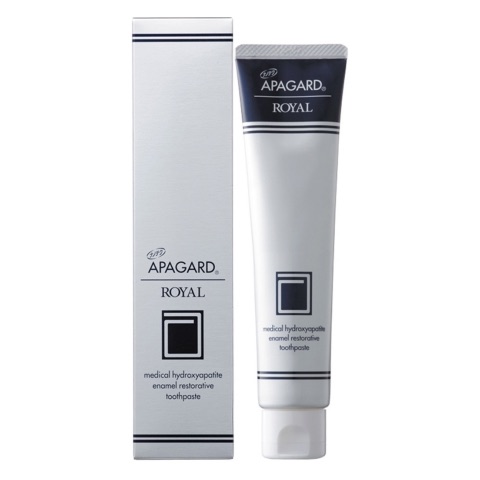
From Sangi, which says it made the first hydroxyapatite toothpaste in 1980. No fluoride, but 16 ingredients including saccharin, SLS and an unnamed flavor, no outside test, and a Japan-only import at about $8 an ounce.
Best for People who want the nano-hydroxyapatite paste with the longest track record, from the company that says it started the category, and who accept saccharin and SLS.
- Our rating
- Poor (1.8 of 5)
- Price range
- Premium
- Size
- 135 g (4.8 oz) tube; Sangi also makes 80 g and 40 g
- Made in
- Made in Japan. Sangi marks Royal “Domestic market only,” so US sellers are importers.
approx. $38 for a 135 g (4.8 oz) tube
See it on Sangi’s site → (opens in a new tab)We are not affiliated with Sangi. This link goes to the maker’s own page, with no tracking code. How we're funded.
Also sold at Japanese Taste ($38), Amazon ($39) .
Reader ratings & reviews
– out of 5
Loading ratings…
Rating breakdown
- 5 stars 0
- 4 stars 0
- 3 stars 0
- 2 stars 0
- 1 star 0
Have this product? Please rate it.
Check your email
We sent a sign-in link to . Click it and you’ll come straight back here, signed in. It expires in 15 minutes; check your spam folder if it doesn’t show up. Thank you for helping the community!
Your review
Reviews are personal experiences, not research, and they never change our quality ratings. Every review is read by our team before it appears.
How we evaluated it
How it scores Our rating, metric by metric
- Ingredients 40% of the rating 1 of 5
It fails two of our rules: it contains sodium saccharin, an artificial sweetener, and SLS, plus PEG-8, PVP, an antiseptic and an unnamed “aroma” in a 16-item list.
- Active ingredient 20% of the rating 4 of 5
Nano-hydroxyapatite is the form Japan approved as an anticaries active in 1993, per Sangi, which says it has sold hydroxyapatite pastes since 1980, but Sangi does not state the percentage.
- Independent testing 15% of the rating 1 of 5
We found no outside test of this paste, for metals or anything else, and Sangi publishes none.
- Trust 10% of the rating 3 of 5
We found no recall, Prop 65 notice or lawsuit, and Sangi names its ingredients, but it sells Royal only in Japan and does not stand behind the US importers who resell it.
- Value 15% of the rating 1 of 5
About $7.98 an ounce ($38 for 4.76 oz), the priciest paste here and 1.7 times the next one.
The rating, 1.8 of 5, is the weighted average of these scores. See how we rank oral care and our standard.
Where to buy Stores and the prices we saw
- Japanese Taste (opens in a new tab) approx. $38. An online shop for Japanese products; the 4.8 oz (135 g) tube was in stock on 2026-10-23.
- Amazon (opens in a new tab) approx. $39. Sold by an importer (GS-JAPAN, "Direct from Japan"), not by Sangi, and shipped by Amazon. Check that the tube arrives sealed.
Prices as we saw them on October 23, 2026. They change often. These links carry no tracking code and earn us nothing.
What’s in it Every ingredient, in label order
- Aqua
- Dicalcium Phosphate
- Silica
- Glycerin
- Hydroxyapatite (nano)
- PEG-8
- PVP
- Glycyrrhetinic Acid
- Cetylpyridinium Chloride
- Sodium Lauryl Sulfate
- Cellulose Gum
- Aroma
- Sodium Saccharin
- Trimagnesium Phosphate
- Hydrolyzed Conchiolin Protein
- Lauryl Diethylenediaminoglycine HCl
Who tested it What each test found, and who paid for it
- Maker’s own test Sangi (field trials among Japanese schoolchildren, as described on its milestones page) 1985
Says anticaries field trials among Japanese schoolchildren succeeded in 1985, and that its hydroxyapatite was approved in Japan in 1993 as an anticaries active. No trial is named or linked, and we could not find the approval record. Open ↗ (opens in a new tab)
Who paid, and why it matters
- Independent The tester took no money from the maker for it: a consumer group, a journalist, a university or a regulator.
- Paid certification An outside lab or certifier tested or listed it, and the maker paid for that.
- Maker’s own test A lab report or certificate of analysis the maker commissioned and published.
A certification is a floor, not a verdict: it checks what its program checks and nothing else. We weigh tests by someone with no stake in the result most.
What people ask Worries raised online and elsewhere, and what we found
- Does it really contain saccharin and SLS?
- Yes. Sangi’s ingredient list (opens in a new tab) includes sodium saccharin and sodium lauryl sulfate, as well as PEG-8, PVP and cetylpyridinium chloride, an antiseptic. SLS can set off mouth ulcers in people prone to them; a 2019 review (opens in a new tab) of trials found fewer ulcers with SLS-free pastes.
- What is in the “aroma”?
- Sangi does not say. The page calls Royal “mild mint flavor” and lists only “aroma”. Under our rules an unnamed flavor costs points, and an artificial one would break them. We could not tell which this is.
- Does it work, and how much hydroxyapatite is in it?
- Sangi says Royal has the most nano mHAP of its Apagard pastes, and a retailer says twice that of M-Plus, but no percentage is published. Our nano-hydroxyapatite guide finds hydroxyapatite likely matches fluoride in short studies, while long cavity trials are few (2021 meta-analysis (opens in a new tab)).
- Is the tube sold in the US genuine?
- Sangi marks Royal as sold in Japan only, so the tubes on Amazon and in specialty shops come from importers and not from Sangi. We could not check any importer’s supply, so check that the tube arrives sealed and is not past its date.
- Does it contain lead or other metals?
- No one has published a test of it that we could find. Lead Safe Mama’s lab tests of other hydroxyapatite pastes found trace lead, so we cannot assume Royal is clean. California’s Prop 65 notice search (opens in a new tab) shows no notice for Apagard or Sangi.
- Is it vegan?
- No. It contains hydrolyzed conchiolin protein, a pearl protein that a retailer describes as a pearl ingredient for gloss.
Why we chose it What put it on our list
- Sangi says it launched the first hydroxyapatite toothpaste, Apadent, in 1980 and Apagard in 1985. It says Japan approved Sangi’s hydroxyapatite as an anticaries active ingredient, “Medical Hydroxyapatite,” in 1993, and Sangi made it nano-sized in 2003 (Sangi’s milestones page).
- Sangi calls Royal the top of the Apagard range, with the highest nano-hydroxyapatite content of its pastes.
- It has no fluoride, and Sangi’s page lists all 16 ingredients.
Trade-offs What to weigh before you buy
- It contains sodium saccharin, an artificial sweetener, and sodium lauryl sulfate. The saccharin breaks our rule on artificial sweeteners.
- The flavor is an unnamed “aroma”, and the list also has PEG-8, PVP and cetylpyridinium chloride.
- Sangi does not state the hydroxyapatite percentage, so you cannot compare it with pastes that state 10%.
- Royal is sold only in Japan. US buyers get it from importers at about $8 an ounce, nearly three times Boka, and Sangi does not stand behind those sales.
- We found no independent test of this paste.
What to know Details worth knowing first
Sangi, a Japanese company, says it put the first hydroxyapatite toothpaste on sale in 1980 and that Japan approved its hydroxyapatite as an anticaries ingredient in 1993. Royal is the top of its Apagard line, with the most nano-hydroxyapatite of its pastes and no fluoride. Our nano-hydroxyapatite guide covers what the research shows for this kind of paste.
It is also the one paste here that breaks our rules. The label is long and includes sodium saccharin, an artificial sweetener, SLS and an unnamed flavor, where the simplest pastes here have none of them. Sangi does not say how much hydroxyapatite is in it, nobody outside the company has published a test, and Royal is sold only in Japan, so in the US you buy it from importers at about $38 a tube.
What we checked Each claim, and how sure we are of it
| What we checked | What we found |
|---|---|
| Fluoride-free, with an active ingredient that has evidence Maker’s claim | Nano hydroxyapatite (Sangi’s “nano mHAP”), the form Japan approved as an anticaries active in 1993 and Sangi made nano in 2003. No fluoride. The percentage is not stated. |
| Every ingredient listed Maker’s claim | Sangi lists 16 ingredients: aqua, dicalcium phosphate, silica, glycerin, hydroxyapatite (nano), PEG-8, PVP, glycyrrhetinic acid, cetylpyridinium chloride, sodium lauryl sulfate, cellulose gum, aroma, sodium saccharin, trimagnesium phosphate, hydrolyzed conchiolin protein and lauryl diethylenediaminoglycine HCl. The flavor (“aroma”) is not broken down. |
| Gentle formulas Maker’s claim | Contains SLS, saccharin and an antiseptic (cetylpyridinium chloride). Not the pick if SLS gives you mouth ulcers. |
| No artificial sweeteners or unnamed flavor Maker’s claim | Contains sodium saccharin, an artificial sweetener, and an unnamed “aroma”. |
| Independent testing Not verified | None found for this paste, for metals or anything else. |
What the labels mean
- Verified We opened an independent record that confirms it: a certifier’s listing, a regulator’s list or a lab report. It is linked under Sources.
- Maker’s claim The maker says so on its own page or label. We read it but found no independent record.
- Not verified We looked and could not confirm it, or the maker does not say. Treat it as unknown.
Sources Where our facts come from
- Sangi: Apagard Royal product page. Maker’s page. The ingredient list, sizes, “Domestic market only,” “highest nano mHAP content,” “Mild mint flavor” and “No fluoride,” seen 2026-10-23. The page prints “Trigmagnesium Phosphate”, which we read as trimagnesium phosphate. Open ↗ (opens in a new tab)
- Sangi: milestones. Maker’s page. Apadent (1980), Apagard (1985) and the field trials, approval of Medical Hydroxyapatite as an anticaries active in Japan (1993), nano size (2003). Open ↗ (opens in a new tab)
- Japanese Taste: Sangi Apagard Royal 135 g. Independent source. $38 for 4.8 oz, in stock on 2026-10-23. Says Royal has twice the nano mHAP of Apagard M-Plus and contains liquid conchiolin, a pearl ingredient. Open ↗ (opens in a new tab)
- Amazon: Apagard Tooth Polish Royal 135 g. Independent source. $39.00 on 2026-10-23 ($8.13 an ounce), sold by GS-JAPAN and shipped by Amazon. Open ↗ (opens in a new tab)
- California Attorney General: Proposition 65 60-day notice search (Apagard). Certifier or regulator listing. No notice found on 2026-10-23. Open ↗ (opens in a new tab)
- Alli, Erinoso and Olawuyi 2019: sodium lauryl sulfate and recurrent aphthous stomatitis, systematic review. Independent source. Cited in our toothpaste ingredients guide. Open ↗ (opens in a new tab)
- Limeback, Enax and Meyer 2021: biomimetic hydroxyapatite and caries prevention, systematic review and meta-analysis. Independent source. Cited in our nano-hydroxyapatite guide. Open ↗ (opens in a new tab)
Alternatives Other options to compare
- RiseWell Hydroxyapatite Toothpaste, Flavorless States 10% micro-hydroxyapatite for its Original line, with 13 ingredients, no SLS and no saccharin. About $3.53 an ounce.
- Boka Ela Mint Nano-hydroxyapatite Toothpaste Nano, SLS-free and about $2.91 an ounce, but it has no stated percentage.