Products · Candles · Bluecorn Candles
Bluecorn Pure Beeswax Pillar Candles (raw, unscented)
Reader ratings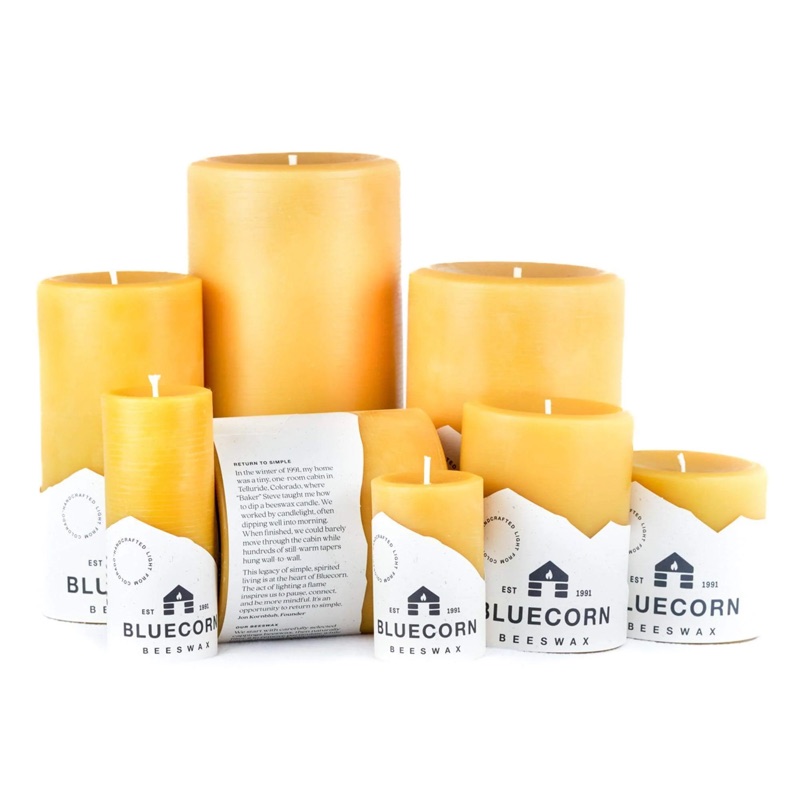
Raw, unscented beeswax pillars from U.S. beekeepers on a cotton wick, the cheapest of our four candles to burn. No test of the wax has been published, and the “non-toxic” and “clean burning” claims are the maker’s own.
Best for Anyone who wants an unscented, single-wax candle with the wax’s source and processing spelled out, and who will burn it in a ventilated room.
- Our rating
- Good (3.7 of 5)
- Price range
- Mid-range
- Size
- 3 x 6 inch pillar; sizes run from 2 x 3 inches ($10) to 4 x 8 inches ($70)
- Made in
- Handmade in Colorado; wax from U.S. beekeepers (maker’s statement)
approx. $32 for a 3 x 6 inch pillar (about 90 hours)
See it on Bluecorn Candles’s site → (opens in a new tab)We are not affiliated with Bluecorn Candles. This link goes to the maker’s own page, with no tracking code. How we're funded.
Also sold at Amazon ($36.48 for a 3 x 6 inch pillar) .
Reader ratings & reviews
– out of 5
Loading ratings…
Rating breakdown
- 5 stars 0
- 4 stars 0
- 3 stars 0
- 2 stars 0
- 1 star 0
Have this product? Please rate it.
Check your email
We sent a sign-in link to . Click it and you’ll come straight back here, signed in. It expires in 15 minutes; check your spam folder if it doesn’t show up. Thank you for helping the community!
Your review
Reviews are personal experiences, not research, and they never change our quality ratings. Every review is read by our team before it appears.
How we evaluated it
How it scores Our rating, metric by metric
- Wax & wick 45% of the rating 4 of 5
One named wax, raw beeswax from U.S. cappings, lightly filtered and not bleached, on a cotton wick, with no scent or dye in this line; the purity and the wick treatment are the maker’s word.
- Independent testing 15% of the rating 1 of 5
No test of the wax, the wick or the burn has been published, by Bluecorn or by anyone else.
- Trust 15% of the rating 3 of 5
No CPSC recall or Prop 65 notice found and the sourcing is stated; points off for “non-toxic” and “totally chemical free” claims and a diesel-fuel comparison with no test behind them.
- Value 25% of the rating 5 of 5
About $0.36 an hour for the 3 x 6 inch pillar and $0.29 for the 4 x 8 inch (maker’s burn times), the lowest cost per hour of the four candles.
The rating, 3.7 of 5, is the weighted average of these scores. See how we rank candles and our standard.
Where to buy Stores and the prices we saw
- Amazon (opens in a new tab) approx. $36.48 for a 3 x 6 inch pillar. Sold by Bluecorn’s own Amazon store (“Bluecorn Beeswax”) and shipped by Amazon, about $4.50 more than the maker’s site. The listing says color Raw, unscented, 3 x 6 inches; the ivory candle is a separate listing.
Prices as we saw them on October 23, 2026. They change often. These links carry no tracking code and earn us nothing.
What’s in it Every ingredient, in label order
- Raw beeswax, lightly filtered (maker: “100% pure, raw beeswax: no additives, no blends”)
- Cotton wick (maker: always cotton, or a cotton and paper blend)
What people ask Worries raised online and elsewhere, and what we found
- Is it really 100% beeswax?
- Bluecorn says so and names its source (cappings wax from U.S. beekeepers), but it publishes no test. Adulteration is documented: a 2024 European Commission lab study (opens in a new tab) found about 27% of commercial beeswax products, candles among them, cut with paraffin or stearic acid, mostly paraffin. We found no test of Bluecorn’s wax by anyone.
- Do beeswax candles clean the air or give off negative ions?
- We found no study showing this, and we did not see Bluecorn claim it. Every candle gives off particles: a 2021 chamber study (opens in a new tab) found soot from all five pillar candle types it tested when the flame was disturbed. Keep the room ventilated.
- Are the wicks safe?
- Bluecorn says its wicks are cotton or cotton and paper, with “no lead or metal” on its votive page. It does not say whether the cotton is treated. A 2021 steady-burn study (opens in a new tab) suggested wick additives behind a burst of particles when a candle is lit, so a plain wick matters.
- Any recalls, Prop 65 notices or lawsuits?
- None found. A search of CPSC’s recall list and of California’s Prop 65 notices (opens in a new tab) by the brand name came back empty on 2026-10-23. We could not search court dockets.
- Does anyone get paid to recommend it?
- Bluecorn runs an affiliate program (opens in a new tab) that pays bloggers and influencers 10% of each sale it sends, through its own portal or Avantlink. We did not look for particular influencers or check how they disclose it.
Trade-offs What to weigh before you buy
- Purity rests on the maker’s word. Bluecorn publishes no test of its wax, and commercial beeswax is the kind of product the 2024 study found adulterated more often than comb wax.
- The marketing goes further than the evidence. The page says “Clean burning, non-toxic” and “Totally chemical free”, and the materials page says paraffin “releases similar emissions as diesel fuel”. Every flame still gives off particles and soot, more in a draft.
- The maker also sells a coconut and soy wax line scented with chemical fragrance (it calls it phthalate-free). We list only the raw beeswax pillar.
- It costs more up front than paraffin and needs care. Burn a 3 inch pillar at least 3 hours at a time to avoid tunneling, set it on a heat-safe plate, and snuff it by dripping wax onto the wick to limit smoke.
- Colored and ivory candles are different products. Colors use a vegetable-oil-based dye the maker calls Prop 65 compliant, and ivory wax is hyper-filtered or bleached.
What to know Details worth knowing first
Beeswax is the one candle wax on our checklist that comes straight from a single natural source. That avoids the two problems we flag in our guide to candles and air fresheners: petroleum paraffin and undisclosed fragrance. Bluecorn’s raw pillar is the best-documented one we found. It says where the wax comes from (cappings from U.S. beekeepers), what is done to it (only lightly filtered) and what the wick is made of (cotton).
What we could not find is any test of the wax itself. Beeswax adulteration is documented, and no maker we reviewed publishes a purity result, so “100% beeswax” stays the maker’s word. That is why the candle scores 4 on wax and wick and 1 on testing. It earns its place on cost: about $0.36 an hour to burn, the lowest of the four.
A candle is still a flame. Every candle gives off fine particles, and a draft makes it worse. Trim the wick to ¼ inch, burn the candle away from fans and open windows, and keep the room ventilated. For the wider picture see indoor pollutants.
What we checked Each claim, and how sure we are of it
- Third-party tested
- No
| What we checked | What we found |
|---|---|
| Pure, named wax Maker’s claim | Product page: “100% pure, raw beeswax: no additives, no blends.” The votive page says “100% pure, lightly filtered beeswax.” No test of the wax is published. |
| A plain wick Maker’s claim | Cotton. Materials page: wicks are “always cotton or a blend of paper and cotton.” Votive page: “Cotton wick - no lead or metal.” Whether the cotton is chemically treated is not stated. |
| No added fragrance Maker’s claim | The raw line is unscented; its only scent is the honey note of the wax. Bluecorn’s Botanica line is scented with essential oils and its Aromática line with chemical fragrance; we did not review either. |
| Honest sourcing Maker’s claim | Raw beeswax from U.S. beekeepers, premium cappings, lightly filtered with a filter press, which keeps the color and scent. Ivory wax is hyper-filtered or bleached and the maker cannot guarantee which. |
| Clean-burn and air claims Not verified | “Clean burning, non-toxic” and a diesel-fuel comparison for paraffin, with no test behind them. We found no published study of beeswax candles for negative ions or air cleaning. |
| Recalls and Prop 65 notices Verified | None found in CPSC’s recall list or California’s Prop 65 notice list for Bluecorn, searched 2026-10-23. Court dockets were not searched. |
| Cost per burning hour Maker’s claim | About $0.29 to $0.40 an hour across the pillar sizes, using the maker’s own burn times. |
What the labels mean
- Verified We opened an independent record that confirms it: a certifier’s listing, a regulator’s list or a lab report. It is linked under Sources.
- Maker’s claim The maker says so on its own page or label. We read it but found no independent record.
- Not verified We looked and could not confirm it, or the maker does not say. Treat it as unknown.
Sources Where our facts come from
- Bluecorn Pure Beeswax Pillar Candles product page. Maker’s page. Prices, sizes and burn times as seen on 2026-10-23. Open ↗ (opens in a new tab)
- Bluecorn candle materials page. Maker’s page. Source of the beeswax, filtration, ivory wax, wick, dye and scented-line statements. Open ↗ (opens in a new tab)
- Bluecorn Pure Beeswax Votive Candles product page. Maker’s page. Open ↗ (opens in a new tab)
- Bluecorn affiliate program page. Maker’s page. States a 10% commission and a 30-day cookie window. Open ↗ (opens in a new tab)
- California Attorney General: Prop 65 60-day notice search for “Bluecorn”. Certifier or regulator listing. No notice names the company. Searched 2026-10-23. Open ↗ (opens in a new tab)
- CPSC recall list search for “Bluecorn”. Certifier or regulator listing. Returned no recalls. Searched 2026-10-23. Open ↗ (opens in a new tab)
- Chatzipanagis et al., 2024, Foods: Assessment of beeswax adulteration by paraffin and stearic acid using ATR-IR spectroscopy. Independent source. European Commission Joint Research Centre. Commercial beeswax products, candles included, were adulterated 27% of the time against 12.5% for comb samples; paraffin was the more common adulterant. Open ↗ (opens in a new tab)
- Serra Bonvehi and Orantes Bermejo, 2012, Food Chemistry: Detection of adulterated commercial Spanish beeswax. Independent source. Paraffin was found in 33 of 90 commercial samples, at 5 to 30%. Open ↗ (opens in a new tab)
- Andersen et al., 2021, Indoor Air: Emissions of soot, PAHs, ultrafine particles and NOx from stressed burning of candles. Independent source. Five pillar candle types with different waxes and wicks. Particle mass was dominated by soot, and wax and wick both changed it. We could not open the full text to see which waxes were used. Open ↗ (opens in a new tab)
- Rasmussen et al., 2021, Indoor Air: Emissions of ultrafine particles from five types of candles during steady burn conditions. Independent source. Suggests wick additives raise emissions when a candle is first lit. Open ↗ (opens in a new tab)
Alternatives Other options to compare
- Bluecorn hand-dipped tapers, votives and tea lights (opens in a new tab) Same maker, wax and cotton wicks. A pair of 8 inch tapers is about $10.50 and burns about an hour per inch; four votives are $16 and burn 12 or more hours each.
- The Beeswax Co. pillars Texas beeswax at similar prices (3 x 6 inch is $32, about 80 hours). Its FAQ repeats the negative-ion claim, so we rate it lower.
- Branch Basics Beeswax Candle A jar candle with a MADE SAFE ingredient listing (a paid certification), at about $49 for roughly 40 hours.