Products · Water filters · Culligan (ZeroWater)
Culligan with ZeroWater Technology 10-Cup Pitcher (ZEROP10)
Reader ratings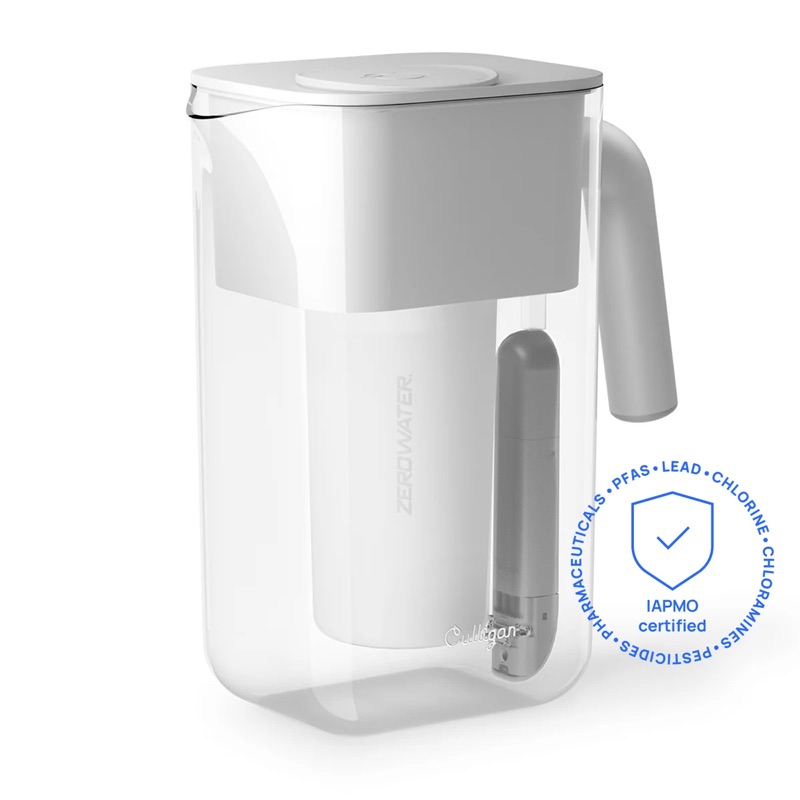
The only pitcher we list with certified fluoride, nitrate, lead and total PFAS reduction; a university test saw about 99% of PFAS removed. Filters are rated 20 gallons, so it costs the most to run, and the water ends up mineral-free.
Best for People who want fluoride, nitrate, lead or PFAS reduced without a reverse osmosis unit, and who accept a high filter cost.
- Our rating
- Good (3.7 of 5)
- Price range
- Budget
- Verified marks
- IAPMO R&T: NSF/ANSI 42, 53 and 401, IAPMO R&T: lead-free (W-17157) and CSA B483.1 (W-17175)
- Size
- 10-cup pitcher, model ZEROP10 (also sold as 7-cup ZEROP07, 12-cup ZEROP12 and dispensers); one 5-stage filter (ZEROF) included
approx. $35 with one filter and a TDS meter on Culligan’s store ($27 to $30 at Target, Amazon and Home Depot on 2026-10-23)
See it on Culligan (ZeroWater)’s site → (opens in a new tab)We are not affiliated with Culligan (ZeroWater). This link goes to the maker’s own page, with no tracking code. How we're funded.
Also sold at Target ($27 to $30, by color), Amazon ($27), Home Depot ($30) .
Reader ratings & reviews
– out of 5
Loading ratings…
Rating breakdown
- 5 stars 0
- 4 stars 0
- 3 stars 0
- 2 stars 0
- 1 star 0
Have this product? Please rate it.
Check your email
We sent a sign-in link to . Click it and you’ll come straight back here, signed in. It expires in 15 minutes; check your spam folder if it doesn’t show up. Thank you for helping the community!
Your review
Reviews are personal experiences, not research, and they never change our quality ratings. Every review is read by our team before it appears.
How we evaluated it
How it scores Our rating, metric by metric
- Proven reduction 35% of the rating 5 of 5
IAPMO lists ZEROP10 for lead, total PFAS, fluoride, nitrate/nitrite, chromium-6, chlorine and 13 drugs and chemicals. It is the only pitcher on our list with fluoride and nitrate on its listing. No chloramine claim.
- What touches the water 20% of the rating 3 of 5
The plastics are named (BPA-free polypropylene, ABS and a polystyrene filter housing), with lead-free and CSA B483.1 listings and no silver. The media include KDF, a copper-zinc blend a reviewer calls bacteriostatic. A polystyrene housing is not what we would choose, and the meter needs batteries.
- Independent testing 15% of the rating 4 of 5
A broad paid IAPMO certification, a peer-reviewed 2024 test of the earlier filter (about 99% PFAS removal) and a reviewer’s lab test with every health-related contaminant removed. Those tests used the older filter or a single sample.
- Trust 10% of the rating 3 of 5
No recall or Prop 65 notice for the pitcher, though Culligan had one in 2024 for an RV filter hose. ZeroWater settled a false-advertising suit in 2010, and old and new filters with different claims are both on sale.
- Running cost & value 20% of the rating 2 of 5
$35 plus about $0.68 to $0.93 a gallon: roughly $1,300 to $1,700 over five years at a gallon a day, among the highest running costs of the drinking-water filters here.
The rating, 3.7 of 5, is the weighted average of these scores. See how we rank water filters and our standard.
Where to buy Stores and the prices we saw
- Target (opens in a new tab) approx. $27 to $30, by color. The new Culligan line: lists lead, total PFAS and fluoride certification and includes a TDS tester and one filter. The lilac pitcher showed $26.99 and in stock on 2026-10-23; model number not shown.
- Amazon (opens in a new tab) approx. $27. Lilac, model ZEROP10LIL (the colored ZEROP10). Sold and shipped by Amazon.com.
- Home Depot (opens in a new tab) approx. $30. Model ZEROP10 on the page, $29.97. In stock with free delivery on 2026-10-23.
Prices as we saw them on October 23, 2026. They change often. These links carry no tracking code and earn us nothing.
What it’s made of What touches your food, water, skin or air
- Pitcher and dispensers: BPA-free polypropylene and ABS plastic (Culligan’s FAQ)
- Filter housing: BPA-free polystyrene (Culligan’s FAQ)
- Five-stage filter: a mesh screen, a foam distributor, granulated activated carbon, ion-exchange resin and an ultra-fine mesh screen. Culligan’s filter page says the carbon is coal-based and mixed with KDF, a copper-zinc blend; its pitcher page says the carbon stage “prevents bacteria from forming”
- TDS meter with two AAA batteries. IAPMO also lists the pitcher as lead-free and under CSA B483.1. No silver is mentioned
Who tested it What each test found, and who paid for it
- Paid certification IAPMO R&T October 2026
Lists ZEROP10 and its sister models with replacement element ZEROFXX under NSF/ANSI 42-2023 (W-17154), 53-2024 (W-17155) and 401-2023 (W-17156), all active to 2030, 20 gallons at 2 gallons a day, plus lead-free (W-17157) and CSA B483.1 (W-17175) listings. Culligan’s data sheet shows lead 98.8% to 98.9%, total PFAS 99.7%, fluoride 99.7% and nitrate 99.1%. Culligan pays for the listings. Open ↗ (opens in a new tab)
- Independent Université de Montréal and Polytechnique Montréal (Teymoorian et al.) June 2024
Tested the earlier ZeroWater 5-stage filter on two Canadian tap waters with 75 PFAS measured: volume-weighted removal of total PFAS over 160 L was 99% (56 ng/L water) and about 100% (13 ng/L water), the best of five pitcher filters. In one water, pH dropped to 2.67 and dissolved solids and organic carbon were released after 80 L, with PFAS removal unaffected. Funded by Canadian public research grants; the authors declare no commercial ties. Open ↗ (opens in a new tab)
- Independent Water Filter Guru (earns affiliate income; lab kits from Tap Score by SimpleLab) October 2026
One before-and-after test of this Culligan pitcher on a Colorado home’s tap water: all nine health-related contaminants fell to 0 (including fluoride 1.4 ppm and uranium), chlorine was undetectable, dissolved solids fell from 138 to 5 ppm and pH fell from 7.6 to 6.6. It scored the pitcher 9.33 of 10. Open ↗ (opens in a new tab)
- Independent Consumer Reports September 2026
Tested the 12-cup Culligan ZeroWater pitcher (ZD-012-RP, overall 68 of 100) and the ZEROD40 dispenser (70) for taste, flow and clogging, and put replacement filters at $105 to $108 a year. CR does not test lead or PFAS removal and did not test the ZEROP10 itself. Open ↗ (opens in a new tab)
- Independent ConsumerLab November 2024
Bought and tested an older ZeroWater 6-cup pitcher. Its public notes say the pitcher can lose its fluoride-filtering ability fairly quickly (November 2024); the full results are members-only. Open ↗ (opens in a new tab)
Who paid, and why it matters
- Independent The tester took no money from the maker for it: a consumer group, a journalist, a university or a regulator.
- Paid certification An outside lab or certifier tested or listed it, and the maker paid for that.
- Maker’s own test A lab report or certificate of analysis the maker commissioned and published.
A certification is a floor, not a verdict: it checks what its program checks and nothing else. We weigh tests by someone with no stake in the result most.
What people ask Worries raised online and elsewhere, and what we found
- Does the TDS meter tell me when it stops working?
- Partly. The meter reads dissolved solids, not PFAS or lead, and Culligan says to change the filter at 006 (Culligan (opens in a new tab)). In the university test PFAS removal stayed near 99% even after the resin ran out of capacity, but ConsumerLab warns that the older pitcher can lose fluoride removal fairly quickly (ConsumerLab (opens in a new tab)). Change by the meter and by the 20-gallon rating, whichever comes first.
- Is the water acidic or “too pure”?
- It is demineralized and a little acidic. A reviewer’s lab test went from pH 7.6 to 6.6 with calcium, magnesium and sodium at zero (review (opens in a new tab)). Our article on reverse osmosis water finds low-mineral water unlikely to matter for most healthy adults who eat a varied diet. Very acidic water means the filter is spent.
- Why do the filters cost so much?
- The certified capacity is only 20 gallons. Consumer Reports estimates $105 to $108 a year (CR (opens in a new tab)) and a reviewer $0.90 a gallon. Water Filter Guru says life falls as your tap water’s dissolved solids rise, to 8 to 15 gallons at 301 to 400 ppm for the older 40-gallon filter (guide (opens in a new tab)). Readers’ comments under that guide report a filter lasting one week at 120 oz a day, about 5 gallons with tap water at 500 to 550 ppm, and four to six weeks at 270 to 300 ppm.
- Which ZeroWater am I buying?
- Culligan sells a new line (model ZEROP, filter ZEROF) and still sells legacy filters. The legacy data sheet has no fluoride line and a 15-gallon rating (legacy sheet (opens in a new tab)). Match your model to the listing.
- Has ZeroWater been in trouble over its claims?
- In 2010 it settled a false-advertising suit brought by the bottled water trade group and agreed to a consent order limiting what it can say (IBWA (opens in a new tab)). Culligan International also got a 2024 Prop 65 notice over lead in an RV filter hose, settled in 2025 (notice 2024-04620 (opens in a new tab)); it was not this pitcher. We found no recall.
- Who gets paid when people recommend it?
- Culligan’s store footer lists an affiliates program; we could not open its terms (Culligan (opens in a new tab)). The reviewer we cite earns commissions on its links to Culligan.
Why we chose it What put it on our list
- IAPMO R&T lists ZEROP10 and its sister models under NSF/ANSI 42-2023, 53-2024 and 401-2023 (files W-17154 to W-17156, active, effective 2025-12-08). The 53 claims are cadmium, copper, fluoride, lead, mercury, total PFAS, hexavalent chromium and nitrate/nitrite.
- Culligan’s data sheet gives fluoride reduced 99.7% from an 8 mg/L challenge (limit 1.0 mg/L), lead 98.8 to 98.9%, total PFAS 99.7% and nitrate 99.1% from a 27 mg/L challenge. The PFAS mix is PFOA, PFOS, PFHxS, PFNA, PFHpA, PFBS and PFDA.
- A peer-reviewed 2024 test of the earlier ZeroWater 5-stage filter found about 99% of 75 PFAS removed from real tap water over 160 L, more than any other filter in the test.
- A reviewer’s lab test of this Culligan pitcher found 100% of the fluoride, uranium, nitrate, copper and every other health-related contaminant in its water removed.
- A TDS meter comes in the box. The pitcher costs about $35 on Culligan’s own store, with replacement filters at $13.67 each in a 12-pack to $18.50 each in a 2-pack.
Trade-offs What to weigh before you buy
- It is the most expensive pitcher to run of those we reviewed. At the 20-gallon rating, filters cost about $0.68 to $0.93 a gallon. Consumer Reports puts replacements at $105 to $108 a year for the ZeroWater pitcher and dispenser it tested, more than twice the Brita Denali’s.
- It removes nearly all dissolved solids (Culligan says 99.9%), minerals included. A reviewer measured pH falling from 7.6 to 6.6 with calcium, magnesium and sodium at zero. In the university test, water from one tap turned strongly acidic (pH 2.67) after 80 L, about 21 gallons; ZeroWater’s instructions treat acidic water as a spent filter.
- The TDS meter reads dissolved solids, not PFAS or lead. Change the filter at the meter’s 006 reading or the 20-gallon rating, whichever comes first.
- Two ZeroWater generations are on sale. The older “legacy” filters on zerowater.com (pitcher ZP-010, about $38) are certified for lead, PFOA/PFOS, chromium and mercury, are rated 15 gallons, and have no fluoride claim on their data sheet. Check for model ZEROP and filter ZEROF.
What to know Details worth knowing first
Fluoride is the reason this pitcher is on the list. Reducing it usually means reverse osmosis, as our article on fluoride-free alternatives explains. ZeroWater’s five-stage filter uses ion exchange, and IAPMO R&T’s listing for the ZEROP models includes a fluoride claim under NSF/ANSI 53, alongside lead, total PFAS, nitrate and chromium. A university test of the earlier filter found about 99% of PFAS removed.
Know which version you are buying. Culligan, which owns ZeroWater, now sells a newer line (model ZEROP, filter ZEROF) with the longer certified list. The older line still sold on zerowater.com has a shorter list and a 15-gallon rating. Match the model number to the listing before you buy.
The cost is the catch. A 20-gallon rating is about three weeks of filter at a gallon a day, so it costs far more to run than any other pitcher here, and the water that comes out has almost no minerals. If lead or PFAS is your only concern, a cheaper pitcher such as the PUR PLUS covers both. Check what’s in your water before choosing.
What we checked Each claim, and how sure we are of it
- Third-party tested
- Yes
- Tested by
- IAPMO R&T, paid for by the maker
| What we checked | What we found |
|---|---|
| Certified standards Verified | IAPMO R&T lists ZEROP07, ZEROP08, ZEROP10, ZEROP12 and ZEROD22 to ZEROD52 with replacement element ZEROFXX under NSF/ANSI 42-2023 (W-17154), 53-2024 (W-17155) and 401-2023 (W-17156), all active, plus lead-free (W-17157) and CSA B483.1 (W-17175). We found no WQA listing for these model numbers. Checked 2026-10-23. |
| Lead, PFAS and fluoride Verified | IAPMO’s 53 listing names lead, total PFAS, fluoride and nitrate/nitrite for ZEROP10. The percentages come from Culligan’s data sheet: lead 98.8 to 98.9%, total PFAS 99.7%, fluoride 99.7% from 8 mg/L. |
| Independent test Verified | A 2024 peer-reviewed study of the earlier ZeroWater filter found about 99% of PFAS removed over 160 L, and a reviewer’s lab sample of this pitcher found fluoride and uranium removed. Neither is a test of the new filter on lead. |
| Flow and waste Maker’s claim | No wastewater. The data sheet gives a service flow of 2 gallons a day and no pour time; a reviewer timed about 7 minutes for a full pitcher. |
| Replacement cost Maker’s claim | Filter rated 20 gallons (data sheet). Culligan’s prices: 2-pack $36.99, 3-pack $47.99, 6-pack $89.99, 12-pack $163.99 (seen 2026-10-23). |
| Matched to your water Not verified | Not something we can check for you. Look up your utility’s water report or get a lab test first. |
What the labels mean
- Verified We opened an independent record that confirms it: a certifier’s listing, a regulator’s list or a lab report. It is linked under Sources.
- Maker’s claim The maker says so on its own page or label. We read it but found no independent record.
- Not verified We looked and could not confirm it, or the maker does not say. Treat it as unknown.
Sources Where our facts come from
- Culligan with ZeroWater Technology 10 Cup Pitcher: Culligan store page. Maker’s page. Shows the $34.99 price, the certified-contaminant table and the plastics used (BPA-free polypropylene, ABS and polystyrene). Open ↗ (opens in a new tab)
- Culligan with ZeroWater replacement filters: store prices. Maker’s page. 2-pack $36.99 to 12-pack $163.99, as seen 2026-10-23. Open ↗ (opens in a new tab)
- IAPMO R&T listing W-17155: NSF/ANSI 53, Culligan International (ZeroWater). Certifier or regulator listing. Pour-through section lists ZEROP10 with claims including fluoride, lead, total PFAS and nitrate/nitrite; capacity 20 gallons. Open ↗ (opens in a new tab)
- IAPMO R&T listing W-17156: NSF/ANSI 401, Culligan International (ZeroWater). Certifier or regulator listing. Open ↗ (opens in a new tab)
- IAPMO R&T listing W-17154: NSF/ANSI 42, Culligan International (ZeroWater). Certifier or regulator listing. Open ↗ (opens in a new tab)
- IAPMO R&T listing W-17157: lead-free, Culligan International (ZeroWater). Certifier or regulator listing. Open ↗ (opens in a new tab)
- IAPMO R&T listing W-17175: CSA B483.1, Culligan International (ZeroWater). Certifier or regulator listing. Open ↗ (opens in a new tab)
- Culligan with ZeroWater Technology performance data sheet. Test report. Published by Culligan. Results by standard, including the fluoride and nitrate lines. Open ↗ (opens in a new tab)
- ZeroWater performance data sheet for the older ZP and ZD models (April 2026). Test report. The legacy line: IAPMO R&T, rated 15 gallons, no fluoride line. Open ↗ (opens in a new tab)
- Performance of pitcher-type POU filters for the removal of 75 PFAS from drinking water (Frontiers in Environmental Chemistry, 2024). Test report. Peer-reviewed test of the earlier ZeroWater filter against Brita, Aquagear and Clearly Filtered on two tap waters. Open ↗ (opens in a new tab)
- Water Filter Guru: Culligan ZeroWater pitcher review. Independent source. A reviewer that earns affiliate income. Before-and-after lab test, pH, minerals and cost. Open ↗ (opens in a new tab)
- Water Filter Guru: how long do ZeroWater filters last?. Independent source. Estimates of filter life by tap-water dissolved solids, for the older 40-gallon filter. Open ↗ (opens in a new tab)
- Consumer Reports: best water filter pitchers of 2026. Independent source. Public text and scores for the Culligan ZD-012-RP (68) and ZEROD40 (70). Detailed ratings are members-only. Open ↗ (opens in a new tab)
- ConsumerLab: water filter pitchers review. Independent source. Public summary and updates, including the note on ZeroWater losing fluoride removal. Full results are members-only. Open ↗ (opens in a new tab)
- Culligan: why change the filter when the TDS meter reads 006?. Maker’s page. Open ↗ (opens in a new tab)
- IBWA: ZeroWater agrees to settle false advertising lawsuit (2010). Independent source. Trade-group press release about the consent order. Open ↗ (opens in a new tab)
- California Attorney General: Prop 65 notice 2024-04620 (Culligan International, The Home Depot). Certifier or regulator listing. Lead in an inline RV filter hose, filed 2024-11-01, settled 2025-04-17. Not a pitcher. Open ↗ (opens in a new tab)
Alternatives Other options to compare
- A reverse osmosis unit certified to NSF/ANSI 58 Also certified for fluoride, with a much higher up-front price and some wastewater. AquaTru’s Carafe is one example.
- PUR PLUS pitcher Cheaper to run, certified for lead, total PFAS and microplastics, but no fluoride or nitrate claim.