Products · Coffee makers & gear · ECM
ECM Classika PID Espresso Machine
Reader ratings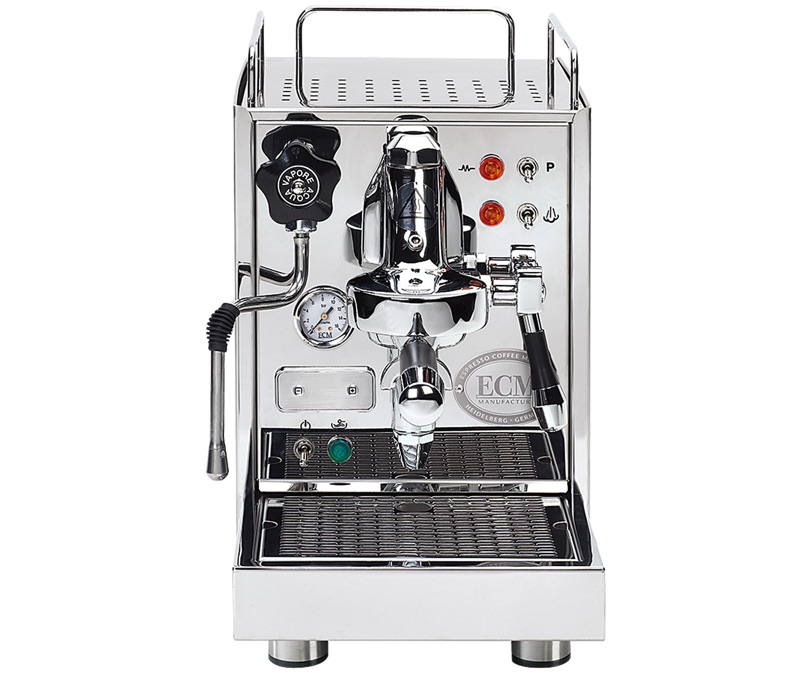
A compact single-boiler machine whose maker names a stainless steel boiler. A retailer’s parts list shows silicone tubing and PTFE gaskets; the E61 group is chrome-plated brass, and nothing says the brass is lead-free.
Best for Someone who wants a smaller, lower-cost ECM with a named stainless steel boiler and accepts brass and PTFE gaskets in the group.
- Our rating
- Fair (3.0 of 5)
- Price range
- Mid-range
- Size
- Single boiler: 0.75 L stainless steel; about 2.8 L tank; vibration pump; 18.5 kg
- Made in
- ECM says it produces in both Italy and Germany; this model’s origin is not stated
approx. $1,699 at Whole Latte Love (sold out when we looked)
See it on ECM’s site → (opens in a new tab)We are not affiliated with ECM. This link goes to the maker’s own page, with no tracking code. How we're funded.
Also sold at Whole Latte Love ($1,699), Pro Coffee Gear ($1,599) .
Reader ratings & reviews
– out of 5
Loading ratings…
Rating breakdown
- 5 stars 0
- 4 stars 0
- 3 stars 0
- 2 stars 0
- 1 star 0
Have this product? Please rate it.
Check your email
We sent a sign-in link to . Click it and you’ll come straight back here, signed in. It expires in 15 minutes; check your spam folder if it doesn’t show up. Thank you for helping the community!
Your review
Reviews are personal experiences, not research, and they never change our quality ratings. Every review is read by our team before it appears.
How we evaluated it
How it scores Our rating, metric by metric
- What touches the water and coffee 45% of the rating 3 of 5
Stainless steel boiler, mushroom and group filter. Against that: a chrome-plated brass E61 group and portafilter with no lead-free claim, PTFE gaskets in the group and valve, silicone tubing and a plastic tank.
- Independent testing 10% of the rating 1 of 5
No independent test of this machine. ECM says each component is “rigorously tested” but names no lab and publishes no result.
- Durability 20% of the rating 4 of 5
Retailers publish a full parts list, ECM services through dealers or directly, and its manual and FAQ give descaling and cleaning intervals. ECM states no warranty period itself; the dealer lists 3 years.
- Trust 10% of the rating 3 of 5
No recall, Prop 65 notice or lawsuit names ECM. But it does not say if its brass is lead-free or what the tubing and seals are, and it shares a managing director and address with Profitec.
- Value 15% of the rating 3 of 5
About $1,699: under half the price of the two dual boilers here ($3,449 and $3,599) and nearly five times the Flair 49 PRO ($359), the other espresso route on this list.
The rating, 3.0 of 5, is the weighted average of these scores. See how we rank coffee makers & gear and our standard.
Where to buy Stores and the prices we saw
- Whole Latte Love (opens in a new tab) approx. $1,699. Stainless steel, no flow control, no wood accents. Every Classika PID variant showed sold out (“Notify me when available”) on 2026-10-23. The store lists and services a 3-year parts and labor warranty; ECM states no warranty period itself and sells spare parts only through authorised dealers.
- Pro Coffee Gear (opens in a new tab) approx. $1,599. Lists a 3-year parts and labor warranty, but the page showed “Notify me when available” (out of stock) on 2026-10-23.
Prices as we saw them on October 23, 2026. They change often. These links carry no tracking code and earn us nothing.
What it’s made of What touches your food, water, skin or air
- Stainless steel boiler, about 0.75 L (ECM)
- E61 brew group, chrome-plated brass (Whole Latte Love spec table), with a stainless steel mushroom (ECM) and a stainless steel filter (parts list)
- Portafilter, chrome-plated brass with a Bakelite handle (Whole Latte Love)
- Baskets (7 g and 14 g): metal not stated
- Silicone tube and a metal flex tube (parts list); the flex tube’s liner is not stated
- PTFE (“Teflon”) gasket and disc in the group and the steam and hot-water valve; EPDM O-rings (parts list)
- Vibration pump (Ulka EX5): body material not stated
- Water tank: plastic per Whole Latte Love (a stainless steel tank is sold as a part)
Who tested it What each test found, and who paid for it
- Maker’s own test ECM
Says on its technology page that each component is rigorously tested and only parts that pass are assembled. No lab, standard or result is named. Open ↗ (opens in a new tab)
Who paid, and why it matters
- Independent The tester took no money from the maker for it: a consumer group, a journalist, a university or a regulator.
- Paid certification An outside lab or certifier tested or listed it, and the maker paid for that.
- Maker’s own test A lab report or certificate of analysis the maker commissioned and published.
A certification is a floor, not a verdict: it checks what its program checks and nothing else. We weigh tests by someone with no stake in the result most.
What people ask Worries raised online and elsewhere, and what we found
- Is the brass lead-free?
- ECM does not say. Whole Latte Love’s spec table lists the group and portafilter as chrome-plated brass. Germany’s risk-assessment institute (BfR) tested eight coffee machines, three of them portafilter machines. The portafilter machines released the most metal: lead, nickel, manganese, chromium and zinc reached or passed proposed limits, mostly right after descaling and falling over each day. One portafilter machine released much less, so the problem can be designed out. The institute named no machines (PubMed (opens in a new tab)). A technician’s account says US rules count “lead-free” as no more than 0.25% lead, averaged over wetted parts (Daily Coffee News (opens in a new tab)). We found no test of this machine. In 2021 the German consumer group Stiftung Warentest tested seven entry-level portafilter machines (test.de (opens in a new tab)); a Severin and a Solis released too much lead after descaling (press release (opens in a new tab)). ECM and Profitec were not among the seven.
- Does a stainless boiler settle the question?
- Only in part. An E61 group is fed by a loop that circulates boiler water through the brass group, so a steel boiler does not keep water off brass; an owner raised this about the ECM Synchronika on Home-Barista (opens in a new tab) and the replies were not alarmed. Rinsing well, especially after descaling, is the BfR’s advice.
- Is there PTFE (“Teflon”) where the water flows?
- A retailer’s copy of ECM’s parts list names PTFE (“Teflon”) gaskets in the E61 group and a gasket and a disc in the steam and hot-water valve, but no PTFE tubing (parts list (opens in a new tab)). Mamavation (opens in a new tab) (affiliate income) says PTFE parts are now standard in espresso machines and that models without them are very difficult to find. It says no test for PTFE exists, so it relied on what brands told it, and it did not rate ECM.
- Who is behind it, and who is paid to talk about it?
- ECM’s legal notice (opens in a new tab) and Profitec’s imprint (opens in a new tab) name the same managing director, Michael Hauck, at the same Bammental address, so the two are sister brands. We found no affiliate program or sponsorship page on ECM’s site, though we did not read every page.
Why we chose it What put it on our list
- ECM names the boiler: “Stainless steel boiler: approx. 0.75 L”. In a single-boiler machine all the brew water passes through that one boiler.
- More of the path can be read from a retailer’s copy of ECM’s parts list: silicone tube, a metal flex tube, a stainless steel filter in the group, EPDM O-rings and PTFE (“Teflon”) gaskets and a disc in the group and steam valve. It names no PTFE or PFA tubing.
- ECM publishes care rules. Its manual asks for water up to 4° dH and says a calcified machine should be descaled only by a dealer; its FAQ gives a 3 to 6 month descaling interval and group cleaning every 150 cups.
- No Prop 65 notice and no recall naming ECM turned up in our searches on 2026-10-23 (the only “ECM” notices belong to unrelated companies).
Trade-offs What to weigh before you buy
- ECM does not say whether its brass is lead-free. Whole Latte Love lists the group and portafilter as chrome-plated brass, and we found no metal-release test.
- PTFE (“Teflon”) gaskets and a disc sit in the group and the steam and hot-water valve, per the parts list. Our category criteria say to avoid PTFE seals where brew water flows.
- Beyond the boiler, ECM describes no material. The vibration pump, tubing liner and tank are not described (the tank is plastic, per Whole Latte Love, although the parts list also names a stainless steel Classika tank).
- A single boiler brews and steams one after the other, and servicing runs through authorised dealers: ECM does no remote diagnosis. At about $1,699 it costs nearly five times a Flair 49 PRO, and both dealers we found showed it out of stock on 2026-10-23.
What to know Details worth knowing first
The Classika PID is ECM’s compact single-boiler machine. ECM names the boiler as stainless steel, and in a single-boiler design every shot passes through it, so that is the main part of the water path. It is the lower-cost way into ECM’s approach, at about half the price of the Synchronika II.
The rest of the path is only partly visible. A retailer’s copy of ECM’s parts list shows silicone tubing, a metal flex tube, a stainless steel filter in the group and PTFE (“Teflon”) gaskets, but no PTFE or PFA tubing. The E61 group and portafilter are chrome-plated brass per the same retailer. ECM does not say whether its brass is lead-free, and we found no test. Our guide to lead in cookware and food explains why we ask.
It rates 3.0 on our scale, the minimum for the list. The reasons are the brass group with no lead-free statement and the PTFE seals in the water path, and ECM could lift the score by answering the questions below. If you buy it, rinse well after every descaling, as the one German test of coffee machines advises. We are asking ECM which parts touch brew water and whether its brass is lead-free, and we will update this page with its answer.
What we checked Each claim, and how sure we are of it
| What we checked | What we found |
|---|---|
| Inert materials in the hot path Maker’s claim | Boiler: stainless steel, stated by ECM. Group and portafilter: chrome-plated brass (Whole Latte Love’s table). Tubing: silicone and a metal flex tube in the parts list; the pump body and tank are not described by ECM. The list names no aluminum part. |
| Lead-free brass Not verified | Not stated by ECM. The group and portafilter are chrome-plated brass per Whole Latte Love. |
| No PTFE or PFA in the water path Not verified | No PTFE or PFA tubing is named. The parts list, as copied by Whole Latte Love, names PTFE (“Teflon”) gaskets in the group and the steam and hot-water valve and a PTFE disc. |
| Filters you can name Not verified | A 7 g and a 14 g basket ship with the machine; the basket metal is not stated. |
| Built to last Maker’s claim | Parts list public through retailers; spare parts and servicing through authorised dealers; manual and FAQ give descaling and cleaning intervals; Whole Latte Love lists a 3-year parts and labor warranty. ECM gives no phone or remote help. |
| Independent testing Not verified | None found. ECM says components are tested but shows no result. |
| California Prop 65 notices Verified | No notice naming ECM Espresso Coffee Machines Manufacture GmbH in the California Attorney General’s 60-day notice database (searched 2026-10-23; “ECM” matches three notices that name unrelated companies). |
| Recalls Verified | No ECM recall in the US Consumer Product Safety Commission recall database (title search, 2026-10-23). |
What the labels mean
- Verified We opened an independent record that confirms it: a certifier’s listing, a regulator’s list or a lab report. It is linked under Sources.
- Maker’s claim The maker says so on its own page or label. We read it but found no independent record.
- Not verified We looked and could not confirm it, or the maker does not say. Treat it as unknown.
Sources Where our facts come from
- ECM: Classika PID product page. Maker’s page. Open ↗ (opens in a new tab)
- ECM: Our technology. Maker’s page. Source for the stainless steel mushroom and the “rigorously tested” line. Open ↗ (opens in a new tab)
- ECM: Classika PID user manual (PDF). Maker’s page. Water hardness limit and descaling advice. It names no materials. Open ↗ (opens in a new tab)
- ECM: FAQ. Maker’s page. Open ↗ (opens in a new tab)
- ECM: Legal notice. Maker’s page. Open ↗ (opens in a new tab)
- Profitec: Imprint. Maker’s page. Names the same managing director and street as ECM. Open ↗ (opens in a new tab)
- Whole Latte Love: ECM Classika PID (price, spec table, warranty). Independent source. A retailer’s spec table, not the maker’s. Open ↗ (opens in a new tab)
- Whole Latte Love: ECM Classika PID part diagram (parts list). Independent source. Part names for the Classika PID; it names the metal or plastic of only some parts. Open ↗ (opens in a new tab)
- Müller et al. 2015: Metal release from coffee machines and electric kettles. Test report. German Federal Institute for Risk Assessment. Brands are not named. Open ↗ (opens in a new tab)
- Stiftung Warentest: portafilter machines in the test (press release, 17 November 2021). Test report. An independent consumer test: a Severin and a Solis released too much lead after descaling. The release names Krups, Smeg, Severin, Solis, Sage and Graef models, none of them ours. Open ↗ (opens in a new tab)
- Stiftung Warentest: portafilter machines in the test (seven entry-level models, 12/2021). Test report. Lists the seven models tested: De’Longhi, Graef, Krups, Sage, Severin, Smeg and Solis, at 156 to 455 euros. The full results are behind a paywall. Open ↗ (opens in a new tab)
- BfR: Some portafilter espresso machines release too much lead (questions and answers). Test report. The institute does not name products and calls the small sample not representative. It advises rinsing after descaling. Open ↗ (opens in a new tab)
- Daily Coffee News: Get the lead out, the longstanding challenge of lead in espresso machines (2019). Independent source. An opinion piece by a technician, republished from the Coffee Technicians Guild. Context, not a test. Open ↗ (opens in a new tab)
- Home-Barista: E61 metal leaching concerns with thermosyphon (2024). Independent source. Forum discussion, not a test. Open ↗ (opens in a new tab)
- Mamavation: Safest espresso machines, moka pots and stovetop espresso makers (December 2024). Independent source. A materials survey, not a lab test. The site earns affiliate income. Open ↗ (opens in a new tab)
- California Attorney General: Prop 65 60-day notice search, defendant name “ECM”. Certifier or regulator listing. Three results, none naming ECM Espresso Coffee Machines Manufacture GmbH; they name unrelated companies. Open ↗ (opens in a new tab)
- CPSC recall database, title search for ECM. Certifier or regulator listing. Open ↗ (opens in a new tab)
Alternatives Other options to compare
- Flair 49 PRO About $359. A manual press with a maker-stated stainless steel brew path, no boiler, brass or tubing, and unnamed O-rings.
- ECM Synchronika II About $3,599. A dual boiler with stainless steel boilers stated by ECM and a very similar parts list.