Products · Condoms & lubricants · GLYDE
GLYDE Ultra Standard Fit Latex Condoms, 53 mm, 12 count
Reader ratings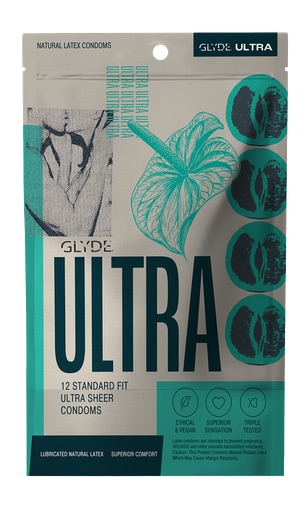
A latex condom whose maker names every chemical, with silicone lubricant, no spermicide or flavor and a clean PFAS screen. Its “no nitrosamines” claim has no test behind it, and a 2014 test of a flavored GLYDE found some. About $1.50 each.
Best for Readers without a latex allergy who want a condom whose maker publishes everything used to make it, will pay about $1.50 each and accept that its no-nitrosamines claim is unproven.
- Our rating
- Fair (3.2 of 5)
- Price range
- Premium
- Verified marks
- FDA device listings tie GLYDE-named condoms to three latex condom clearances (510(k) K994095, K070511 and K002393); none that we could open names GLYDE or a 53 mm by 190 mm condom
- Size
- 12 condoms, 53 mm wide, 190 mm long, lightly lubricated with silicone; 36-count and 144-count packs are also sold
- Made in
- Not stated by the maker. FDA’s listing database names three factories as makers of GLYDE-named condoms: Thai Nippon Rubber Industry (Thailand), and Richter Rubber Technology and Innolatex (both Malaysia). We could not tell which makes this pack.
approx. $17.99 for 12 condoms
See it on GLYDE’s site → (opens in a new tab)We are not affiliated with GLYDE. This link goes to the maker’s own page, with no tracking code. How we're funded.
Also sold at Amazon ($18) .
Reader ratings & reviews
– out of 5
Loading ratings…
Rating breakdown
- 5 stars 0
- 4 stars 0
- 3 stars 0
- 2 stars 0
- 1 star 0
Have this product? Please rate it.
Check your email
We sent a sign-in link to . Click it and you’ll come straight back here, signed in. It expires in 15 minutes; check your spam folder if it doesn’t show up. Thank you for helping the community!
Your review
Reviews are personal experiences, not research, and they never change our quality ratings. Every review is read by our team before it appears.
How we evaluated it
How it scores Our rating, metric by metric
- Ingredients & materials 40% of the rating 4 of 5
The maker names the latex, the silicone lubricant and every processing chemical, with no spermicide, paraben, glycerin, fragrance or flavor, but the list is 13 items long and includes a dithiocarbamate rubber accelerator.
- Protection 15% of the rating 4 of 5
FDA’s listing database ties GLYDE-named condoms to three latex condom clearances; the two summaries we opened cite ASTM D3492 and describe use against pregnancy and STIs, but they name no brand and describe 52 by 180 mm and 54 by 185 mm condoms, not this 53 by 190 mm pack.
- Independent testing 20% of the rating 2 of 5
Mamavation’s lab found no organic fluorine, a PFAS marker, in one sample, but the only independent nitrosamine test of a GLYDE condom, in 2014, found 92 ppb in a flavored 2011 lot, and the maker’s “no detectable levels” claim has no test behind it.
- Trust 10% of the rating 3 of 5
No recall, warning letter, Prop 65 notice or lawsuit found and the FAQ lists its chemicals, but “FDA approved”, “certified non-toxic” and “nitrosamine-free” claims are unchecked or loosely worded, and GLYDE gave the 2014 testers no evidence for its process change.
- Value 15% of the rating 2 of 5
$17.99 for 12 is about $1.50 a condom ($1.08 in the maker’s 36-pack), against LOLA’s $1.00 and Trojan Original’s 50 cents.
The rating, 3.2 of 5, is the weighted average of these scores. See how we rank condoms & lubricants and our standard.
Where to buy Stores and the prices we saw
- Amazon (opens in a new tab) approx. $18. The 12-count pack, $17.99 one-time ($16.19 with Subscribe & Save, 10% off) on 2026-11-03. Sold by “GLYDE VEGAN CONDOMS | U.S.A.” and shipped by Amazon; the seller name matches the brand’s US arm, but we saw no link to it from the maker’s site. The Walmart listing we opened is from a third-party reseller at $24.28, so we did not list it.
Prices as we saw them on November 3, 2026. They change often. These links carry no tracking code and earn us nothing.
What’s in it Every ingredient, in label order
- Non-GMO natural rubber latex
- Ammonia
- Potassium oleate
- Potassium hydroxide
- Emulgin B2 / Vulcastab LW
- Vultamol
- Sulphur
- Zinc oxide
- Irganox 1330
- Bentonite clay
- Zinc dibutyl dithiocarbamate
- Silicone lubricant
- Calcium carbonate, magnesium carbonate and oat powders
Who tested it What each test found, and who paid for it
- Independent Mamavation with Environmental Health News (Mamavation earns affiliate income) February 2024
Sent 25 condoms and 4 lubricants to an EPA-certified lab for total organic fluorine, a PFAS marker with a 10 ppm detection limit. “Glyde Ultra Standard Fit Ultra Thin Condoms” had no detectable organic fluorine and sit in Mamavation’s “best” condom group, ranked on how fully the maker disclosed materials. Mamavation says it bought the condoms at Walmart or Amazon between February and August 2023 and gives no sample count or lot. Its arsenic, lead, cadmium and mercury results sit behind a free sign-up that we did not use. Open ↗ (opens in a new tab)
- Independent Reproductive Health Technologies Project with the Center for Environmental Health (funded in part by the co-founders of Sustain, a condom maker whose own pre-market condom was also tested) September 2014
Had 23 condoms, bought from US pharmacy chains and online vendors, tested in February 2014 for nitrosamines that migrate out of the rubber (BS ISO 29941:2010, at the Tun Abdul Razak Research Centre). Its one GLYDE sample, a Blueberry-flavored condom from lot BB15961, released 37 ppb NDMA and 55 ppb NDBA, 92 ppb in all, against the 50 ppb limit the EU sets for rubber toys, a comparison the authors call imperfect. GLYDE told the testers that lot was made in February 2011 and that it changed its process in 2013, but had given them no evidence by publication. The report says results may not match what is sold now, and it did not test the Ultra. Open ↗ (opens in a new tab)
- Maker’s own test Thai Nippon Rubber Industry, with FDA review (510(k) K994095, “One Touch” latex condom) January 2000
The 2000 abbreviated 510(k) summary describes a natural latex, silicone-lubricated condom in conformance with ASTM D3492, cleared for contraception and to help prevent sexually transmitted diseases. It names no brand (“No Specific Brand Name”) and the condom described is 52 mm wide and 180 mm long; FDA’s listing database lists GLYDE - ULTRA and GLYDE - SLIM FIT under this number. Open ↗ (opens in a new tab)
- Maker’s own test Richter Rubber Technology, with FDA review (510(k) K070511, “Richter Male Latex Condom”) January 2008
The 2008 abbreviated 510(k) summary describes a natural latex, silicone-lubricated, unflavored and unscented condom, 54 mm wide and 185 mm long, conforming to ASTM D3492 and ISO 4074, for contraception and to help prevent sexually transmitted diseases including HIV. It names no brand; FDA’s listing database lists “Lovative Pte.Ltd. - Glyde Ultra”, Glyde Maxi and Glyde Slim Fit for Richter under this number. Open ↗ (opens in a new tab)
- Maker’s own test GLYDE America (statements on its product page and FAQ)
Says the condoms are electronically tested, then “checked again by independent laboratories”, and made by a process that leaves “no detectable levels of nitrosamines”. It names no laboratory and publishes no test method or report for either claim. Open ↗ (opens in a new tab)
Who paid, and why it matters
- Independent The tester took no money from the maker for it: a consumer group, a journalist, a university or a regulator.
- Paid certification An outside lab or certifier tested or listed it, and the maker paid for that.
- Maker’s own test A lab report or certificate of analysis the maker commissioned and published.
A certification is a floor, not a verdict: it checks what its program checks and nothing else. We weigh tests by someone with no stake in the result most.
What people ask Worries raised online and elsewhere, and what we found
- Is it really free of nitrosamines?
- Not shown. GLYDE’s FAQ (opens in a new tab) says nitrosamines form when latex is heated and an accelerator is added, and that its process leaves “no detectable levels”, but it names no test method or report, and its own list includes an accelerator, zinc dibutyl dithiocarbamate. The only independent nitrosamine test of a GLYDE condom we found is a 2014 study by the Reproductive Health Technologies Project and the Center for Environmental Health (opens in a new tab): a Blueberry-flavored condom from a lot made in 2011 released 92 ppb, above the EU’s 50 ppb limit for rubber toys. GLYDE told the testers it changed its process in 2013 but gave them no evidence, and we found no published test of the Ultra. The study was funded in part by the founders of a rival condom maker. A 2001 review (opens in a new tab) judged the cancer risk from nitrosamines in condoms very low, but a 2005 German survey (opens in a new tab) of 32 condoms found releases from below 10 to 660 µg per kg of material. If it matters to you, ask GLYDE which test it uses.
- Is it “FDA approved”?
- Condoms are cleared, not approved. FDA’s registration and listing database (opens in a new tab) names GLYDE condoms under three clearances from three factories: K994095 (Thai Nippon, Thailand, also relabeled by Mayer Laboratories of Berkeley, California), K070511 (Richter Rubber Technology, Malaysia) and K002393 (Innolatex, Malaysia). The two summaries we could open, K994095 (opens in a new tab) and K070511 (opens in a new tab), are generic, name no brand and describe 52 by 180 mm and 54 by 185 mm condoms; we could not open K002393’s file. So we could not tie today’s 53 by 190 mm pack to one clearance, or tell which factory makes it.
- Is it fragrance-free and flavor-free?
- This version is. Amazon calls it fragrance-free and the materials list has no fragrance or flavor, though the maker’s page says “no harsh fragrances”, a phrase that leaves room. GLYDE also sells vanilla, wildberry and other flavored condoms, which use flavors and which we do not list.
- Are the “vegan”, “fair trade” and “certified non-toxic” claims real?
- We could not check them. The maker says it is certified vegan by the Vegan Society, uses non-GMO fair trade latex and is “the world’s first certified non-toxic” condom. We did not open the Vegan Society’s register, and no certifier or certificate is named for the fair trade or non-toxic claims.
- Is it safe for people with a latex allergy?
- No. It is natural rubber latex, and the maker’s page says not to use it if you or your partner has a latex allergy. The maker says its formula has a reduced latex protein level, which we could not check. Polyisoprene or nitrile condoms are the usual alternative.
- Are lookalike listings genuine?
- Be careful. A Walmart listing we opened labels “Glyde Ultra - Pack of 12” with the brand “Make Me Blush”, sells it at $24.28 and ships it from a third-party reseller. Amazon’s listing at $17.99 is sold under the GLYDE name and shipped by Amazon. The maker’s own US site has the same $17.99 price.
- Any recalls, Prop 65 notices or lawsuits?
- None found. California’s Prop 65 notice search (opens in a new tab) has nothing under Glyde or Mayer Laboratories, FDA’s device recall database has no match for GLYDE, Mayer Laboratories, Lovative or the three factories, and FDA’s warning-letter search (opens in a new tab) lists no letter to GLYDE or Mayer Laboratories (searched 2026-11-03). We could not read Reddit or search court dockets.
Why we chose it What put it on our list
- The maker’s FAQ lists every chemical used in making the condom. Mamavation said very few of the condom brands it asked would disclose all their materials, and LOLA’s list leaves them out.
- Mamavation’s lab found no organic fluorine (a PFAS marker, 10 ppm limit) in this condom and ranked it in the “best” group.
- No spermicide, paraben, glycerin, casein, talc or flavor, per the maker; the lubricant is silicone.
- FDA’s listing database ties GLYDE-named condoms to latex condom clearances that cite ASTM D3492 (and ISO 4074 for one) and describe use against pregnancy and STIs.
Trade-offs What to weigh before you buy
- The nitrosamine-free claim has no published test behind it. The one independent test of a GLYDE condom, in 2014, found nitrosamines above the EU toy limit in a flavored lot made in 2011, and the maker’s FAQ ties nitrosamines to accelerators while its list includes one.
- FDA’s database names three factories for GLYDE-named condoms, and the maker does not say which makes this pack.
- It costs about $1.50 a condom, three times Trojan Original’s 50 cents and half again LOLA’s $1.00. The maker’s 36-pack ($38.99) is $1.08 a condom.
- Amazon is the only store we could confirm that sells it under the GLYDE name; the maker’s own US site sells it too.
- It is natural rubber latex and not for anyone with a latex allergy.
What to know Details worth knowing first
GLYDE is one of the few condom makers that publishes what goes into the latex. Its FAQ lists the rubber, the silicone lubricant and the processing chemicals, from ammonia and sulphur to zinc oxide, an antioxidant and a zinc dithiocarbamate accelerator. It adds no spermicide, paraben, glycerin or flavor to this version.
Mamavation’s lab found no organic fluorine, a marker for PFAS, in the condom and ranked it among its “best”, partly for that openness. The gaps are plain. The maker’s “no detectable nitrosamines” claim has no method or report, and the one independent test of a GLYDE condom, in 2014, found nitrosamines above the EU’s toy limit in a flavored lot made in 2011. GLYDE says it changed its process in 2013 but gave the testers no evidence, and we found no test of today’s Ultra. FDA’s database ties the name to three generic latex condom clearances from three factories, not to one filing for this pack.
It is also dearer than the others we list: about $1.50 each. Like all latex condoms it is wrong for anyone with a latex allergy. See our guide to birth control types and their risks for how condoms compare.
What we checked Each claim, and how sure we are of it
- Tested by
- Mamavation’s EPA-certified lab (PFAS marker screen only)
| What we checked | What we found |
|---|---|
| FDA-cleared Maker’s claim | FDA’s listing database ties GLYDE-named condoms to K994095 (Thai Nippon, January 2000, also relabeled by Mayer Laboratories), K070511 (Richter, January 2008) and K002393 (Innolatex, 2000). The two summaries we opened cite ASTM D3492 (K070511 also ISO 4074) and name no brand; they describe 52 by 180 mm and 54 by 185 mm condoms, not today’s 53 by 190 mm pack. |
| Protection matched to the need Verified | Natural rubber latex. The K994095 summary gives the use as contraception and to help prevent sexually transmitted diseases. |
| Tested for nitrosamines Not verified | The maker says there are no detectable levels and names no method or report; its list includes zinc dibutyl dithiocarbamate. The only independent test we found, in 2014, was of a flavored lot made in 2011 and found 92 ppb. None for the Ultra. |
| Ingredients listed Maker’s claim | Non-GMO natural rubber latex, ammonia, potassium oleate, potassium hydroxide, Emulgin B2 / Vulcastab LW, Vultamol, sulphur, zinc oxide, Irganox 1330, bentonite clay, zinc dibutyl dithiocarbamate, silicone lubricant, and carbonate and oat powders, from the maker’s FAQ. |
| No spermicide Maker’s claim | The maker’s page says “No spermicides”, and none appears in the list. |
| Independent PFAS screen Verified | Mamavation’s lab found no organic fluorine above 10 ppm in this condom (published February 2024, bought 2023). |
| Flavor and fragrance Maker’s claim | This version is unflavored and the list has no fragrance. The maker’s page says “no harsh fragrances”. |
What the labels mean
- Verified We opened an independent record that confirms it: a certifier’s listing, a regulator’s list or a lab report. It is linked under Sources.
- Maker’s claim The maker says so on its own page or label. We read it but found no independent record.
- Not verified We looked and could not confirm it, or the maker does not say. Treat it as unknown.
Sources Where our facts come from
- GLYDE Ultra, 12 count (maker page, GLYDE America). Maker’s page. $17.99 price, claims (no nitrosamines, no spermicide, vegan, fair trade) and size, seen 2026-11-03. Open ↗ (opens in a new tab)
- GLYDE America FAQs. Maker’s page. Source for the list of chemicals used and the nitrosamine, vegan, fair trade and lubricant statements. Open ↗ (opens in a new tab)
- GLYDE America: About GLYDE America. Maker’s page. Source for the “world’s first certified non-toxic, ethical and fair-trade condom” and Vegan Society statements. Open ↗ (opens in a new tab)
- GLYDE America: The difference. Maker’s page. Says the condoms are nitrosamine-, glycerin- and paraben-free and FDA and CE approved. Open ↗ (opens in a new tab)
- Mamavation: Condoms & Lubricants Tested for Indications of PFAS “Forever Chemicals”. Test report. An advocacy outlet’s lab screen for total organic fluorine (10 ppm limit) of 25 condoms; the article carries affiliate links. Lists Glyde Ultra Standard Fit among its “best” condoms. Published February 6, 2024. Open ↗ (opens in a new tab)
- FDA 510(k) K994095: Thai Nippon Rubber Industry, One Touch latex condoms (January 18, 2000). Certifier or regulator listing. A scanned abbreviated 510(k): a natural latex condom meeting ASTM D3492, silicone lubricant, no specific brand name. Open ↗ (opens in a new tab)
- FDA registration and listing (openFDA): proprietary name GLYDE - ULTRA. Certifier or regulator listing. Four records: GLYDE-named condoms under K994095 for Thai Nippon Rubber Industry and for Mayer Laboratories (repack or relabel), under K070511 for Richter Rubber Technology (as “Lovative Pte.Ltd. - Glyde Ultra”) and under K002393 for Innolatex. Open ↗ (opens in a new tab)
- FDA 510(k) K070511: Richter Rubber Technology, Richter Male Latex Condom (January 14, 2008). Certifier or regulator listing. A scanned abbreviated 510(k): a 54 mm by 185 mm silicone-lubricated latex condom conforming to ASTM D3492 and ISO 4074; proprietary name “None”. Open ↗ (opens in a new tab)
- Making a Good Thing Even Better: Removing Nitrosamines from Condoms (Reproductive Health Technologies Project, September 2014; archived copy). Test report. Tested 23 condoms for migrating nitrosamines in February 2014; Glyde Blueberry lot BB15961 released 92 ppb in total (37 NDMA, 55 NDBA). Funded in part by the founders of a rival condom maker, with results held back until publication. The tested lot was made in 2011, per GLYDE. Open ↗ (opens in a new tab)
- Center for Environmental Health: Greening Condoms, the Case for Removing Unnecessary Exposures to Nitrosamines (September 19, 2014). Test report. The partner group’s summary of the same study. Its server refused our automated requests, so we read an archived copy. Open ↗ (opens in a new tab)
- Amazon: GLYDE Ultra Standard Fit Condoms, 12 Count, 53mm. Independent source. Subscribe & Save $16.19 (10% off, $1.35 a condom) on 2026-11-03, which puts the one-time price at $17.99; sold by GLYDE VEGAN CONDOMS | U.S.A., shipped by Amazon. Open ↗ (opens in a new tab)
- Walmart: Glyde Ultra - Pack of 12 (third-party seller). Independent source. $24.28 on 2026-11-03, sold and shipped by SARONITE, brand shown as “Make Me Blush”. Not a store we list. Open ↗ (opens in a new tab)
- California Prop 65 60-day notice search: Glyde. Certifier or regulator listing. No matching notices (a search for Mayer Laboratories also found none). Searched 2026-11-03. Open ↗ (opens in a new tab)
- FDA warning-letter search for Glyde (FDA.gov). Certifier or regulator listing. No warning letter to GLYDE appears (a search for Mayer Laboratories also found none). Searched 2026-11-03. Open ↗ (opens in a new tab)
- FDA device enforcement (recall) search for Glyde (openFDA). Certifier or regulator listing. Returns “No matches found”; Mayer Laboratories, Lovative, Thai Nippon, Richter and Innolatex also returned none. Searched 2026-11-03. Open ↗ (opens in a new tab)
- Toxicological evaluation of nitrosamines in condoms (Int J Hyg Environ Health, 2001; PMID 11759152). Independent source. A literature review that estimated lifetime exposure from condoms and judged the tumor risk very low. Open ↗ (opens in a new tab)
- Migration of nitrosamines from rubber products, are balloons and condoms harmful? (Mol Nutr Food Res, 2005; PMID 15672455). Independent source. 32 German condoms released from below 10 to 660 µg nitrosamines per kg of material. Open ↗ (opens in a new tab)
Alternatives Other options to compare
- LOLA Ultra Thin Latex Condoms Made by the same Thai maker according to FDA’s database, with a three-item material list that omits the processing chemicals, at about $1.00 each.
- Trojan Original Lubricated Latex Condoms The lowest price per condom here, at about 51 cents, but Trojan gives no ingredient list and no nitrosamine statement.