Products · Salt & minerals · Jacobsen Salt Co.
Jacobsen Salt Co. Pure Kosher Sea Salt (1 lb)
Reader ratings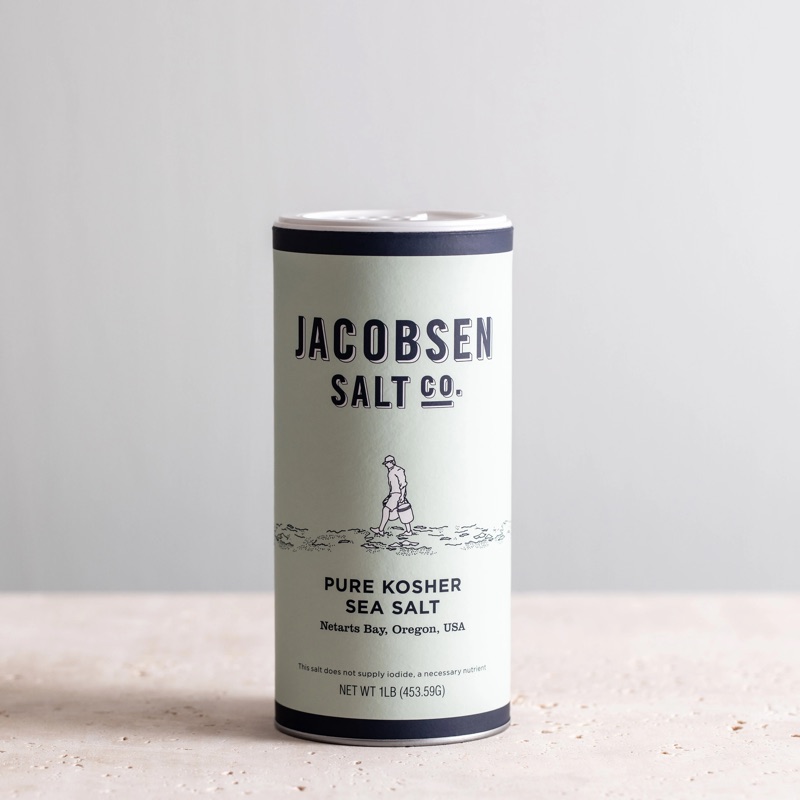
Oregon sea salt with one ingredient. Independent labs found no lead, cadmium or mercury in 2024 and again in 2025. It is about $13 a pound, no one has published a microplastics count, and the maker was out of stock on 23 Oct 2026.
Best for Cooks who want a sea salt with nothing added and the best lead record we found, and who will pay about $13 a pound for it.
- Our rating
- Good (4.2 of 5)
- Price range
- Premium
- Size
- 1 lb (454 g)
- Made in
- Netarts Bay, Oregon, USA
approx. $13 for 1 lb (454 g); out of stock at the maker on 23 Oct 2026
See it on Jacobsen Salt Co.’s site → (opens in a new tab)We are not affiliated with Jacobsen Salt Co.. This link goes to the maker’s own page, with no tracking code. How we're funded.
Also sold at AT BBQ ($15 for 1 lb ($14.99)), Amazon ($28 for 1 lb ($28.00)) .
Reader ratings & reviews
– out of 5
Loading ratings…
Rating breakdown
- 5 stars 0
- 4 stars 0
- 3 stars 0
- 2 stars 0
- 1 star 0
Have this product? Please rate it.
Check your email
We sent a sign-in link to . Click it and you’ll come straight back here, signed in. It expires in 15 minutes; check your spam folder if it doesn’t show up. Thank you for helping the community!
Your review
Reviews are personal experiences, not research, and they never change our quality ratings. Every review is read by our team before it appears.
How we evaluated it
How it scores Our rating, metric by metric
- Ingredients 25% of the rating 5 of 5
Sea salt only, with no additives, anti-caking agents or added iodine, per the maker.
- Independent testing 35% of the rating 5 of 5
No lead, cadmium or mercury at Lead Safe Mama’s lab in 2024 and 2025 (two samples), and lead below Mamavation’s reporting limit. Microplastics were not conclusively identified.
- Packaging 10% of the rating 3 of 5
A canister whose material and lid the maker does not state.
- Trust 15% of the rating 4 of 5
One FDA recall in 2016 for undeclared milk in a different product, a seasoning salt. No Prop 65 notices and nothing open for this salt.
- Value 15% of the rating 2 of 5
About $13 a pound, among the dearest salts here, and out of stock at the maker on 23 Oct 2026.
The rating, 4.2 of 5, is the weighted average of these scores. See how we rank salt & minerals and our standard.
Where to buy Stores and the prices we saw
- AT BBQ (opens in a new tab) approx. $15 for 1 lb ($14.99). A barbecue and grilling supplier. The listing is a 1 lb container made in the USA with the maker’s barcode (814417023978), limit one per customer; in stock on 2026-10-23.
- Amazon (opens in a new tab) approx. $28 for 1 lb ($28.00). Sold by ADIVE Store, a third-party seller, and shipped by Amazon. About twice the maker’s price.
Prices as we saw them on October 23, 2026. They change often. These links carry no tracking code and earn us nothing.
What’s in it Every ingredient, in label order
- Sea salt
Who tested it What each test found, and who paid for it
- Independent Lead Safe Mama, tested at Purity Laboratories (the site earns affiliate income; the retest was not covered by a fundraising campaign) August 2025
Retest of Pure Kosher Sea Salt from Netarts Bay (lot 2025-197, case 2508380), tested by ICP-MS on 27 August 2025: lead below 5 ppb, cadmium below 5 ppb, mercury below 5 ppb, arsenic below 10 ppb. One sample. Open ↗ (opens in a new tab)
- Independent Lead Safe Mama, tested at SimpleLab in Colorado (a commercial lab it hired; the site earns affiliate income) July 2024
First test of a canister collected on 1 July 2024 and reported on 24 July 2024: lead, cadmium, mercury and arsenic all not detected (limits 1.5, 3, 1.5 and 6 µg/kg). One sample. Open ↗ (opens in a new tab)
- Independent Mamavation (EPA-certified lab, not named; the site earns affiliate income) May 2026
Tested Jacobsen’s Kosher Sea Salt: lead below its reporting limit, cadmium 0.5 ppb, arsenic 9.8 ppb, aluminum 1.7 ppm, mercury not detected. It sits in the lowest-metals group, where lead was 45 ppb or less. Microplastics were not conclusively identified in any salt. One sample per brand. Open ↗ (opens in a new tab)
Who paid, and why it matters
- Independent The tester took no money from the maker for it: a consumer group, a journalist, a university or a regulator.
- Paid certification An outside lab or certifier tested or listed it, and the maker paid for that.
- Maker’s own test A lab report or certificate of analysis the maker commissioned and published.
A certification is a floor, not a verdict: it checks what its program checks and nothing else. We weigh tests by someone with no stake in the result most.
What people ask Worries raised online and elsewhere, and what we found
- Is it free of lead and other heavy metals?
- In three independent tests of different samples, yes. Lead Safe Mama (opens in a new tab) found none above its limits twice, and Mamavation (opens in a new tab) found lead below its reporting limit. Lead Safe Mama stresses that results apply to one product, and found lead in Jacobsen’s Italian fine salt.
- Does sea salt carry microplastics?
- It can. A 2018 study of 39 salt brands (opens in a new tab) found 0 to 1,674 particles per kg in sea salts (one outlier at 13,629), with the highest counts in sea salts from Asia. The maker says oysters and six stages of filtration clean its water; it has not published a count, and Mamavation’s imaging could not identify plastic in any salt it tested.
- Is it worth about $13 a pound?
- Only if the lead record matters most to you. Lead Safe Mama’s readers asked for a cheaper clean salt, and it later cleared Maldon’s flakes (about the same price) and Diamond Crystal’s box (far less).
- Does it have iodine, anti-caking agents or other additives?
- No. It is not iodized, and the maker says it is a pure sea salt with no additives.
Why we chose it What put it on our list
- One ingredient. The maker’s product page lists the ingredient as sea salt, and its FAQ calls it a pure sea salt with no additives, hand-harvested in Netarts Bay on the Oregon coast.
- Lead Safe Mama’s lab found no lead, cadmium or mercury in a July 2024 test and again in an August 2025 retest of another sample. The 2025 report, from Purity Laboratories, has lead, cadmium and mercury below 5 ppb and arsenic below 10 ppb.
- Mamavation’s lab found lead below its reporting limit, cadmium at 0.5 ppb, arsenic at 9.8 ppb and mercury not detected. That put it in the group with the lowest metals among salts from 39 brands.
- The maker says oysters in the bay filter the seawater first and that it then runs it through six stages of filtration, but it has published no test of the finished salt for plastic.
Trade-offs What to weigh before you buy
- It costs about $13 a pound, more than three times Diamond Crystal’s price per pound. The maker’s page showed it out of stock on 23 Oct 2026. Lead Safe Mama’s readers had asked for a cheaper clean salt for this reason.
- Results are for this product only. Lead Safe Mama found lead in Jacobsen’s Italian fine sea salt (opens in a new tab) in September 2024. Buy the Oregon kosher salt, not the Italian fine.
- No one has published a microplastics count for it. Mamavation’s imaging could not conclusively identify plastic in any salt it tested, and a 2018 study found the highest counts in sea salts.
- It is not iodized. The canister in Lead Safe Mama’s photo says it does not supply iodide. See our iodine guide if salt is a main source for you.
- The maker does not say what the canister and its lid are made of.
What to know Details worth knowing first
Jacobsen Salt Co. harvests this salt from Netarts Bay on the Oregon coast and adds nothing to it. Lead Safe Mama’s lab found no lead, cadmium or mercury in 2024 and again in a 2025 retest of another sample. Mamavation’s lab found lead below its reporting limit. Few salts have been tested that often with results that clean.
It costs about $13 a pound, more than three times Diamond Crystal’s price per pound, and the maker showed it out of stock on 23 October 2026. The results are for this product only: Lead Safe Mama found lead in Jacobsen’s Italian fine sea salt.
No one has published a microplastics count for it. Sea salts can carry plastic, and the maker says oysters and six stages of filtration clean its water. It is not iodized, so see our iodine guide if salt is a main source for you. For what to look for in any salt, see our sea salt guide.
What we checked Each claim, and how sure we are of it
| What we checked | What we found |
|---|---|
| Nothing added Maker’s claim | The maker’s product page lists the ingredient as sea salt (“Certified Kosher”, net weight 1 lb), and its FAQ calls it a pure sea salt with no additives. |
| Dated lab results Verified | Lead Safe Mama’s reports are from July 2024 and August 2025 (Purity Laboratories). Mamavation’s result is in its guide, last updated May 2026. |
| Heavy metals Verified | No lead, cadmium or mercury above 5 ppb and no arsenic above 10 ppb at Lead Safe Mama’s lab in 2025; non-detect in 2024. Mamavation found arsenic at 9.8 ppb. |
| Honest mineral claims Maker’s claim | The maker claims no minerals, only a clean, briny taste. |
| Iodine Maker’s claim | Not iodized. The canister in Lead Safe Mama’s 2024 photo says it does not supply iodide. |
| Source and drying Maker’s claim | Hand-harvested in Netarts Bay, Oregon, with oysters filtering the water first, six stages of filtration and a proprietary evaporation and drying process, all per the maker. |
What the labels mean
- Verified We opened an independent record that confirms it: a certifier’s listing, a regulator’s list or a lab report. It is linked under Sources.
- Maker’s claim The maker says so on its own page or label. We read it but found no independent record.
- Not verified We looked and could not confirm it, or the maker does not say. Treat it as unknown.
Sources Where our facts come from
- Jacobsen Salt Co. Pure Kosher Sea Salt product page. Maker’s page. $13 for 1 lb (454 g), marked unavailable on 23 Oct 2026 (a notify-me button, limit 4 per order). The ingredient tab reads sea salt, origin Netarts Bay, certified kosher. Open ↗ (opens in a new tab)
- AT BBQ: Jacobsen Salt Co. Pure Kosher Sea Salt. Independent source. $14.99 for a 1 lb container, in stock on 2026-10-23; barcode 814417023978 matches the maker’s. Open ↗ (opens in a new tab)
- Jacobsen Salt Co. FAQ. Maker’s page. Pure sea salt with no additives; oysters and six stages of filtration; no iodine. Open ↗ (opens in a new tab)
- Lead Safe Mama: 2025 retest of Jacobsen Pure Kosher Sea Salt (Nov 2025). Test report. Purity Laboratories report, case 2508380. The site earns affiliate income. Open ↗ (opens in a new tab)
- Lead Safe Mama: July 2024 laboratory results for Jacobsen Pure Kosher Sea Salt. Test report. SimpleLab report, collected 1 Jul 2024 and reported 24 Jul 2024: non-detect for lead, cadmium, mercury and arsenic. Open ↗ (opens in a new tab)
- Lead Safe Mama: Jacobsen’s Pure Italian Fine Sea Salt tests positive for lead (Sept 2024). Test report. A different Jacobsen product, not this one. Open ↗ (opens in a new tab)
- Mamavation: Sea salt and Himalayan salt tested for heavy metals and microplastics. Test report. EPA-certified lab, one sample per brand. The site earns affiliate income. Open ↗ (opens in a new tab)
- FDA enforcement reports: recalling firm Jacobsen Salt. Certifier or regulator listing. Searched 23 Oct 2026. One Class II recall in 2016 for a blue cheese seasoning salt with undeclared milk. Open ↗ (opens in a new tab)
- California Attorney General: Prop 65 60-day notice search. Certifier or regulator listing. Searched by alleged violator on 23 Oct 2026: no notice for Jacobsen Salt. Open ↗ (opens in a new tab)
- Kim et al. (2018), Environmental Science & Technology: microplastics in food-grade salts (PMID 30285421). Independent source. 39 brands; relatively high counts in sea salts produced in Asia. Open ↗ (opens in a new tab)
Alternatives Other options to compare
- Diamond Crystal Kosher Salt (3 lb box) Also clean at two independent labs, with salt as the only ingredient, at about $4 a pound.
- Maldon Sea Salt Flakes A finishing salt from Essex, England, with clean lead results in two independent tests, at about $13 a pound.