Products · Coffee · Kicking Horse Coffee
Kicking Horse Three Sisters Medium Roast Whole Bean
Reader ratings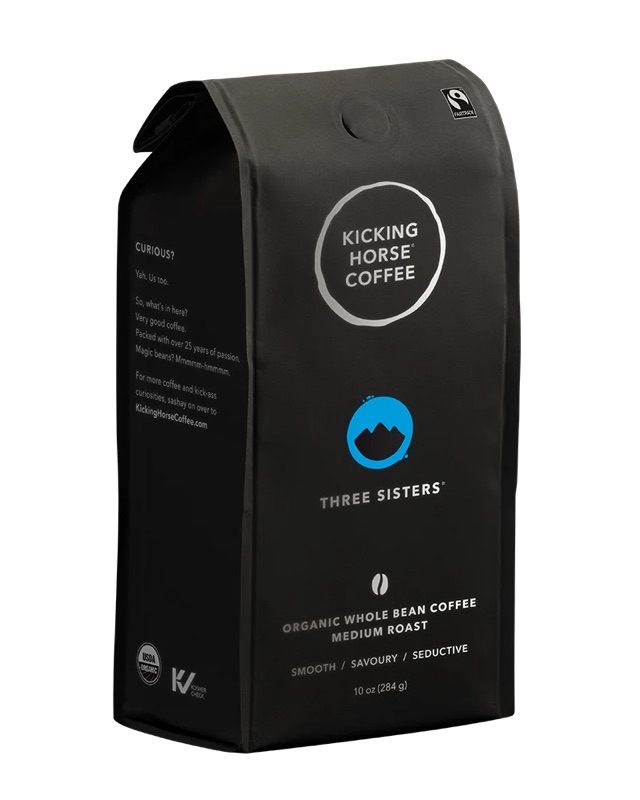
A widely sold organic medium roast that USDA lists by name and that ranked in Clean Label Project’s cleanest 16 of 57 coffees in 2025. The bag has a best-by date, not a roast date, and no lab results are posted. About $1.70 an ounce.
Best for Shoppers who want an organic coffee they can find in a store, at a modest price, and will not pay extra for posted lab reports.
- Our rating
- Fair (3.0 of 5)
- Price range
- Mid-range
- Verified marks
- USDA Organic (Ecocert)
- Size
- 10 oz whole bean (2.2 lb also sold)
- Made in
- Central and South America (no farms named); roasted in the Canadian Rockies, British Columbia
approx. $16.99 for 10 oz (approx. $14.89 on Amazon)
See it on Kicking Horse Coffee’s site → (opens in a new tab)We are not affiliated with Kicking Horse Coffee. This link goes to the maker’s own page, with no tracking code. How we're funded.
Also sold at Amazon ($14.89 for 10 oz), Vitacost ($14.89 for 10 oz) .
Reader ratings & reviews
– out of 5
Loading ratings…
Rating breakdown
- 5 stars 0
- 4 stars 0
- 3 stars 0
- 2 stars 0
- 1 star 0
Have this product? Please rate it.
Check your email
We sent a sign-in link to . Click it and you’ll come straight back here, signed in. It expires in 15 minutes; check your spam folder if it doesn’t show up. Thank you for helping the community!
Your review
Reviews are personal experiences, not research, and they never change our quality ratings. Every review is read by our team before it appears.
How we evaluated it
How it scores Our rating, metric by metric
- Beans & farming 25% of the rating 3 of 5
USDA’s listing names the 10 oz Three Sisters, and the maker says every bean is also Fairtrade. Origin is only Central and South America: no farm, co-op or harvest is named.
- Independent testing 35% of the rating 3 of 5
Clean Label Project, buying at retail in 2025, put it among the cleanest 16 of 57 coffees. That is a rank with no numbers, and mold toxins were not scored. The maker’s own testing claim has no lab or report behind it.
- Roast & packaging 15% of the rating 2 of 5
No roast date: the bag shows a best-before date that the maker says falls 18 months after roasting. Whole beans are offered. The foil-lined bag is not recyclable.
- Trust 10% of the rating 3 of 5
No recalls or Prop 65 notices found. Its sustainability page calls the coffee pesticide free because it is organic, which organic does not guarantee, and its mold-testing claim names no lab.
- Value 15% of the rating 4 of 5
$16.99 for 10 oz is $1.70 an ounce, mid-range here. The 2.2 lb bag works out to about $1.25 an ounce.
The rating, 3.0 of 5, is the weighted average of these scores. See how we rank coffee and our standard.
Where to buy Stores and the prices we saw
- Amazon (opens in a new tab) approx. $14.89 for 10 oz. Shipped and sold by Amazon.com.
- Vitacost (opens in a new tab) approx. $14.89 for 10 oz. Sold by Vitacost, with the same barcode as the maker’s 10 oz bag. The page shows a best-by date of 9 May 2027.
Prices as we saw them on October 23, 2026. They change often. These links carry no tracking code and earn us nothing.
What’s in it Every ingredient, in label order
- Organic Arabica Coffee
Who tested it What each test found, and who paid for it
- Paid certification USDA National Organic Program, through Ecocert SAS (a certifier Kicking Horse pays) October 2026
Lists Kicking Horse Coffee Co. Ltd. as an organic operation, with “Whole Bean Coffee Three Sisters 10 oz” in its scope. Organic rules cover farming inputs and handling, not mold toxins, heavy metals or pesticide residue levels. Open ↗ (opens in a new tab)
- Independent Clean Label Project (a nonprofit that also runs a separate certification program for brands); coffees bought at retail August 2025
Three Sisters was among the 16 lowest-scoring of 57 coffees for heavy metals, pesticides, glyphosate, BPA and BPS, phthalates and acrylamide. Ranks only, no numbers; mold toxins were not one of the six scored categories. Its one-sheet labels Three Sisters non-organic, which conflicts with USDA’s listing. Open ↗ (opens in a new tab)
- Maker’s own test Kicking Horse (maker’s statement; no lab named) October 2026
Says its quality-control team does green-bean analysis, roasted sampling and independent lab analysis, and that its testing has always been negative to molds, bacteria or yeast. No lab, date, report or numbers for mycotoxins, pesticides or heavy metals. Open ↗ (opens in a new tab)
Who paid, and why it matters
- Independent The tester took no money from the maker for it: a consumer group, a journalist, a university or a regulator.
- Paid certification An outside lab or certifier tested or listed it, and the maker paid for that.
- Maker’s own test A lab report or certificate of analysis the maker commissioned and published.
A certification is a floor, not a verdict: it checks what its program checks and nothing else. We weigh tests by someone with no stake in the result most.
What people ask Worries raised online and elsewhere, and what we found
- Is the coffee pesticide free?
- Kicking Horse’s sustainability page (opens in a new tab) calls it pure and pesticide free because it is organic, and says independent auditors test it for pesticide and herbicide residues. Organic farming limits synthetic pesticides but does not promise zero residue: Clean Label Project (opens in a new tab) found AMPA, a glyphosate breakdown product, in every organic coffee it tested. Kicking Horse publishes no residue results.
- Why is there no roast date?
- The bag shows a best-before date. The FAQ (opens in a new tab) says unopened beans stay fresh for 18 months after roasting and that the beans were roasted 18 months before the date on the back. That leaves a long window in which a bag can sit before you buy it: the bag Vitacost listed on 23 October 2026 had a best-by date of 9 May 2027, which by the maker’s rule means roasting around 9 November 2025, nearly a year earlier.
- Is it organic? Clean Label Project calls it non-organic.
- The Clean Sixteen sheet (opens in a new tab) labels Three Sisters non-organic. USDA’s listing names the 10 oz Three Sisters, and the maker says all its coffee is organic and Fairtrade. Clean Label Project’s own list of the 57 coffees tested (opens in a new tab) names it “Organic Three Sisters”, so the sheet’s label looks like an error, but Clean Label Project has not said so. We trust the USDA record.
- Does it test for mold toxins?
- The FAQ says its testing has always been negative to molds, bacteria or yeast, which says nothing about ochratoxin A, and gives no lab or numbers. Most coffee tests under food-safety limits (a 2024 review (opens in a new tab) of 40 studies found only two reporting average roasted-coffee levels above the EU limit), so this is a gap in documentation, not proof of a problem.
Why we chose it What put it on our list
- USDA’s Organic Integrity Database lists Kicking Horse Coffee Co. Ltd. (Invermere, British Columbia) as certified through Ecocert (status effective 7 March 2025, profile updated 6 October 2026). Its scope names “Whole Bean Coffee Three Sisters 10 oz”.
- In 2025 Clean Label Project bought 57 popular coffees and tested them at an ISO 17025 lab. Three Sisters is on its Clean Sixteen list of the products with the lowest combined scores for heavy metals, pesticides, glyphosate, BPA and BPS, phthalates and acrylamide.
- The only ingredient is organic Arabica coffee, and the company says it roasts nothing else in its facility: no additives, fillers or flavoring.
- Price: $16.99 for 10 oz from the maker (about $1.70 an ounce), and about $14.89 on Amazon, where Amazon sells it itself.
Trade-offs What to weigh before you buy
- There is no roast date. The company says the beans were roasted 18 months before the best-before date on the back. That is a long window: a bag can sit on a shelf for months before you buy it.
- The company posts no lab results, only an FAQ line saying its testing has been negative for molds, bacteria and yeast. Clean Label Project’s ranking is independent, but its six categories do not include mold toxins, and it shows ranks rather than numbers.
- Clean Label Project’s one-sheet labels Three Sisters “Non-Organic”. USDA’s listing and the maker both say organic, so the two records conflict.
- The sustainability page calls the coffee “pesticide free”. Organic does not mean residue-free; Clean Label Project found AMPA in every organic coffee it tested.
- The foil-lined bag is not recyclable, per the company.
What to know Details worth knowing first
Kicking Horse is one of the most widely sold organic coffees in North America, which makes it a practical mid-priced choice. USDA’s organic database lists the company and names the Three Sisters 10 oz whole bean. In 2025, Clean Label Project bought it with 56 other popular coffees and placed it among the 16 with the lowest combined contamination scores.
What it lacks is documentation. The bag prints a best-before date rather than a roast date, the company posts no lab results, and its sustainability page calls the coffee “pesticide free”, which organic farming does not promise. Clean Label Project’s test is a useful outside check, but it ranks six contaminant groups that do not include mold toxins, and it publishes ranks rather than numbers.
For average drinkers in most countries, ochratoxin A intake from coffee stays below the tolerable daily intake (mold toxins in food), and organic plus reasonably fresh is a sound way to buy it; see organic vs. conventional and coffee and health. If you want a printed roast date or a posted report, look at the other coffees on this list.
What we checked Each claim, and how sure we are of it
| What we checked | What we found |
|---|---|
| Organic or residue-tested Verified | Listed as USDA Organic: Kicking Horse Coffee Co. Ltd., NOP ID 7880301821, certified by Ecocert SAS. The scope names “Whole Bean Coffee Three Sisters 10 oz”. |
| Independent contaminant test Verified | In Clean Label Project’s 2025 Clean Sixteen of 57 coffees. Individual results are not published, and mold toxins are not one of the six ranked categories. |
| Published lab tests Maker’s claim | None posted. Kicking Horse’s FAQ, answering a question about mycotoxins, says its quality-control team does green-bean analysis, roasted sampling and “independent lab analysis”, and that its testing “has always been negative to molds, bacteria or yeast”. No lab, date, report or mycotoxin, pesticide or heavy-metal result is given. |
| A roast date Maker’s claim | No roast date. The best-before date is 18 months after roasting, per the company FAQ. |
| Hot coffee kept off plastic Maker’s claim | Sold as whole beans (or ground), so nothing hot touches the packaging. The bag has a foil lining, per the FAQ. |
| Notices and recalls Verified | We found no FDA enforcement report and no California Prop 65 notice naming Kicking Horse when we searched on 23 Oct 2026. |
What the labels mean
- Verified We opened an independent record that confirms it: a certifier’s listing, a regulator’s list or a lab report. It is linked under Sources.
- Maker’s claim The maker says so on its own page or label. We read it but found no independent record.
- Not verified We looked and could not confirm it, or the maker does not say. Treat it as unknown.
Sources Where our facts come from
- Kicking Horse Coffee: Three Sisters product page. Maker’s page. Seen 23 October 2026: $16.99 for 10 oz; ingredients: Organic Arabica Coffee; origin: Central and South America. Open ↗ (opens in a new tab)
- Kicking Horse Coffee FAQ (best-before date, mold and toxin testing statement, foil bag). Maker’s page. Open ↗ (opens in a new tab)
- Kicking Horse Coffee: sustainability (pesticide-free wording). Maker’s page. Open ↗ (opens in a new tab)
- USDA Organic Integrity Database: Kicking Horse Coffee Co. Ltd.. Certifier or regulator listing. Checked 22 October 2026 (not re-opened on 23 October). Open ↗ (opens in a new tab)
- Clean Label Project: Coffee Clean Sixteen, 2025. Test report. Ranks 16 of 57 retail coffees by combined contamination scores. The one-sheet labels Three Sisters non-organic, which conflicts with USDA’s listing and with Clean Label Project’s own tested-products list (“Organic Three Sisters”). Open ↗ (opens in a new tab)
- Clean Label Project coffee study, August 2025. Test report. Source for the AMPA finding in organic coffees. Open ↗ (opens in a new tab)
- A worldwide systematic review of ochratoxin A in various coffee products (Massahi et al., 2024). Independent source. PMID 39259858. Opened and checked. Open ↗ (opens in a new tab)
- openFDA: food enforcement reports (recalling firm search). Certifier or regulator listing. Searched 23 Oct 2026: no matches. Open ↗ (opens in a new tab)
- California Attorney General: Prop 65 60-day notice search. Certifier or regulator listing. Searched by alleged violator (exact phrase “Kicking Horse”) on 23 Oct 2026: no notice. Open ↗ (opens in a new tab)
- Amazon listing: Kicking Horse Three Sisters, 10 oz. Independent source. Opened 23 October 2026: $14.89; ships from and sold by Amazon.com. Open ↗ (opens in a new tab)
- Vitacost listing: Kicking Horse Three Sisters, 10 oz. Independent source. Opened 23 October 2026: $14.89, UPC 629070800084 (the maker’s code), best-by 9 May 2027. Open ↗ (opens in a new tab)
Alternatives Other options to compare
- Fresh Roasted Coffee Organic Peru Organic with a roast-date sticker, about $16 for 12 oz. Its testing rests on the maker’s word.
- Purity Coffee FLOW Posts a lab report for mold toxins and was tested by an independent lab, at about $29 for 12 oz.