Products · Red light therapy · Mito Red Light
Mito Red Light MitoPRO 1500X
Reader ratings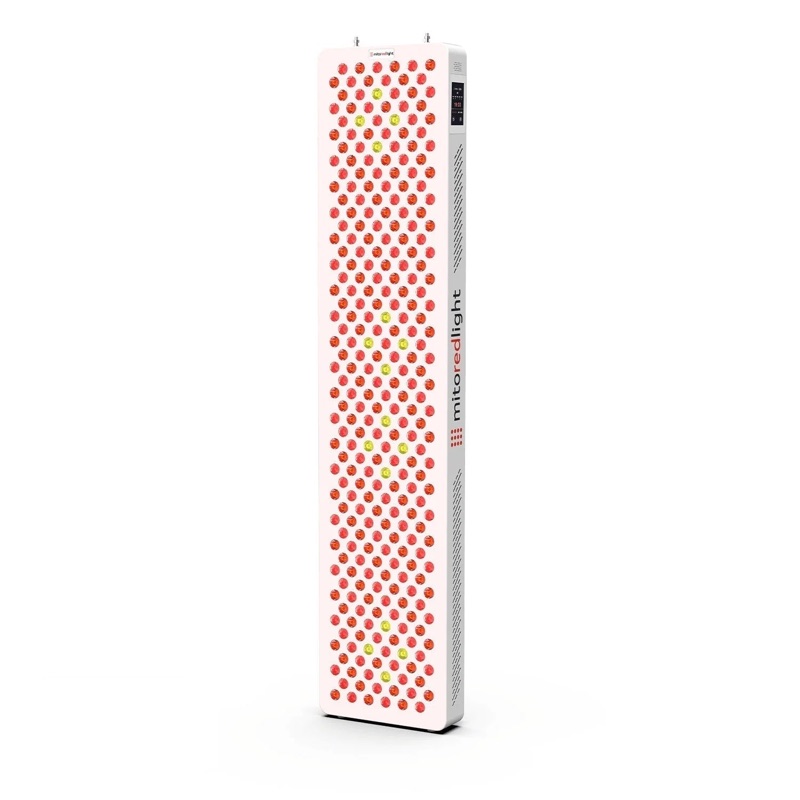
A 43-inch plug-in panel with six wavelengths and goggles in the box. An affiliate reviewer measured 68 mW/cm² at 6 inches in 2024 against Mito’s lab average of 53; its LEDs span 7.6 inches. ETL names the model; flicker is not stated.
Best for Someone who wants one tall panel for a back, torso or legs in a single position, with six wavelengths, a touchscreen and goggles in the box, and who will pay more per square inch than for Mito’s plainer 2.0 panels.
- Our rating
- Fair (3.3 of 5)
- Price range
- Premium
- Verified marks
- ETL Listed by Intertek as a horticultural luminaire to UL 1598, CAN/CSA C22.2 No. 250.0 and ANSI/CAN/UL 8800 (the directory names MitoPRO 1500X)
- Size
- 43 × 10 × 3 in, 25 lb, 300 LEDs with two chips each (590, 630, 660, 810, 830 and 850 nm); 445 W rated
- Made in
- Designed and sold by Mito Red Light LLC (Scottsdale, Arizona). Mito names no country of manufacture: its FAQ says only that its devices are made in a facility certified to MDSAP and ISO 13485. FDA’s registration data lists Mito as a specification developer and importer, and Shenzhen Sungrow LED Technology Co., Ltd (Shenzhen, China), which also lists models sold by other brands, as a manufacturer with the MitoPRO 1500X among its listed products.
approx. $1,299 for the 43 × 10 in, 300-LED panel
See it on Mito Red Light’s site → (opens in a new tab)We are not affiliated with Mito Red Light. This link goes to the maker’s own page, with no tracking code. How we're funded.
Reader ratings & reviews
– out of 5
Loading ratings…
Rating breakdown
- 5 stars 0
- 4 stars 0
- 3 stars 0
- 2 stars 0
- 1 star 0
Have this product? Please rate it.
Check your email
We sent a sign-in link to . Click it and you’ll come straight back here, signed in. It expires in 15 minutes; check your spam folder if it doesn’t show up. Thank you for helping the community!
Your review
Reviews are personal experiences, not research, and they never change our quality ratings. Every review is read by our team before it appears.
How we evaluated it
How it scores Our rating, metric by metric
- Measured output 30% of the rating 4 of 5
Light Therapy Insiders’ spectrometer found an average of 68 mW/cm² at 6 inches in 2024 (74.5 in his shopping tool, with 151 W of total output against the lab’s 149.4 W), near the more than 73 lab figure Mito prints, but Mito’s own lab average is 53.5, the reviewer earns commission from Mito and we could not open the lab report.
- Evidence 25% of the rating 3 of 5
Red (630, 660 nm) and near-infrared (810, 830, 850 nm) match the ranges our guides use and a 6 J/cm² skin dose takes about 1.5 minutes at 6 inches, but Mito’s own lab spectrum shows almost no 590 nm amber, the LEDs span only 7.6 of the panel’s 10 inches, and “medical grade” wording goes past what an FDA registration shows.
- Safety 20% of the rating 3 of 5
ETL lists the model to lighting standards, goggles come in the box and an outside test found EMF within the Building Biology limit at 6 inches, but no flicker figure is published and the IEC 60601 claims have no listing we could open.
- Trust 10% of the rating 3 of 5
Mito shows lab results by report number and prints both irradiance figures, but its pages disagree on size and spectrum, FDA lists an open recall of a different Mito product, it pays creators commission, and its manual makes a detox claim with no study.
- Value 15% of the rating 3 of 5
At $1,299 for a 43 × 10 in panel it costs about $3.02 per square inch against $2.31 for the MitoMAX 2.0, with six wavelengths, a touchscreen and a 3-year warranty; Light Therapy Insiders put it at $7.90 per watt of light at his discounted price.
The rating, 3.3 of 5, is the weighted average of these scores. See how we rank red light therapy and our standard.
What it’s made of What touches your food, water, skin or air
- Housing and lens materials: not stated by Mito
- 300 LEDs with two chips each: 590, 630 and 660 nm red and amber, 810, 830 and 850 nm near-infrared
- Cooling fans, so air passes over the LEDs
- Power cord, over-the-door hook, steel hanging cables and four vinyl hanging straps; opaque goggles and IR3 glasses in the box; floor stand sold separately
- Mito’s manual carries a California Prop 65 warning that the hardware and power cord contain chemicals such as lead
Who tested it What each test found, and who paid for it
- Independent Light Therapy Insiders (an affiliate reviewer’s own spectrometer; he earns commission on Mito sales, says he received a complimentary product to review and says he has met Mito’s founder) February 2024
In his comparison of 17 panels, published in February 2024 and updated in July 2026, he took nine spectrometer readings at 6 inches and averaged them: 68 mW/cm² for this model, tied for ninth on power. The LEDs span only 7.6 inches across, which cost it points, and he ranked it fifth overall. He tested it just after its release, before the IEC-upgraded version Mito’s lab tested in September 2025, and we could not tell whether the hardware differs. A December 2024 roundup by the same reviewer gives 75 mW/cm² and a price of $1,249, and his shopping tool lists it at 74.5 mW/cm² and 151 W of total output, a figure his method derives from the average and the LED coverage area. Open ↗ (opens in a new tab)
- Independent Light Therapy Insiders (same reviewer; EMF testing against Building Biology limits at 6 inches) January 2025
Of the 17 panels in his 2024 comparison, 12 stayed within the Building Biology limits for magnetic and electric fields at 6 inches, measured with an electrosmog meter, and the 1500X was one of them; he gives no figures, though his shopping tool marks both its electric and magnetic fields green. He notes the panel has Bluetooth, which adds a microwave field and can be switched off. Open ↗ (opens in a new tab)
- Independent Light Therapy Insiders (same reviewer; he says every panel in his 2026 preview was independently lab tested, by a lab he does not name) October 2026
In an October 2026 preview the 1500X scored 39.1% on half-body coverage, the share of a shoulder-to-waist grid receiving at least 30 mW/cm², and he calls it taller and narrower than Mito’s 1500+ V2 and slightly worse on that measure. Output figures were not published. He also describes the panel as basic, without a touchscreen or smart modes, which does not match Mito’s own listing, so we are cautious about this preview. Open ↗ (opens in a new tab)
- Maker’s own test LightLab International Allentown, LLC, Allentown, PA (hired by Mito) September 12, 2025
Report LLIA002765-006, tested 12 September 2025 in Mode 1 (red plus near-infrared) at 6 inches, over the area below the LEDs: average 53.5, peak 72.5 and lowest 10.5 mW/cm², 149.4 W of radiant power from a 418.7 W draw. Mito’s page prints more than 73 mW/cm² for this model, which matches the peak, not the average. The lab’s spectrum, plotted in Mito’s explorer, has peaks near 634, 662, 814 and 834 nm, a shoulder near 850 nm and no separate peak at 590 nm. NVLAP lists the lab (code 201079-0) as accredited to ISO/IEC 17025:2017 for energy-efficient lighting products until 30 September 2027; we did not read its scope. We could not open the PDF, which Mito sends on request; we read Mito’s table and its explorer, which embeds the same figures. Open ↗ (opens in a new tab)
- Paid certification Intertek (ETL listing; the maker pays)
Lists MitoPRO 1500X among Mito’s models as a horticultural luminaire, in three entries (UL 1598, CAN/CSA C22.2 No. 250.0 and ANSI/CAN/UL 8800), marked ETL or cETL Listed, and says a representative sample of the listed devices was tested. These are lighting-equipment standards. UL says UL 8800 addresses eye and skin exposure from the light, but the directory does not say what was tested for this model, and it does not mention flicker, light output or the IEC 60601 medical standards that Mito’s page names. Open ↗ (opens in a new tab)
Who paid, and why it matters
- Independent The tester took no money from the maker for it: a consumer group, a journalist, a university or a regulator.
- Paid certification An outside lab or certifier tested or listed it, and the maker paid for that.
- Maker’s own test A lab report or certificate of analysis the maker commissioned and published.
A certification is a floor, not a verdict: it checks what its program checks and nothing else. We weigh tests by someone with no stake in the result most.
What people ask Worries raised online and elsewhere, and what we found
- Are Mito’s irradiance numbers legit? The page says more than 160 mW/cm².
- Mito prints two figures at 6 inches for the 1500X: more than 160 from a consumer solar meter and more than 73 from a laboratory. It says it lists both so shoppers can compare with rivals that quote either, and that its lab numbers are “the numbers your skin sees”. LightLab’s table gives a peak of 72.5 and an average of 53.5 mW/cm² over the area below the LEDs (lowest point 10.5), so the lab figure on the page is the peak. Light Therapy Insiders measured an average of 68 in February 2024 (comparison (opens in a new tab)) and gave 75 in a December 2024 roundup (roundup (opens in a new tab)), above the lab’s average and near its peak. His two pages differ by 7, but his shopping tool (opens in a new tab) agrees with the later one: 74.5 mW/cm² and 151 W of total output, within about 1% of the lab’s 149.4 W of radiant power, which fits the two averaging over different areas. The solar-meter 160 is more than twice either figure. We could not open the lab report itself.
- Does it really give off six wavelengths?
- Mito’s page lists six (6% 590, 22% 630, 22% 660 and 17% each at 810, 830 and 850 nm) and does not say whether the percentages are shares of LEDs or of light. The lab’s spectrum for this panel, plotted in Mito’s explorer, has peaks near 634, 662, 814 and 834 nm and a shoulder near 850 nm, and no separate peak at 590 nm (about 2% of the tallest peak there). We read about 42% of its area in the red and 58% in the near-infrared. Light Therapy Insiders called it the only panel with amber light but published no spectrum for it, and his shopping tool lists only 630, 660, 810 and 830 nm for it, which matches neither Mito nor his own roundup, so we found no outside check of the spectrum.
- Is one 43-inch panel enough for the whole body?
- Not in one position. The panel is 10 inches wide, but its LEDs span only 7.6 inches, which cost it points in the first round of Light Therapy Insiders’ 2024 comparison, and in his October 2026 preview it scored 39.1% on half-body coverage (preview (opens in a new tab)). One panel treats a strip of the body at a time, front or back.
- Is it “medical grade”? Mito calls its panels FDA Class II registered medical devices.
- FDA lists Mito Red Light LLC under product code ILY, an infrared heating lamp that is exempt from FDA’s premarket review, so the panel is registered, not cleared or approved (FDA classification (opens in a new tab)). Mito’s own footer says the products have not been evaluated by FDA, and its FAQ says only “a certain subset” of its products have 510(k) clearance; the one it advertises as FDA-cleared is an LED mask. The page lists IEC 60601 certifications, but Intertek’s listings are to lighting standards, and Mito’s own certifications page (opens in a new tab) gives UL medical-equipment certification only to other products, the MitoADAPT 4.0 series and the MitoPOD, MitoMAT and MitoQUAD belt. Truth in Advertising reported in March 2023 that Mito’s site carried the FDA’s logo, which FDA policy bars on private-sector materials; Mito removed it (report (opens in a new tab)).
- Is it safe? Mito recalled a product for fire risk.
- FDA lists a Class 2 recall (Z-2478-2026) of the battery-powered Mito Mobile Super, whose lithium-ion battery may catch fire. Mito says one customer’s unit caught fire while charging in February 2025, no one was hurt, and the recall covers only that model, sold from May 2023 to September 2024 (Mito’s notice (opens in a new tab), FDA (opens in a new tab)). FDA still shows it as open. The MitoPRO 1500X plugs into the wall and has no battery, and FDA lists no recall of it; a July 2025 Reddit post (opens in a new tab) titled “mitopro 1500x recall” is a buyer whose order was canceled a day before delivery, and it gives no reason. An outside test put its magnetic and electric fields within Building Biology limits at 6 inches.
- Do the people who recommend it get paid?
- Yes. Mito’s partners page (opens in a new tab) offers creators and influencers affiliate links and commissions. Light Therapy Insiders, the source of every outside figure for this model, says he earns commission on Mito sales, his pages say he received complimentary products, and his May 2026 review of Mito (opens in a new tab) says products were provided free and that he has met the founder and toured its setup. His average is close to Mito’s own lab peak, but treat any glowing review as possibly paid.
- What if it breaks, and can I return a 25 lb panel?
- Mito’s policy page (opens in a new tab) gives a 60-day trial with no restocking fee, but you may pay return shipping unless you bought the optional “Free Returns & Package Protection” at checkout, which is not refundable. The 3-year warranty replaces a defective unit; Mito says it does not repair panels or supply replacement parts, and damage from negligence is not covered. A July 2026 Reddit thread (opens in a new tab) describes a buyer of a roughly $1,200 Mito panel who, after it was knocked off its stand, was told Mito does not offer a replacement control panel; other commenters said that is normal for accidental damage.
- Does the manual’s “detox” claim hold up?
- The manual’s FAQ says a session “can cause some detox related symptoms” and advises starting with 2 to 3 minutes. It cites no study and our guides, which cover the trials we rely on, do not mention such an effect, so we treat it as unsupported. Starting short is still sensible advice for any new light dose.
- Does red light therapy work, and at what dose?
- Our guides find it likely helps skin texture and muscle recovery when the dose is high enough, with most trials at 3 to 6 J/cm² for skin and 10 to 40 J/cm² for muscle and joints (benefits and usage). At 68 mW/cm² a 6 J/cm² dose takes about 1.5 minutes at 6 inches and a 30 J/cm² dose about 7 minutes; at the lab’s 53.5 average, about 2 and 9 minutes. Mito’s manual advises 10 minutes at 12 to 18 inches, where output is lower and unmeasured. A 2026 study of social media promotion found most posts about at-home devices cited no peer-reviewed study (PubMed 41822644 (opens in a new tab)), and a 2025 measurement study of hand-held LED devices found makers’ dose instructions inconsistent with measured output (PubMed 39996950 (opens in a new tab)).
- Has Mito been sued, or had a warning letter or a Prop 65 notice?
- Joovv sued Mito for patent infringement in June 2023 and the case was terminated in January 2025; it was about patents, not safety or labeling (docket (opens in a new tab)). On 3 November 2026 we found no FDA warning letter to Mito Red Light (FDA search (opens in a new tab)), no 60-day Prop 65 notice naming Mito on the California attorney general’s list (opens in a new tab), no CPSC recall and no consumer class action; CourtListener’s federal dockets show only the Joovv case.
- Does the manual carry a Prop 65 warning for lead?
- Yes. Mito’s manual (opens in a new tab) says the enclosed hardware and power cord contain chemicals, such as lead, known to California to cause cancer and birth defects or other reproductive harm, adds that this is true of virtually all power cords and electronics, and says to wash hands after use. It does not say which part or how much, and we found no lead test of the panel.
- Are the panels hard on the eyes?
- Mito’s manual calls its plug-in panels “very bright”, says to wear the goggles or glasses in the box when facing them, particularly with near-infrared on, warns against looking at the light directly and rates the panel Risk Group 1, a rating with no report we could open. One owner of this panel wrote on Reddit (opens in a new tab) that after sitting in front of it with closed eyes and no goggles at 75% brightness they could stand it for only about 30 seconds and the next day still had eye pain, colored spots and a headache; the post has no follow-up. Wear the goggles.
Why we chose it What put it on our list
- An affiliate reviewer’s spectrometer found an average of 68 mW/cm² at 6 inches in February 2024 (75 in a December 2024 roundup), against the more than 73 mW/cm² lab figure Mito prints, and the 151 W of total output in his shopping tool is within about 1% of the lab’s 149.4 W. His EMF results, published in January 2025, put it among the 12 of 17 panels within Building Biology limits at 6 inches. He earns commission from Mito, so we count his figures as an outside check, not an endorsement.
- Mito prints both a solar-meter figure (more than 160) and a lab figure (more than 73) at 6 inches, and its testing page gives LightLab’s average, peak and lowest readings with a report number (LLIA002765-006). The reviewer gave Mito full marks in his 2024 comparison for linking its lab data.
- Intertek’s ETL directory names the MitoPRO 1500X in listings to three lighting standards, the panel plugs into the wall with no battery, and opaque goggles and IR3 glasses come in the box.
- It has a 3-year warranty, a 60-day trial with no restocking fee and free shipping in the lower 48 states; a door hook, hanging cables and straps are in the box.
Trade-offs What to weigh before you buy
- The LEDs span only 7.6 of the panel’s 10 inches, and Light Therapy Insiders’ 2026 lab test gave it a 39.1% half-body coverage score, so one panel treats a strip of the body, not all of it. He ranked it fifth of 17 panels in 2024.
- Mito’s own lab average is 53.5 mW/cm² with the lowest point at 10.5; the more than 73 on its page is the peak. At $1,299 you pay about $3.02 per square inch, against $2.31 for the MitoMAX 2.0.
- The outside figures date from February and December 2024, before the IEC-upgraded version Mito’s lab tested in September 2025. Their author earns commission from Mito and his pages differ (68 and 75 mW/cm², and 74.5 in his shopping tool).
- Mito’s pages disagree on the panel’s size (43 × 10 in in the manual and on the product page, 42 × 9 in in the lab table) and on its spectrum: its lab table labels the tested mode “Red 660 nm + NIR 850 nm”, and Mito’s own lab spectrum shows no separate 590 nm peak, so “six wavelengths” is five with a trace of amber.
- The page says medical grade and lists IEC 60601 certifications. The only listings we could open are ETL to lighting standards, Mito’s own certifications page gives UL medical-equipment certification only to other products, and its footer says the products have not been evaluated by FDA. No flicker figure is published.
- Return shipping on a 25 lb box is yours unless you buy the optional “Free Returns & Package Protection” at checkout. Mito says it does not repair panels or sell replacement parts, and damage from negligence is not covered.
- Mito’s manual carries a California Prop 65 warning for chemicals such as lead in the hardware and power cord, which Mito says is true of virtually all electronics. We found no test of how much.
- Brand note: FDA lists an open Class 2 recall of Mito’s battery-powered Mito Mobile Super handheld, begun 12 February 2025 after a charging fire (Z-2478-2026; no injuries reported). This plug-in panel has no battery and is not covered. Mito’s manual also says a session “can cause some detox related symptoms”, with no study cited.
What to know Details worth knowing first
The MitoPRO 1500X is a 43 × 10 inch plug-in panel with 300 two-chip LEDs: 590, 630 and 660 nm red and amber, and 810, 830 and 850 nm near-infrared. It hangs from an over-the-door hook and cables that come in the box, and Mito sells a $139 floor stand. It is meant for a back, torso or legs in one position. Our guides explain how red light therapy works and what the research supports for skin, pain and recovery.
Someone outside the company has measured this exact model: Light Therapy Insiders found 68 mW/cm² on average at 6 inches in 2024, and later figures say 74.5 to 75, near the more than 73 lab figure Mito prints; his 151 W total output is within about 1% of the lab’s 149.4 W. He is an affiliate who earns commission from Mito, and he tested it before the IEC-upgraded version Mito’s lab measured in 2025, so treat his figures as a check, not proof. Mito’s own lab average is 53.5. At those figures a 6 J/cm² skin dose takes about 1.5 to 2 minutes at 6 inches and a 30 J/cm² dose 7 to 9 minutes, longer at the 12 to 18 inches Mito’s manual advises. The LEDs span only 7.6 inches across, so one panel treats a strip of the body, not all of it.
At $1,299 it costs more per square inch than Mito’s plainer MitoMAX 2.0, for six wavelengths (though the lab’s own spectrum shows almost no amber), a touchscreen and a 3-year warranty. Mito’s pages disagree on its size and spectrum, its “medical grade” wording goes past an FDA registration, we could not find the IEC 60601 certificates it names, and a different Mito product, a battery handheld, is under an open FDA recall. We list it because the output has been checked outside, the safety listing names the model and the maker publishes its lab numbers.
What we checked Each claim, and how sure we are of it
- Third-party tested
- Yes
- Tested by
- Light Therapy Insiders (outside spectrometer and EMF meter; affiliate of Mito); LightLab International Allentown (output, hired by Mito; report not opened); Intertek (ETL luminaire listing)
| What we checked | What we found |
|---|---|
| Measured output Maker’s claim | Product page, at 6 inches: more than 160 mW/cm² by consumer solar meter and more than 73 by laboratory spectroradiometer. LightLab’s table for this model: average 53.5, peak 72.5, lowest 10.5 mW/cm², 149.4 W of radiant power (report LLIA002765-006, 12 September 2025). The full report is not public, Mito sends it on request, and we could not check it. |
| Independent measurement Verified | Light Therapy Insiders, an affiliate of Mito, measured this model at 6 inches in February 2024: average 68 mW/cm² (75 in a December 2024 roundup; 74.5 mW/cm² and 151 W of total output in his shopping tool). His averages are about 27% to 39% above Mito’s lab average and near its peak, but his 151 W total is within about 1% of the lab’s 149.4 W of radiant power, so the averages differ mainly in the area they cover (nine spots, against the lab’s grid over the area below the LEDs). We found no peak figure for it, and his test predates the IEC-upgraded version Mito’s lab tested; we could not tell whether the hardware differs. |
| Wavelengths Maker’s claim | Mito says 590, 630, 660, 810, 830 and 850 nm (6, 22, 22, 17, 17 and 17%). The reviewer called it the only panel with amber light but published no spectrum for it, and his shopping tool lists only 630, 660, 810 and 830 nm for it. The lab’s spectrum, plotted in Mito’s explorer, has peaks near 634, 662, 814 and 834 nm and a shoulder near 850 nm; we read about 42% of its area in the red and 58% in the near-infrared. Mito’s lab table labels the tested mode “Red 660nm + NIR 850nm”. No outside spectrum for this model. |
| 590 nm amber Not verified | Mito’s page lists 6% at 590 nm, which fits about 18 of the 300 lenses. The lab’s spectrum has no separate peak at 590 nm: it reads about 2% of the tallest peak there, on the rising edge of the 630 nm band. We found no outside figure for how much light the amber gives. |
| Regulatory status Verified | Mito says “FDA Class II registered”. FDA lists Mito Red Light LLC (registration 3015313684, active) as developing specifications for infrared lamps (product code ILY, exempt from 510(k)) and as an importer, and lists Shenzhen Sungrow LED Technology Co., Ltd (registration 3016171836, establishment type “Manufacture Medical Device”) with the MitoPRO 1500X among its listed products. There is no clearance for this panel; Mito’s FAQ says “a certain subset” of its products have 510(k) clearance, and the one it advertises as FDA-cleared is an LED mask. |
| Electrical safety (ETL) Verified | Intertek’s ETL directory names MitoPRO 1500X under Mito Red Light LLC (and Mito Red Professional LLC) in three entries: UL 1598, CAN/CSA C22.2 No. 250.0 and ANSI/CAN/UL 8800 (horticultural lighting), each marked ETL or cETL Listed on a representative sample of the listed devices. These are lighting-equipment standards. UL says UL 8800 addresses eye and skin exposure from the light, but the directory does not say what was tested for this model. It shows no certificate number or date. |
| IEC 60601 claims Not verified | Mito’s FAQ says the MitoPRO X is certified to IEC 60601-1-2, 60601-2-83, 60601-1-6 and TS 60601-4-2, ISO 13485 and MDSAP, and the page’s spec line says IEC 60601-1. We found no certificate or listing for any of these. Mito’s own certifications page gives UL medical-equipment certification only to the MitoADAPT 4.0 series (file MDAF.E551417) and the MitoPOD, MitoMAT and MitoQUAD belt (file MDAB.E548571); we could not open UL’s directory. Mito’s manual declares Class II equipment, IP21, Risk Group 1 and CISPR 11 Class B emissions. |
| Flicker Not verified | Mito says the panel is flicker-free. We found no measurement. |
| Eye protection Maker’s claim | Opaque goggles and IR3 glasses are in the box, per Mito’s FAQ and manual, which calls the panels “very bright” and says to wear them facing the panel, particularly with near-infrared on. The manual also warns against looking at the light directly and against sessions over 20 minutes. |
| EMF and noise Verified | Mito says no detectable EMF at 6 or more inches. Light Therapy Insiders’ meter found magnetic and electric fields within Building Biology limits at 6 inches (published January 2025, no figures given), his shopping tool marks both fields green and lists sound at 51 dB, and he says the Bluetooth can be switched off. |
| Warranty and returns Maker’s claim | 3-year warranty (replacement, no repairs or parts), 60-day trial with no restocking fee, return shipping on the buyer unless “Free Returns & Package Protection” was bought, free US shipping in the lower 48 states (Mito’s policy page, updated 14 September 2026). |
| Recall history Verified | One FDA recall under Mito’s name: Z-2478-2026, Class 2, for the battery-powered Mito Mobile Super (a lithium-ion battery that may catch fire). Initiated 12 February 2025, posted 17 June 2026, status open. It does not cover this plug-in panel. On 3 November 2026 we found no other FDA device recall, no FDA warning letter to Mito Red Light, no CPSC recall, no 60-day California Prop 65 notice naming Mito and no consumer class action; the only federal case found is a 2023 patent suit by Joovv, terminated in January 2025. |
| Prop 65 warning Maker’s claim | Mito’s manual carries a California Prop 65 warning that the enclosed hardware and power cord contain chemicals, such as lead, known to the state to cause cancer and birth defects or other reproductive harm, and says this is true of virtually all power cords and electronics. It does not say which part or how much. |
| Price per area Maker’s claim | About $3.02 per square inch of panel (43 × 10 in, from Mito’s manual); the MitoMAX 2.0 is about $2.31. |
What the labels mean
- Verified We opened an independent record that confirms it: a certifier’s listing, a regulator’s list or a lab report. It is linked under Sources.
- Maker’s claim The maker says so on its own page or label. We read it but found no independent record.
- Not verified We looked and could not confirm it, or the maker does not say. Treat it as unknown.
Sources Where our facts come from
- Mito Red Light MitoPRO X product page. Maker’s page. Price, compare table (size, LEDs, power, both irradiance figures), FAQ on wavelengths, certifications, box contents and warranty, and the $139 floor stand. Checked 3 November 2026. Open ↗ (opens in a new tab)
- MitoPRO X user manual, January 2026 edition (PDF). Maker’s page. Parameters table (43 × 10 × 3 in, 25 lb, Class II, IP21, Risk Group 1, peak wavelengths), eye protection, Prop 65 warning, EMC declaration, 12 to 18 inch distance, 20-minute limit and the detox FAQ. Open ↗ (opens in a new tab)
- Mito Red Light independent third-party testing page (updated April 2026). Maker’s page. LightLab table with the 1500X row (average 53.5, peak 72.5 mW/cm², 149.4 W, report LLIA002765-006). Says the full reports are sent on request and that the tested panels are IEC-upgraded; we could not open the PDF. Open ↗ (opens in a new tab)
- Mito iso-irradiance test data explorer. Maker’s page. Embeds the same LightLab figures, the lowest reading (10.5 mW/cm²) and the measured spectrum for the 1500X, sampled every 2 nm. Our band shares are our own sums of that data. Open ↗ (opens in a new tab)
- Mito Red Light: why choose Mito (certifications, FDA wording, warranty). Maker’s page. Lists ETL files and UL medical-equipment certification (IEC 60601) only for the MitoADAPT 4.0 series and the MitoPOD, MitoMAT and MitoQUAD belt, not the MitoPRO X. Open ↗ (opens in a new tab)
- Mito Red Light FAQ. Maker’s page. Says devices are made in a facility certified to MDSAP and ISO 13485 (no country named) and that “a certain subset” of products have 510(k) clearance. Open ↗ (opens in a new tab)
- Intertek ETL directory: Mito Red Light LLC, luminaires (UL 1598). Certifier or regulator listing. Names MitoPRO 300X and 1500X among Mito’s horticultural luminaires; a representative sample of the listed devices was tested. Open ↗ (opens in a new tab)
- Intertek ETL directory: Mito Red Light LLC, luminaires (CAN/CSA C22.2 No. 250.0). Certifier or regulator listing. Same model list, cETL Listed. Open ↗ (opens in a new tab)
- Intertek ETL directory: Mito Red Light LLC, horticultural lighting (ANSI/CAN/UL 8800). Certifier or regulator listing. Same model list, cETL or ETL Listed to the outline of investigation for horticultural lighting equipment. Open ↗ (opens in a new tab)
- Intertek ETL directory: Mito Red Professional LLC, luminaires (UL 1598). Certifier or regulator listing. Names MitoPRO 300X, 750X and 1500X; the same models also have CAN/CSA C22.2 No. 250.0 and ANSI/CAN/UL 8800 entries under this company. Open ↗ (opens in a new tab)
- UL: scope expansion of UL 8800, horticultural lighting equipment (14 March 2023). Independent source. Lists photobiological effects, addressing potential human eye and skin exposure safety, among what the standard covers. Open ↗ (opens in a new tab)
- NIST NVLAP directory: LightLab International Allentown, LLC (lab code 201079-0). Certifier or regulator listing. Search “LightLab”: accredited to ISO/IEC 17025:2017, Energy Efficient Lighting Products program, expires 30 September 2027. The scope and certificate PDFs are posted; we did not open them. Open ↗ (opens in a new tab)
- FDA registration and listing data (via openFDA): MitoPRO. Certifier or regulator listing. Mito Red Light LLC (3015313684): develops specifications and is an initial importer, product code ILY. Shenzhen Sungrow LED Technology Co., Ltd (3016171836): manufacturer, lists MitoPRO 1500X. Data updated 26 October 2026. Open ↗ (opens in a new tab)
- 21 CFR 890.5500, infrared lamp (eCFR). Certifier or regulator listing. Class II (special controls). An infrared therapeutic heating lamp is exempt from 510(k) notification; the rule describes lamps that provide topical heating at roughly 700 nm and above. Read 3 November 2026. Open ↗ (opens in a new tab)
- FDA product classification: ILY, lamp, infrared, therapeutic heating. Certifier or regulator listing. Class 2, 510(k) exempt (21 CFR 890.5500). Read 3 November 2026. Open ↗ (opens in a new tab)
- FDA medical device recall database: Class 2 recall Z-2478-2026, Mito Red Light, Super Mobile. Certifier or regulator listing. Date initiated by firm 12 February 2025; date posted 17 June 2026; status open, classified. Read 3 November 2026. Open ↗ (opens in a new tab)
- FDA warning letters database. Certifier or regulator listing. Searched on 3 November 2026 (content current to 27 October 2026): no letter to Mito Red Light. Open ↗ (opens in a new tab)
- California Attorney General: Prop 65 60-day notice search for “Mito”. Certifier or regulator listing. Nine notices match “Mito”; none names Mito Red Light. Open ↗ (opens in a new tab)
- CPSC recalls search for “Mito”. Certifier or regulator listing. Two matches, both other companies (Temitoys, DMITOY); no Mito Red Light recall. Open ↗ (opens in a new tab)
- CourtListener: Joovv Incorporated v. Mito Red Light Incorporated (D. Ariz. 2:23-cv-01084). Independent source. Patent infringement case filed 13 June 2023, terminated 10 January 2025. The only federal case found naming Mito. Open ↗ (opens in a new tab)
- Mito Mobile Super safety recall and product notice. Maker’s page. Says the recall covers only the Mito Mobile Super, one fire was reported and no one was injured. Open ↗ (opens in a new tab)
- Mito Red Light partners page (creators and affiliates). Maker’s page. Affiliate links, commissions and creative assets for creators and influencers; also links Mito’s Amazon store (2.0 series, no MitoPRO X), Shopify Collective and Faire wholesale. Open ↗ (opens in a new tab)
- Mito Red Light refund and warranty policy (updated 14 September 2026). Maker’s page. 60-day trial, no restocking fee, return shipping may be the buyer’s, 3-year warranty for the MitoPRO X series, no repairs or replacement parts. Open ↗ (opens in a new tab)
- Light Therapy Insiders: Best red light therapy panel 2025, epic comparison (12 February 2024, updated 11 July 2026). Independent source. Seventeen panels measured at 6 inches by spectrometer (nine readings averaged). The 1500X: 68 mW/cm², LEDs 7.6 inches across, fifth overall. The reviewer earns commission through links and a discount code. Open ↗ (opens in a new tab)
- Light Therapy Insiders: red light therapy panels at home, 2024 to 2025 (13 December 2024). Independent source. Gives the 1500X 75 mW/cm², a price of $1,249 ($1,187 with his link), a touchscreen and an app. Same affiliate disclosure. Open ↗ (opens in a new tab)
- Light Therapy Insiders: low EMF red light therapy panels (7 January 2025). Independent source. Twelve of seventeen panels, the 1500X among them, within Building Biology limits for magnetic and electric fields at 6 inches; no figures. Same affiliate disclosure. Open ↗ (opens in a new tab)
- Light Therapy Insiders: the best valued red light therapy panel (29 December 2024). Independent source. Seventh on value at $7.90 per watt of light, at his discounted price. Also states his method: nine spectrometer readings at 6 inches and a total wattage derived from the average and the LED coverage area. Same affiliate disclosure. Open ↗ (opens in a new tab)
- Light Therapy Insiders: the 2026 red light therapy showdown preview (27 October 2026). Independent source. The 1500X scored 39.1% on half-body coverage; no output figures yet. Calls it basic with no touchscreen, which does not match Mito’s listing. Same affiliate disclosure. Open ↗ (opens in a new tab)
- Light Therapy Insiders: Mito Red Light review, are they still worth it? (15 May 2026). Independent source. Says Mito sends its panels to independent labs and publishes the results, lists ETL, CE, RoHS and FDA registration, and offers a 60-day return with no restocking fee. Also says products were provided free and that he has met the founder and toured the setup. Open ↗ (opens in a new tab)
- Light Therapy Insiders shopping tool. Independent source. Checked 3 November 2026: lists the Mito Pro 1500 X at $1,187 (his discounted price), 151 W and 74.5 mW/cm², with its electric and magnetic fields marked green and sound at 51 dB. Its wavelength entry for the panel (630, 660, 810, 830 nm) does not match Mito’s list. Open ↗ (opens in a new tab)
- Truth in Advertising: Mito Red Light (9 March 2023). Independent source. A watchdog’s Ad Alert: the FDA logo on Mito’s website, removed after its inquiry. Not a legal finding. Open ↗ (opens in a new tab)
- Reddit r/redlighttherapy: Devastated by Mito Customer Service. Independent source. July 2026, 37 replies, mixed. One buyer’s account, not verified. We read it through a Reddit archive because Reddit blocks automated access. Open ↗ (opens in a new tab)
- Reddit r/redlighttherapy: mitopro 1500x recall. Independent source. July 2025, no replies. A buyer whose order was canceled a day before delivery; no recall is described. Read through the same archive. Open ↗ (opens in a new tab)
- Reddit r/redlighttherapy: Using MitoPro without goggles. Independent source. April 2025, an owner of the 1500X reports eye pain after using it without goggles. One account, not verified; most replies drift to other topics. Open ↗ (opens in a new tab)
- PubMed: At-home red light therapy devices, promotion and recommendation patterns on social media (PMID 41822644). Certifier or regulator listing. Cureus 2026; 132 posts, 8.3% cited peer-reviewed articles. Record and abstract opened through PubMed (esummary, efetch). Open ↗ (opens in a new tab)
- PubMed: Photobiomodulation LED devices for home use, design, function and potential, a pilot study (PMID 39996950). Certifier or regulator listing. Dent J (Basel) 2025; five torch-type intra-oral and hand-held LED devices, wide spread in output and dose instructions inconsistent with measured output. Not panels. Abstract read. Open ↗ (opens in a new tab)
Alternatives Other options to compare
- Mito Red Light MitoMAX 2.0 A 36 × 9 inch panel with two wavelengths for about $749 and a lab average of 55.7 mW/cm² (tested in 2023), but no outside measurement of the model.
- Mito Red Light MitoPRO 300X The same design in a 13 × 10 inch tabletop panel for about $449.