Products · Cooking oils & fats · Pure Indian Foods
Pure Indian Foods Organic Cultured Ghee (Grassfed)
Reader ratings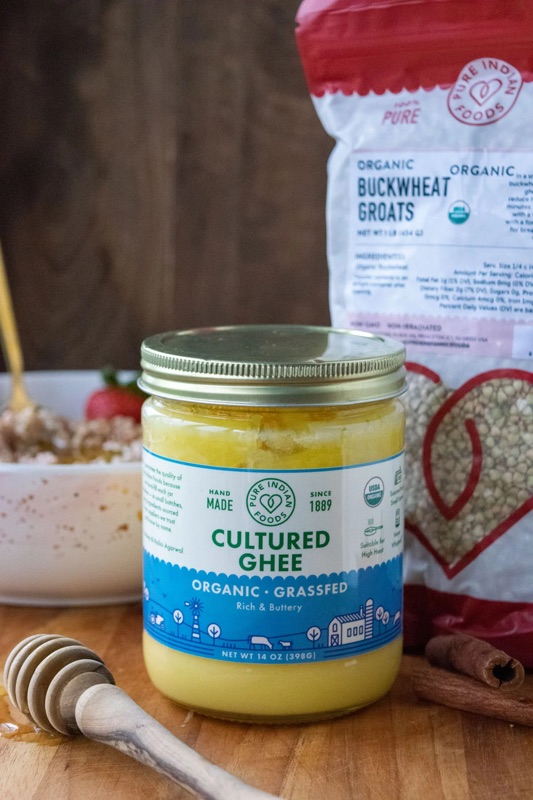
One-ingredient organic cultured ghee in glass, the kind our ghee guide suggests. USDA lists it as organic; the grass-fed claim and batch tests are the maker’s word and no independent test exists. The dearest fat here, about $2 an ounce.
Best for Cooks who want a cultured, organic ghee in glass for high-heat cooking and will pay more for it, knowing the grass-fed claim is unverified.
- Our rating
- Fair (3.4 of 5)
- Price range
- Premium
- Verified marks
- USDA Organic (OneCert; scope lists cultured ghee)
- Size
- 7.5 oz or 14 oz glass jar
- Made in
- Milk from small family farms in the Northeast USA, California and New Zealand (maker)
approx. $15 for 7.5 oz; approx. $26 for 14 oz
See it on Pure Indian Foods’s site → (opens in a new tab)We are not affiliated with Pure Indian Foods. This link goes to the maker’s own page, with no tracking code. How we're funded.
Also sold at Amazon ($26 for the 14 oz jar ($25.73)), Walmart.com ($28 for the 14 oz jar ($27.79)) .
Reader ratings & reviews
– out of 5
Loading ratings…
Rating breakdown
- 5 stars 0
- 4 stars 0
- 3 stars 0
- 2 stars 0
- 1 star 0
Have this product? Please rate it.
Check your email
We sent a sign-in link to . Click it and you’ll come straight back here, signed in. It expires in 15 minutes; check your spam folder if it doesn’t show up. Thank you for helping the community!
Your review
Reviews are personal experiences, not research, and they never change our quality ratings. Every review is read by our team before it appears.
How we evaluated it
How it scores Our rating, metric by metric
- Ingredients & processing 35% of the rating 5 of 5
One ingredient, cultured organic butter simmered into ghee, with nothing else added.
- Independent testing 25% of the rating 2 of 5
Only the paid USDA organic listing stands behind it. The batch tests the maker describes are unpublished, and no independent lab has tested it.
- Packaging 15% of the rating 4 of 5
Glass jar, per the maker’s product data. The lid liner is not stated.
- Trust 10% of the rating 2 of 5
A 2025 Prop 65 notice alleges lead in its neem leaf powder, not the ghee. “Grassfed” has no certifier, the origin is stated two ways, and it runs affiliate and referral programs.
- Value 15% of the rating 2 of 5
$2.00 an ounce for 7.5 oz and $1.86 for 14 oz, the highest of the fats here.
The rating, 3.4 of 5, is the weighted average of these scores. See how we rank cooking oils & fats and our standard.
Where to buy Stores and the prices we saw
- Amazon (opens in a new tab) approx. $26 for the 14 oz jar ($25.73). Sold by iHerb, not the maker; five were left in stock on 2026-10-23. The 7.5 oz jar was not listed. The listing photo shows a glass jar marked organic and grassfed cultured ghee.
- Walmart.com (opens in a new tab) approx. $28 for the 14 oz jar ($27.79). Marketplace seller iHerb, not Walmart or the maker. The listing’s barcode matches the maker’s 14 oz jar. Its packaging fields are generic, so we do not rely on them.
Prices as we saw them on October 23, 2026. They change often. These links carry no tracking code and earn us nothing.
What’s in it Every ingredient, in label order
- Grassfed organic cultured butter (made from non-homogenized whole milk from grassfed cows)
Who tested it What each test found, and who paid for it
- Paid certification USDA organic certification (OneCert) October 2026
Pure Indian Foods Corporation is certified for handling since 2022, with “Cultured Ghee, (Grassfed)” in scope. That certifies how the milk is sourced and the ghee is made, not a lab test of each jar. It does not verify the grass-fed claim. Open ↗ (opens in a new tab)
- Maker’s own test Pure Indian Foods (its own batch tests)
Says each batch is tested for gluten, lactose (no more than 0.25%) and casein and whey (no more than 2.5 ppm). No lab is named and no results are published. Open ↗ (opens in a new tab)
Who paid, and why it matters
- Independent The tester took no money from the maker for it: a consumer group, a journalist, a university or a regulator.
- Paid certification An outside lab or certifier tested or listed it, and the maker paid for that.
- Maker’s own test A lab report or certificate of analysis the maker commissioned and published.
A certification is a floor, not a verdict: it checks what its program checks and nothing else. We weigh tests by someone with no stake in the result most.
What people ask Worries raised online and elsewhere, and what we found
- Is it really grass-fed?
- The maker’s claim, with no certifier. The page says the cows are on pasture “spring thru fall”, which leaves out winter. Organic certification requires pasture access but does not prove a 100% grass diet.
- Where does the milk come from?
- The product page gives the country of origin as the United States. The FAQ says the milk comes from small family farms in the Northeast USA, California and New Zealand, with New Zealand used when local supply is short.
- Is it really lactose- and casein-free?
- The maker says each batch is tested to under 0.25% lactose and 2.5 ppm casein and whey. It shows no test results, so we cannot confirm it. Ask a clinician if you have a milk allergy.
- Does it contain phthalates or metals?
- No independent result exists. Mamavation’s 2025 ghee test (opens in a new tab) did not include it and found other ghees from non-detect to 2,702 ppb of phthalates.
- Any recalls, Prop 65 notices or lawsuits?
- One Prop 65 notice: 2025-03902 (opens in a new tab), filed 3 October 2025 by CalSafe Research Center, alleges lead in the company’s Organic Neem Leaf Powder, a different product. The page shows no complaint or settlement. We found nothing for the ghee, no FDA recall and no class action.
- Do influencers promote it, and are they paid?
- The site has an affiliate sign-up, a rewards and referral program, promo codes and a “Featured on Social Media” section. The product page quotes two authors, Dr. Louisa Williams and Nora Gedgaudas. It does not say whether they were paid.
Why we chose it What put it on our list
- The ingredient is “grassfed organic cultured butter”, made from non-homogenized whole milk, and nothing else. It is made from cultured butter, which our ghee guide prefers.
- The USDA Organic Integrity Database lists Pure Indian Foods Corporation of Burlington, New Jersey as certified (by OneCert, since 07/01/2022), with “Cultured Ghee, (Grassfed)” in its handling scope.
- The maker’s product data tags the jar “Packed in Glass”, and the page shows a best-by date (10/31/2027 on the listing we read).
- It says where the milk comes from: small family farms in the Northeast USA, California and New Zealand, with a preference for the closest supply. A tablespoon (14 g) has 120 calories, 14 g of fat and 9 g of saturated fat, with no trans fat.
Trade-offs What to weigh before you buy
- Ghee is about 60% saturated fat. Our ghee guide suggests keeping it to 1 to 2 tablespoons a day and says olive oil is better studied for heart health.
- “Grassfed” is the maker’s claim, and no grass-fed certifier is named. The page says the cows eat fresh green grass “spring thru fall”, which does not say what they eat in winter. Some milk comes from New Zealand when local supply is short, while the product page lists the country of origin as the United States.
- The page says each batch is tested for gluten, lactose (no more than 0.25%) and casein and whey (no more than 2.5 ppm), but it publishes no results or lab name. We found no independent test of this ghee for metals or plasticizers.
- It costs about $2.00 an ounce for the 7.5 oz jar and about $1.86 for the 14 oz, above Organic Valley’s ghee, which is organic but not cultured. The page does not say what the lid liner is made of.
What to know Details worth knowing first
Our ghee guide advises looking for ghee from grass-fed milk, ideally made from cultured butter, because it has more CLA, vitamins and DHA. Pure Indian Foods’ cultured ghee is made that way, in a glass jar, and the company says where its milk comes from.
The independent part is the USDA record: Pure Indian Foods Corporation is certified organic, and “Cultured Ghee (Grassfed)” is in the scope of its certificate. The rest is the maker’s word. We could not find a grass-fed certifier, a published batch result, or any outside test of the ghee for metals or plasticizers.
It costs more than ordinary organic ghee. If price matters more than culture and grass-fed, the Organic Valley ghee is the cheaper organic choice, and a lab has at least tested it for phthalates. Either way, ghee is mostly saturated fat and works best in small amounts.
What we checked Each claim, and how sure we are of it
| What we checked | What we found |
|---|---|
| Purity you can check Verified | Pure Indian Foods Corporation is in the USDA Organic Integrity Database with “Cultured Ghee, (Grassfed)” in its handling scope. That certifies how it is made, not a lab test of each jar. The company’s batch tests have no published results. |
| Fat profile stated Maker’s claim | Label: 120 calories, 14 g fat, 9 g saturated fat and 0 g trans fat per tablespoon. |
| Made without solvents Maker’s claim | Made from cultured butter by the traditional method the maker describes. No solvents are mentioned. |
| Packaging that blocks light, with a date Maker’s claim | A glass jar, per the maker’s product data. The maker says to store unopened jars in a dark, cool place. The page shows a best-by date. |
| A traceable source Maker’s claim | Milk from small family farms in the Northeast USA, California and New Zealand. No farm is named. |
| Grass-fed Maker’s claim | The maker’s claim. No grass-fed certifier listing found. |
What the labels mean
- Verified We opened an independent record that confirms it: a certifier’s listing, a regulator’s list or a lab report. It is linked under Sources.
- Maker’s claim The maker says so on its own page or label. We read it but found no independent record.
- Not verified We looked and could not confirm it, or the maker does not say. Treat it as unknown.
Sources Where our facts come from
- Pure Indian Foods Cultured Ghee, Grassfed & Certified Organic product page. Maker’s page. $14.99 for 7.5 oz and $25.99 for 14 oz on 2026-10-23. The FAQ names the milk sources. Open ↗ (opens in a new tab)
- USDA Organic Integrity Database: Pure Indian Foods Corporation. Certifier or regulator listing. Certified handling operation, OneCert, effective 07/01/2022. The scope lists “Cultured Ghee, (Grassfed)”. Profile updated 10/14/2026; re-read in a browser on 2026-10-23. Open ↗ (opens in a new tab)
- Mamavation: Ghee tested for toxic phthalates (May 2025). Test report. Ten other ghees, one sample each; Pure Indian Foods was not tested. The site earns affiliate income. Open ↗ (opens in a new tab)
- California Attorney General: Prop 65 60-day notice search. Certifier or regulator listing. Searched by alleged violator on 23 Oct 2026. One notice names Pure Indian Foods Corporation (2025-03902, lead, Organic Neem Leaf Powder); none for the ghee. openFDA food enforcement showed no report. Open ↗ (opens in a new tab)
- California Attorney General: 60 Day Notice 2025-03902. Certifier or regulator listing. Filed 10/03/2025 by CalSafe Research Center, Inc. (attorney Manning Law, APC) against Pure Indian Foods Corporation: lead and lead compounds in Pure Indian Foods Organic Neem Leaf Powder, UPC 850013619924. The page shows no complaint or settlement. Open ↗ (opens in a new tab)
Alternatives Other options to compare
- Organic Valley Organic Ghee Organic and pasture-raised, but not cultured and not labelled grass-fed. An independent lab found 105 ppb of phthalates in it. About $1.55 an ounce for the 13 oz jar.
- Marianne’s Harvest Organic Beef Tallow A non-dairy animal fat for high heat. USDA organic, about $17 for 11 oz.