Products · Mushroom supplements · Real Mushrooms
Real Mushrooms Organic Lion’s Mane Mushroom Powder
Reader ratings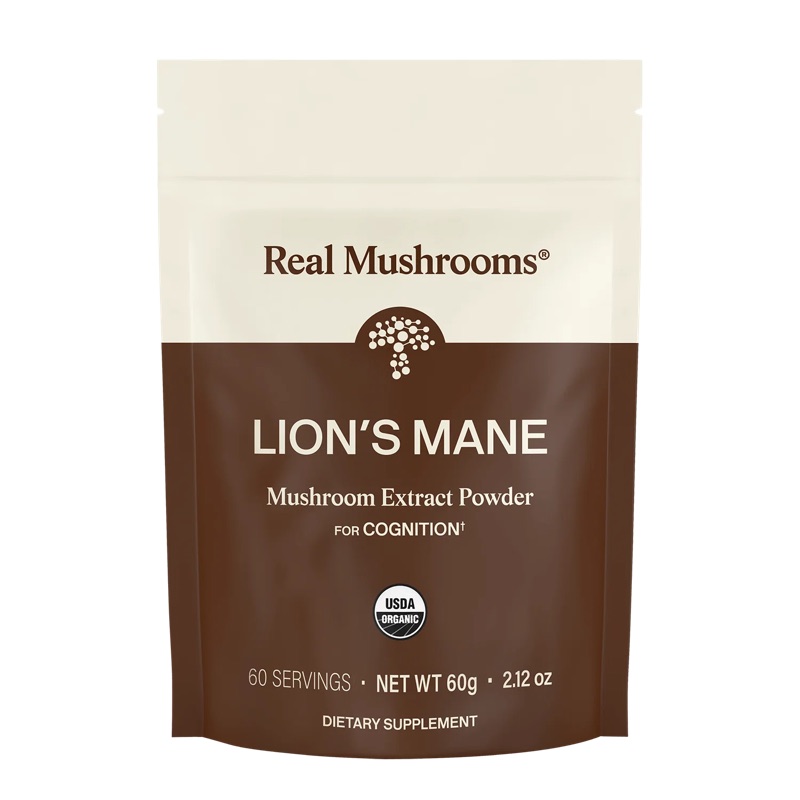
One ingredient: a hot-water lion’s mane fruiting-body extract. Three SGS Canada reports show beta-glucan of 30.5% to 41.0%, low metals and no pathogens, and one a low alpha-glucan figure. The maker ordered and chose the samples.
Best for People who want a one-ingredient lion’s mane powder that shows its beta-glucan and contaminant results, and who will stir 1 g a day into a drink.
- Our rating
- Good (3.6 of 5)
- Price range
- Mid-range
- Verified marks
- Purity-IQ Certified Authentic (Hericium erinaceus; identity by NMR)
- Size
- 60 g pouch, 1 g a serving (a 150 g pouch is approx. $70)
- Made in
- Extract of organic fruiting bodies grown in China, per the maker; distributed from Calgary, Canada
approx. $35 for 60 g (60 servings)
See it on Real Mushrooms’s site → (opens in a new tab)We are not affiliated with Real Mushrooms. This link goes to the maker’s own page, with no tracking code. How we're funded.
Also sold at Vitacost ($35 for 60 g), Amazon ($35 for 60 g), Walmart ($38 for 60 g) .
Reader ratings & reviews
– out of 5
Loading ratings…
Rating breakdown
- 5 stars 0
- 4 stars 0
- 3 stars 0
- 2 stars 0
- 1 star 0
Have this product? Please rate it.
Check your email
We sent a sign-in link to . Click it and you’ll come straight back here, signed in. It expires in 15 minutes; check your spam folder if it doesn’t show up. Thank you for helping the community!
Your review
Reviews are personal experiences, not research, and they never change our quality ratings. Every review is read by our team before it appears.
How we evaluated it
How it scores Our rating, metric by metric
- What is in it 25% of the rating 5 of 5
One ingredient, a hot-water extract of organic lion’s mane fruiting body, with its beta-glucan stated (300 mg a gram) and nothing added. SGS measured 40.9%.
- Independent testing 35% of the rating 3 of 5
Three SGS Canada reports that the maker commissioned and posted (60 g pouch 2025, 150 g pouch 2026, capsules 2026): beta-glucan by a named method, metals and microbes, and a starch marker in the 2025 one. One sample each, and ConsumerLab’s independent test is members-only.
- Evidence 15% of the rating 2 of 5
Lion’s mane has several small human trials, mostly cognition in older adults, at about 3 g of dried mushroom. This gives 1 g of extract with no stated ratio, and the claims on the page run ahead of the trials.
- Trust 10% of the rating 4 of 5
No recall, FDA warning letter or Prop 65 notice. It pays affiliates 15% and its supplier was founded by a co-founder’s father, and Reddit users have asked for third-party reports (it now posts some).
- Value 15% of the rating 4 of 5
About $0.58 a gram of extract in the 60 g pouch ($0.47 in the 150 g), the cheapest extract here along with Cordyceps-M.
The rating, 3.6 of 5, is the weighted average of these scores. See how we rank mushroom supplements and our standard.
Where to buy Stores and the prices we saw
- Vitacost (opens in a new tab) approx. $35 for 60 g. Vitacost says it sources directly from brands or authorized distributors, with no third-party resellers. Same price as Real Mushrooms’ own site.
- Amazon (opens in a new tab) approx. $35 for 60 g. The one-time offer is sold by FRONT ROW, a New York company, and shipped by Amazon; Real Mushrooms Inc. also sells on the listing. The listing says “independently verified by NSF International”: see the questions below.
- Walmart (opens in a new tab) approx. $38 for 60 g. Sold by iHerb through Walmart’s marketplace, at a higher price than the maker’s.
Prices as we saw them on October 23, 2026. They change often. These links carry no tracking code and earn us nothing.
What’s in it Every ingredient, in label order
- Organic lion’s mane (Hericium erinaceus) mushroom extract, 1,000 mg (beta-(1,3)(1,6)-glucans 300 mg)
Who tested it What each test found, and who paid for it
- Maker’s own test SGS Canada (ordered and posted by Real Mushrooms) May 2026
Report VR26-02726.002 for the 150 g pouch (sample 25825, received 6 May 2026, completed 27 May 2026): beta-D-glucan 40.9% (Megazyme K-YBGL); arsenic below 0.05, cadmium below 0.01, mercury below 0.05 and lead 0.08 ppm (ICP-MS); total aerobic count below 100 CFU/g; E. coli, Salmonella and S. aureus absent in 10 g; yeast and mold below 20 CFU/g. SGS notes that a third-party lab ran the microbial tests. No alpha-glucan or starch result. Open ↗ (opens in a new tab)
- Maker’s own test SGS Canada (ordered and posted by Real Mushrooms), 60 g pouch April 2025
Report VR25-01992.002 for RM-LM60, the 60 g pouch (sample 07224, received 28 March 2025, completed 7 April 2025): beta-D-glucan 30.5% and alpha-glucan 3.6% (Megazyme K-YBGL); arsenic below 0.05, cadmium 0.10, mercury below 0.05 and lead below 0.01 ppm (ICP-MS); total aerobic count below 100 CFU/g; E. coli, Salmonella and S. aureus absent in 10 g; yeast and mold below 20 CFU/g. Posted on the maker’s lion’s mane capsule page, not on this product’s page. Open ↗ (opens in a new tab)
- Maker’s own test SGS Canada (ordered and posted by Real Mushrooms), capsules July 2026
Report VR26-03674.008 for RM-LM150C, the 300-count capsules (sample L26015002-3, received 18 June 2026, completed 3 July 2026): beta-D-glucan 41.0%; arsenic below 0.05, cadmium 0.04, mercury below 0.05 and lead 0.05 ppm; total aerobic count 200 CFU/g; E. coli, Salmonella and S. aureus absent in 10 g; yeast and mold below 20 CFU/g. A different format from this powder. Open ↗ (opens in a new tab)
- Independent ConsumerLab (subscription-funded) October 2022
Real Mushrooms Lion’s Mane was one of 12 lion’s mane and chaga products ConsumerLab chose to test for beta-glucan, alpha-glucan and metals in 2022; ConsumerLab says it buys products on the open market, not from makers. Its public release says most products held the beta-glucan their labels implied, and four lion’s mane products were not approved because they were mycelium sold as “mushroom”. Real Mushrooms’ blog says ConsumerLab found its lion’s mane the best of those tested; ConsumerLab’s public pages name no Top Pick and hide the per-product results, so we could not check. Open ↗ (opens in a new tab)
- Paid certification Purity-IQ (NMR authentication) 2026
Lists Real Mushrooms Lion’s Mane as authenticated Hericium erinaceus by NMR. It checks which species it is, not purity or potency, and the listing gives no lot numbers or values. Open ↗ (opens in a new tab)
Who paid, and why it matters
- Independent The tester took no money from the maker for it: a consumer group, a journalist, a university or a regulator.
- Paid certification An outside lab or certifier tested or listed it, and the maker paid for that.
- Maker’s own test A lab report or certificate of analysis the maker commissioned and published.
A certification is a floor, not a verdict: it checks what its program checks and nothing else. We weigh tests by someone with no stake in the result most.
What people ask Worries raised online and elsewhere, and what we found
- Does Real Mushrooms show real third-party lab reports? Reddit users have asked.
- A July 2024 r/MushroomSupplements thread (opens in a new tab) says the company sent its own analyses and declined to share third-party ones. Its product pages now post SGS Canada reports for some products, including this one and its lion’s mane capsules. Those are lab reports, but the maker orders and pays for them and picks the sample, and ConsumerLab’s independent test of it is members-only.
- Someone posted that a Real Mushrooms lion’s mane was mostly sugar filler. Is that true?
- A January 2025 Reddit thread (opens in a new tab) repeats a Trustpilot review that claims a home test of a “Lions Mane Mushroom Formula” found mostly sucrose. We found no Real Mushrooms product by that name, the poster said the review could be false, and SGS measured 40.9% beta-glucan in the 150 g pouch and 30.5% beta-glucan against 3.6% alpha-glucan in the 60 g pouch. We treat it as unverified.
- Does a fruiting-body extract have the compounds that matter for the brain?
- Our lion’s mane page says hericenones come from the fruiting body and erinacines mainly from mycelium, and that trial doses were 1 to 3 g a day. A 2025 review (opens in a new tab) found five small randomized trials and three pilots, mostly on cognition in older adults. The posted report does not measure either compound.
- Is it NSF certified? Amazon’s listing says it was independently verified by NSF.
- Amazon’s bullets say the powder is “independently verified by NSF International.” NSF’s Certified for Sport directory lists only two Real Mushrooms products, 5 Defenders and Cordyceps-M capsules, not this powder, and the maker’s own page says only that it is made in an NSF-certified facility. NSF also certifies supplements under a general program that we could not search, so we cannot rule out a listing there.
- Is it really organic, and does grown-in-China matter?
- Real Mushrooms says its extracts come from certified organic mushrooms grown in China by its supplier Nammex, and the pouch says it is certified organic by QAI. We found no record for Real Mushrooms in the USDA Organic Integrity Database; Nammex is listed as certified by QAI. Mushrooms take up metals from what they grow on, which is why the metal results matter.
- Who is paid to promote it?
- Real Mushrooms runs an affiliate program (opens in a new tab) that pays 15% of each referred sale with no cap, plus a discount code for the creator’s audience, so many “best lion’s mane” lists are paid links. Its supplier, Nammex, was founded by the father of a Real Mushrooms co-founder, per its story page (opens in a new tab).
Why we chose it What put it on our list
- One ingredient and nothing else: organic lion’s mane extract, 1,000 mg a gram, with 300 mg of beta-(1,3)(1,6)-glucans stated on the label. “No grain, no starch, no fillers.”
- Beta-glucan is measured and the method is named. SGS Canada report VR26-02726.002 (150 g pouch, completed 27 May 2026) reads 40.9% by the Megazyme K-YBGL assay, against 30% claimed.
- The same report gives metals by ICP-MS (arsenic below 0.05, cadmium below 0.01, mercury below 0.05, lead 0.08 ppm) and microbes (E. coli, Salmonella and S. aureus absent in 10 g; yeast and mold below 20 CFU/g).
- The maker’s lion’s mane capsule page also posts a March 2025 report for the 60 g pouch itself (VR25-01992.002): beta-glucan 30.5% and alpha-glucan 3.6%, the starch marker, with arsenic below 0.05, cadmium 0.10, mercury below 0.05 and lead below 0.01 ppm and no pathogens. A June 2026 report for the capsules reads 41.0% beta-glucan.
- It is fruiting body only, hot-water extracted, not mycelium on grain. Purity-IQ, an outside program, lists Real Mushrooms Lion’s Mane as authenticated Hericium erinaceus by NMR.
- About $0.58 a gram in the 60 g pouch, and about $0.47 in the 150 g pouch ($69.95), among the cheapest extracts here.
Trade-offs What to weigh before you buy
- The three SGS reports (the 150 g pouch in May 2026, the 60 g pouch in March 2025 and the capsules in June 2026) are single samples, ordered and paid for by Real Mushrooms and chosen to post. It says it tests every lot, which we could not check. Ask for the report for your lot.
- Only the March 2025 report has an alpha-glucan (starch) figure, and none has a figure for hericenones. The 150 g report prints the table header over the beta-glucan row, so the digits are hard to read; we read 40.9%, and the maker’s other reports share the same layout.
- It is a hot-water extract with no alcohol step, and the label gives no extract ratio, so 1 g cannot be converted into grams of dried mushroom. The trials we cite gave about 3 g of dried fruiting body a day.
- We found no listing for Real Mushrooms in the USDA Organic Integrity Database. Its extract supplier, Nammex, is listed, so “organic” on the finished powder rests on the label.
What to know Details worth knowing first
Mushroom supplements are easy to mislabel. Many are mycelium grown on grain, and the “polysaccharides” on their labels can be mostly starch. Our mushroom guide explains the difference. This powder is the other kind: one ingredient, a hot-water extract of lion’s mane fruiting bodies, with its beta-glucan stated on the label.
What earns it a place is the lab reports Real Mushrooms posts. SGS Canada measured beta-glucan at 40.9% (150 g pouch, 2026) and 30.5% (60 g pouch, 2025) by the Megazyme method that independent testers also use, found 3.6% alpha-glucan, the starch marker, in the 2025 sample, and found metals low and no pathogens. They are single samples, ordered and paid for by Real Mushrooms, so ask for the report for your own lot. ConsumerLab tested the product in 2022 with no stake in the result, but its findings are for members.
The evidence for lion’s mane itself is modest: two small trials on our lion’s mane page, and five small randomized trials in a 2025 review. The trials used about 3 g of dried mushroom, and this gives 1 g of extract with no stated ratio. Real Mushrooms also pays affiliates 15% of sales, so many online recommendations are paid links.
What we checked Each claim, and how sure we are of it
| What we checked | What we found |
|---|---|
| Fruiting body or mycelium, stated Maker’s claim | Fruiting body only. The label reads “No grain, no starch, no fillers,” and the product page says 100% hot-water-extracted fruiting bodies. |
| Measured beta-glucans Verified | SGS Canada report VR26-02726.002 (RM-LM150 pouch, sample 25825, completed 27 May 2026): beta-D-glucan by Megazyme K-YBGL, 40.9%, against 30% on the label. A March 2025 report for the 60 g pouch (VR25-01992.002) reads 30.5%. One sample each, posted by the maker. |
| Starch or alpha-glucan reported Verified | The March 2025 SGS report for the 60 g pouch reads alpha-glucan 3.6% beside beta-glucan 30.5%; the 2026 reports do not report it. Real Mushrooms says it tests every lot for beta-glucan and that the product has no added starch. |
| Tested for contaminants Verified | 150 g report: arsenic below 0.05, cadmium below 0.01, mercury below 0.05, lead 0.08 ppm (ICP-MS, USP <232>/<233>). 60 g report (2025): arsenic below 0.05, cadmium 0.10, mercury below 0.05, lead below 0.01. Total aerobic count below 100 CFU/g in both; E. coli, Salmonella and S. aureus absent in 10 g; yeast and mold below 20 CFU/g. |
| Independent testing (a lab the maker does not pay) Not verified | ConsumerLab chose and tested it in 2022; the per-product result is for members. Real Mushrooms’ blog says ConsumerLab found its lion’s mane the best of those tested, which we could not confirm. |
| A named species Verified | Hericium erinaceus. Purity-IQ’s public listing for Real Mushrooms shows Lion’s Mane as authenticated by NMR. The listing gives no lot numbers or values. |
| Origin and organic certification Maker’s claim | The maker says its extracts come from certified organic mushrooms grown in China (supplier Nammex). The label says certified organic by QAI. No Real Mushrooms listing in the USDA Organic Integrity Database; Nammex Mushrooms Inc. is listed as certified by QAI (status effective 24 January 2022). |
| Extract or powder, stated Maker’s claim | Hot-water extract: the label lists 1,000 mg of mushroom extract per 1 g serving. No extract ratio is given. |
| NSF Certified for Sport Not verified | Not listed. NSF’s directory shows only Real Mushrooms’ 5 Defenders and Cordyceps-M capsules (searched 2026-10-23). The maker says the powder is made in an NSF-certified facility; Amazon’s listing says it is independently verified by NSF. |
| Recalls, warning letters and Prop 65 Verified | No openFDA recall record, no FDA warning letter naming Real Mushrooms or Nammex, and no Prop 65 notice naming either (searched 2026-10-23). |
What the labels mean
- Verified We opened an independent record that confirms it: a certifier’s listing, a regulator’s list or a lab report. It is linked under Sources.
- Maker’s claim The maker says so on its own page or label. We read it but found no independent record.
- Not verified We looked and could not confirm it, or the maker does not say. Treat it as unknown.
Sources Where our facts come from
- Real Mushrooms Organic Lion’s Mane Mushroom Powder product page. Maker’s page. Price ($34.95 for 60 g, $69.95 for 150 g) and claims, read 2026-10-23. Open ↗ (opens in a new tab)
- SGS Canada analysis report VR26-02726.002 (RM-LM150 pouch). Test report. An image of the lab’s report, posted on the product page. The table header prints over the beta-glucan row. Open ↗ (opens in a new tab)
- Real Mushrooms pouch label (back). Maker’s page. Supplement Facts: 1,000 mg extract and 300 mg beta-(1,3)(1,6)-glucans per 1 g serving. No other ingredients. Open ↗ (opens in a new tab)
- Real Mushrooms quality assurance page. Maker’s page. States the Megazyme K-YBGL method, metals and microbe testing and Purity-IQ authentication. Open ↗ (opens in a new tab)
- Purity-IQ Certified Authentic listing for Real Mushrooms. Certifier or regulator listing. Open ↗ (opens in a new tab)
- USDA Organic Integrity Database: Nammex Mushrooms Inc. (NOP 5520030770). Certifier or regulator listing. The extract supplier, certified by QAI. Real Mushrooms itself is not listed. Open ↗ (opens in a new tab)
- ConsumerLab news release: lion’s mane and chaga supplements (6 October 2022). Independent source. Names Real Mushrooms Lion’s Mane among 12 products ConsumerLab selected. Gives overall results only. Open ↗ (opens in a new tab)
- ConsumerLab lion’s mane and chaga supplements review (public summary). Independent source. Says it found one lion’s mane product that passed all tests and was reasonably priced, without naming it. Results are for members. Open ↗ (opens in a new tab)
- ConsumerLab: how lion’s mane and chaga products were evaluated. Independent source. Shows that the Megazyme K-YBGL assay is the method an independent tester uses for mushroom beta-glucan and alpha-glucan. Open ↗ (opens in a new tab)
- Real Mushrooms blog: ConsumerLab results. Maker’s page. The maker’s account of ConsumerLab’s tests and its separate consumer-survey award. Not checked against ConsumerLab’s paid reports. Open ↗ (opens in a new tab)
- Real Mushrooms affiliate program. Maker’s page. 15% commission on referred sales, no cap, a discount code for the creator’s audience. Open ↗ (opens in a new tab)
- Real Mushrooms our-story page. Maker’s page. Says Nammex was founded by Jeff Chilton, who co-founded Real Mushrooms with his son Skye. Open ↗ (opens in a new tab)
- Reddit r/MushroomSupplements: Real Mushrooms and 3rd party reports (July 2024). Independent source. We read the thread’s title and opening text only; Reddit blocks automated page fetches. Open ↗ (opens in a new tab)
- Reddit r/MushroomSupplements: Real Mushrooms, legit or not? (January 2025). Independent source. Quotes an unverified Trustpilot review. We read the opening text only. Open ↗ (opens in a new tab)
- Menon and colleagues 2025: Hericium erinaceus as a supplement, a systematic review (Frontiers in Nutrition). Independent source. Five randomized trials, three pilot trials and 15 laboratory studies, searched to June 2024. Open ↗ (opens in a new tab)
- FDA warning letters search for “real mushrooms”. Certifier or regulator listing. No letter names Real Mushrooms or Nammex (searched 2026-10-23). Open ↗ (opens in a new tab)
- California Attorney General: 60-day notice search for “Real Mushrooms”. Certifier or regulator listing. No notice names Real Mushrooms or Nammex (searched 2026-10-23). Open ↗ (opens in a new tab)
Alternatives Other options to compare
- Real Mushrooms Organic Lion’s Mane Extract Capsules (opens in a new tab) The same maker’s capsules, 120 for approx. $35. Their page posts SGS reports for the 60 g pouch (March 2025) and for the 300-count capsules (June 2026: 41.0% beta-glucan, low metals).
- Mycelium-on-grain lion’s mane powders Often cheaper per gram, but the label may not report starch, so the “polysaccharides” figure can be mostly grain. See what to look for.