Products · Tea & teaware · Den’s Tea
Den’s Tea Organic Sencha Yutaka-Midori
Reader ratings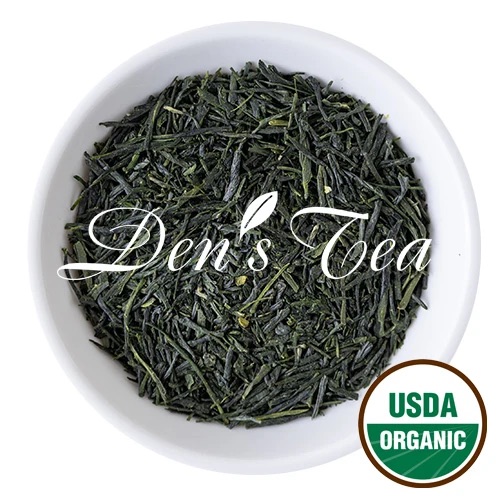
First-flush organic sencha from one named Kagoshima grower, sold by a California importer. USDA lists the product by name. Den’s publishes no heavy-metal, pesticide or fluoride results, and shows California’s lead warning on its teas.
Best for Loose-leaf green tea drinkers who want a named grower, cultivar and harvest at a mid-range price.
- Our rating
- Fair (3.3 of 5)
- Price range
- Mid-range
- Verified marks
- USDA Organic (CCOF)
- Size
- 2 oz (56 g) or 1 lb (454 g)
- Made in
- Shibushi City, Kagoshima, Japan (single origin, grower Mr. Onitsuka), first flush
approx. $17.75 for 2 oz (56 g); $124 for 1 lb
See it on Den’s Tea’s site → (opens in a new tab)We are not affiliated with Den’s Tea. This link goes to the maker’s own page, with no tracking code. How we're funded.
Reader ratings & reviews
– out of 5
Loading ratings…
Rating breakdown
- 5 stars 0
- 4 stars 0
- 3 stars 0
- 2 stars 0
- 1 star 0
Have this product? Please rate it.
Check your email
We sent a sign-in link to . Click it and you’ll come straight back here, signed in. It expires in 15 minutes; check your spam folder if it doesn’t show up. Thank you for helping the community!
Your review
Reviews are personal experiences, not research, and they never change our quality ratings. Every review is read by our team before it appears.
How we evaluated it
How it scores Our rating, metric by metric
- Leaves & farming 25% of the rating 4 of 5
USDA’s listing names this sencha. The page names the grower (Mr. Onitsuka, Shibushi City, Kagoshima), the cultivar (Yutaka-Midori) and a first-flush harvest. It gives no harvest year, and Den’s FAQ says all its teas are grown in Shizuoka.
- Independent testing 30% of the rating 2 of 5
No lead, pesticide or fluoride results are published. Den’s says it often lab-tests its non-organic teas for pesticides and shows California’s lead warning on its teas, with no figures. The organic listing covers farming, not lead.
- What touches the tea 15% of the rating 4 of 5
Loose leaf. Den’s FAQ describes the 2 oz package as a re-sealable foil bag with an oxygen absorber; it does not say what else the bag is made of.
- Trust 10% of the rating 3 of 5
No Prop 65 notices or recalls found, and it shows the lead warning voluntarily. But its FAQ contradicts the product page on where the tea is grown, and it gives no numbers for its safety statements.
- Value 20% of the rating 4 of 5
$17.75 for 56 g is about $0.63 a cup at Den’s own count of 28 cups per package, less with a second steep, or $0.32 a gram. That is fair for a first-flush, single-grower sencha. Tao of Tea’s genmaicha costs about $0.12 a gram.
The rating, 3.3 of 5, is the weighted average of these scores. See how we rank tea & teaware and our standard.
What’s in it Every ingredient, in label order
- Organic green tea (sencha, Yutaka-Midori cultivar); the page prints no ingredient line
Who tested it What each test found, and who paid for it
- Paid certification USDA National Organic Program, through CCOF (a certifier Den’s Tea pays) October 2026
Lists Den’s Tea, Inc. as an organic operation, with “Tea (Japanese Green Tea - Sencha Yutaka-Midori)” in its scope. Organic rules cover farming inputs and handling, not lead or other metals, and set no fluoride limit. Open ↗ (opens in a new tab)
- Maker’s own test Den’s Tea (maker’s statement; no lab named) October 2026
Says it often submits its non-organic teas to a lab to check pesticide residue. Shows California’s lead warning on its teas and says levels are well below FDA’s tolerable intake levels, with no figures. Nothing is published for this tea. Open ↗ (opens in a new tab)
Who paid, and why it matters
- Independent The tester took no money from the maker for it: a consumer group, a journalist, a university or a regulator.
- Paid certification An outside lab or certifier tested or listed it, and the maker paid for that.
- Maker’s own test A lab report or certificate of analysis the maker commissioned and published.
A certification is a floor, not a verdict: it checks what its program checks and nothing else. We weigh tests by someone with no stake in the result most.
What people ask Worries raised online and elsewhere, and what we found
- Does it contain lead?
- Den’s says tea naturally contains lead from the soil and shows California’s lead warning on its teas (Prop 65 page (opens in a new tab)). It says the levels are well below FDA’s tolerable intake levels but gives no figure, and we found no independent test of this tea. Steeped tea usually passes little lead into the cup: Consumer Reports found concerning lead after brewing in only two of the 30 teas it tested in 2024 (report (opens in a new tab)), and the article does not name Den’s among the brands it tested. But there is no number here for Den’s.
- Is it from Kagoshima or Shizuoka?
- The product page says Mr. Onitsuka grows it in Shibushi City, Kagoshima; the FAQ (opens in a new tab) says all Den’s teas are grown in Shizuoka and packed by its parent company there. We went with the specific product page, but the two statements conflict.
- What about fluoride?
- Tea plants take up fluoride, and levels rise as the leaf matures (Lu et al. 2004 (opens in a new tab)). In a 2021 test of four Asian green teas, the Japanese tea had the least in the cup (1.88 ppm against 3.58 to 6.83 ppm for the others; study (opens in a new tab)). A first-flush sencha uses young leaf, but Den’s publishes no fluoride result. See our fluoride guide.
- Is the foil bag lined with plastic?
- Den’s FAQ calls the 2 oz package a re-sealable foil bag with an oxygen absorber and does not say what else it is made of. The tea is dry, so little touches it that matters, but we cannot say the bag is plastic-free.
Why we chose it What put it on our list
- The USDA Organic Integrity Database lists Den’s Tea, Inc. (certifier CCOF) with “Tea (Japanese Green Tea - Sencha Yutaka-Midori)” among its certified products.
- The page names the grower (Mr. Onitsuka, Shibushi City, Kagoshima), the cultivar (Yutaka-Midori) and the harvest (first flush).
- Den’s says its teas are processed and packed by its parent company, Shirakata Denshiro Shoten, shipped to California and kept in chilled storage. Its FAQ says the bag holds an oxygen absorber.
- At $17.75 for 56 g it is about $0.32 a gram, or $0.63 a cup at Den’s own count of 28 cups per 2 oz package (2 g a cup).
Trade-offs What to weigh before you buy
- No heavy-metal, pesticide or fluoride results are published for the organic line. Den’s says it often sends its non-organic teas to a lab for pesticide residue, but gives no numbers, and we found none for this tea.
- Den’s shows California’s Prop 65 lead warning for its teas and says tea “naturally contains lead from the soil”. We found no lead figure for this tea.
- Den’s FAQ says all its teas are grown in Shizuoka, while this page says Kagoshima. We went with the product page.
- The page gives no harvest year. Den’s FAQ describes the 2 oz package as a re-sealable foil bag with an oxygen absorber, and does not say what else the bag is made of.
What to know Details worth knowing first
Sencha is the everyday Japanese green tea, steeped for a minute or two in water well below boiling. This one comes from a single grower in Kagoshima and is a first-flush (spring) harvest. Den’s Tea is a California importer whose parent company packs the tea in Japan. Den’s suggests 160 °F water and 90 seconds for the first cup.
We list it because it names its grower and cultivar and USDA lists the product by name, which is rarer than it should be. What it lacks is any number. The organic listing covers how the tea was grown, which speaks to pesticides. It says nothing about heavy metals or fluoride, which come from the soil. Den’s says so itself: its FAQ notes that tea “naturally contains lead from the soil”, and it carries California’s lead warning.
If you want a lab result on a brewed cup, see The Tao of Tea’s genmaicha, and read what its detection limit does and does not rule out. For how steeped leaf compares with tea bags, see loose leaf vs. tea bags.
What we checked Each claim, and how sure we are of it
| What we checked | What we found |
|---|---|
| Tested for lead and pesticides Not verified | Not published. Den’s says it often submits non-organic teas to a lab for pesticide residue and shows a Prop 65 lead warning, but gives no results for this tea. |
| Organic Verified | Den’s Tea, Inc. (Carson, California; NOP ID 5561008105) is certified by CCOF under the USDA National Organic Program. The listing names “Tea (Japanese Green Tea - Sencha Yutaka-Midori)”. |
| Named origin Maker’s claim | Grower Mr. Onitsuka, Shibushi City, Kagoshima; cultivar Yutaka-Midori; first flush. This comes from Den’s page; its FAQ says all its teas are grown in Shizuoka. |
| Loose leaf or plastic-free bags Maker’s claim | Loose leaf. Den’s FAQ calls the 2 oz package a re-sealable foil bag with an oxygen absorber; it does not say what else the bag is made of. |
| Freshness Maker’s claim | First flush. Den’s says teas are packed in Japan, kept in chilled storage in California, and sold in bags with an oxygen absorber. No harvest year is stated. |
| Notices and recalls Verified | We found no FDA enforcement report and no California Prop 65 notice naming Den’s Tea when we searched on 23 Oct 2026. |
What the labels mean
- Verified We opened an independent record that confirms it: a certifier’s listing, a regulator’s list or a lab report. It is linked under Sources.
- Maker’s claim The maker says so on its own page or label. We read it but found no independent record.
- Not verified We looked and could not confirm it, or the maker does not say. Treat it as unknown.
Sources Where our facts come from
- Den’s Tea: Organic Sencha Yutaka-Midori (product page). Maker’s page. Seen 23 October 2026: $17.75 for 2 oz; grower, cultivar, first flush; brewing 2 to 3 g per 4 oz. Open ↗ (opens in a new tab)
- Den’s Tea: infrequently and frequently asked questions. Maker’s page. Source for the organic, lab-testing, freshness, bag, Shizuoka and Prop 65 statements. Open ↗ (opens in a new tab)
- Den’s Tea: California Proposition 65. Maker’s page. The lead warning and Den’s explanation. Open ↗ (opens in a new tab)
- USDA Organic Integrity Database: Den’s Tea, Inc.. Certifier or regulator listing. Checked 22 October 2026 (not re-opened on 23 October). Open ↗ (opens in a new tab)
- Consumer Reports: Good news on tea, few contaminants, lots of health benefits (20 May 2024). Test report. Opened 23 Oct 2026 and again in the second pass. Independent tests of 30 teas; lead was concerning after brewing in only two (Luzianne Iced Black Tea and From Great Origins Organic Hibiscus). The article names brands such as Bigelow, Lipton, Twinings and Yamamotoyama, not Den’s Tea, but it does not print the full list of 30. Open ↗ (opens in a new tab)
- Fluoride content in tea and its relationship with tea quality (Lu et al., 2004). Independent source. PMID 15237954. Opened and checked: fluoride rises with leaf maturity. Open ↗ (opens in a new tab)
- Fluoride content in Asian produced green teas (Ing et al., 2021). Independent source. PMID 34343066. Opened and checked: Japanese 1.88 ppm, Sri Lankan 3.58, South Korean 5.36, Chinese 6.83. Open ↗ (opens in a new tab)
- California Attorney General: Prop 65 60-day notice search. Certifier or regulator listing. Searched by alleged violator (exact phrases “Den’s Tea”, “Dens Tea” and “Shirakata”) on 23 Oct 2026: no notice. Open ↗ (opens in a new tab)
- openFDA: food enforcement reports (recalling firm search). Certifier or regulator listing. Searched 23 Oct 2026: no matches. Open ↗ (opens in a new tab)
Alternatives Other options to compare
- The Tao of Tea Organic Genmaicha About a third of the price per gram. An outside lab found no lead in a strong brew of it, at a 5 ppb detection limit, but it names no farm.
- Rishi Organic Nishi Sencha First Flush (opens in a new tab) Also names its grower (Nishi-san, Kirishima) and is listed as organic, at about $32 for 50 g. Prop 65 lead notices have named other Rishi products: matcha, oolong and a chai concentrate.