Products · Tea & teaware · Matchaful
Matchaful Houjicha (organic roasted green tea powder)
Reader ratings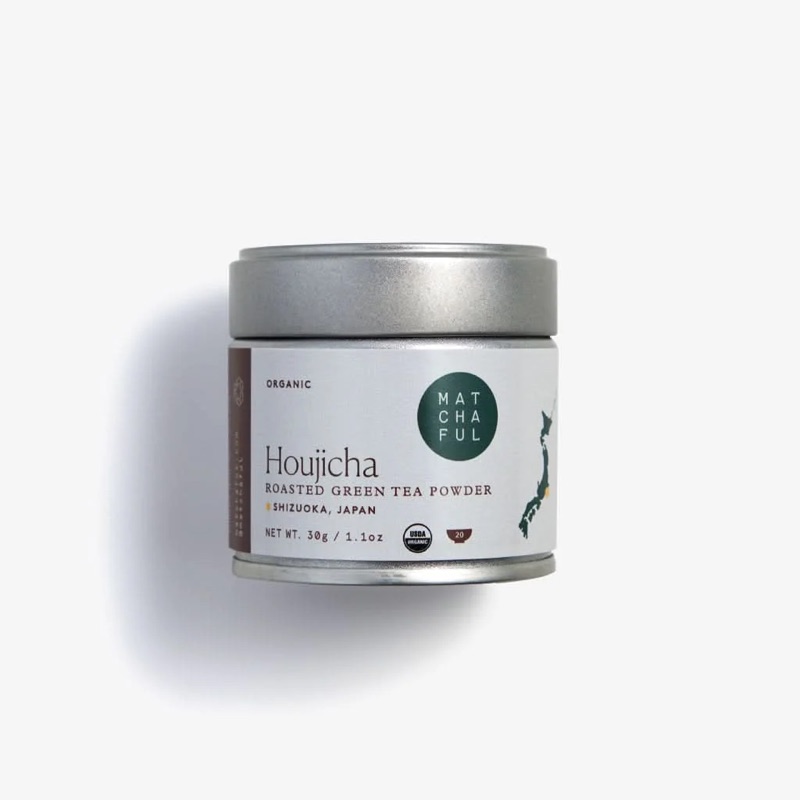
Roasted green tea powder from an organic Shizuoka farm group. Matchaful’s 2026 report shows less lead than its matchas (45 to 50 ppb, about 0.1 µg per 2 g serving) and no pesticides detected. The numbers are the maker’s; no outside test.
Best for People who whisk or blend powdered tea and want a lower-lead, lower-priced option than matcha, with a toasty rather than grassy taste.
- Our rating
- Good (3.6 of 5)
- Price range
- Budget
- Verified marks
- USDA Organic (CCOF)
- Size
- 30 g tin or 100 g bag
- Made in
- Tenryu District, Shizuoka, Japan (produced by Osada Tea), as stated by the maker
approx. $30 for a 30 g tin ($48 for 100 g)
See it on Matchaful’s site → (opens in a new tab)We are not affiliated with Matchaful. This link goes to the maker’s own page, with no tracking code. How we're funded.
Also sold at Amazon ($37 for the 30 g tin) .
Reader ratings & reviews
– out of 5
Loading ratings…
Rating breakdown
- 5 stars 0
- 4 stars 0
- 3 stars 0
- 2 stars 0
- 1 star 0
Have this product? Please rate it.
Check your email
We sent a sign-in link to . Click it and you’ll come straight back here, signed in. It expires in 15 minutes; check your spam folder if it doesn’t show up. Thank you for helping the community!
Your review
Reviews are personal experiences, not research, and they never change our quality ratings. Every review is read by our team before it appears.
How we evaluated it
How it scores Our rating, metric by metric
- Leaves & farming 25% of the rating 4 of 5
USDA lists “Houjicha Roasted Matcha” under Matchaful’s organic certification. The page names the producer (Osada Tea), the area (Tenryu District, Shizuoka) and first-flush leaves, and prints a Best By date. No farm or harvest year is given.
- Independent testing 30% of the rating 3 of 5
Matchaful’s own 2026 report, lab name blacked out: lead 49.7 ppb (45 by ICP-MS), the lowest of its three powders, fluoride 120 mg/kg, and no pesticides detected. No independent test of Houjicha exists.
- What touches the tea 15% of the rating 4 of 5
A powder in a 30 g tin or a 100 g bag. No tea bag is involved. The pages do not say what the bag is made of.
- Trust 10% of the rating 3 of 5
No Prop 65 notices or recalls found, and it publishes lab reports. But the lab’s name is blacked out, and its blog calls the metals extremely low without saying what they are compared with.
- Value 20% of the rating 4 of 5
$30 for 30 g is $1.00 a gram. The 100 g bag is $0.48 a gram, the lowest per gram of Matchaful’s powders.
The rating, 3.6 of 5, is the weighted average of these scores. See how we rank tea & teaware and our standard.
Where to buy Stores and the prices we saw
- Amazon (opens in a new tab) approx. $37 for the 30 g tin. Sold by Matchaful Inc. and shipped by Amazon, $7 more than the maker’s own site, with the same barcode as the maker’s 30 g tin. The title says “Organic Roasted Green Tea Powder” and the page carries Amazon’s USDA Organic badge.
Prices as we saw them on October 23, 2026. They change often. These links carry no tracking code and earn us nothing.
What’s in it Every ingredient, in label order
- 100% Pure Organic Japanese Green Tea
Who tested it What each test found, and who paid for it
- Paid certification USDA National Organic Program, through CCOF (a certifier Matchaful pays) October 2026
Lists Matchaful, Inc dba Matchaful as an organic operation (status effective 6 Nov 2024), with “Houjicha Roasted Matcha” among its products. Organic rules cover farming inputs and handling, not lead or other metals, and set no fluoride limit. Open ↗ (opens in a new tab)
- Maker’s own test An unnamed lab (name blacked out; some methods marked ISO/IEC 17025), paid by Matchaful February 2026
Report for Houjicha, received 16 January and reported 4 February 2026: lead 49.7 ppb (45 ppb by ICP-MS), cadmium 14.1 ppb (12 by ICP-MS), arsenic 13.6 ppb (13 by ICP-MS), mercury below 5 ppb; pesticides not detected at the limit of quantitation in two screening panels; fluoride 0.012 % (120 mg/kg) by ion-selective electrode; cesium and iodine below detection. Open ↗ (opens in a new tab)
Who paid, and why it matters
- Independent The tester took no money from the maker for it: a consumer group, a journalist, a university or a regulator.
- Paid certification An outside lab or certifier tested or listed it, and the maker paid for that.
- Maker’s own test A lab report or certificate of analysis the maker commissioned and published.
A certification is a floor, not a verdict: it checks what its program checks and nothing else. We weigh tests by someone with no stake in the result most.
What people ask Worries raised online and elsewhere, and what we found
- Is there lead in it?
- Yes, but less than in Matchaful’s matchas. At 45 to 50 ppb, a 2 g serving carries about 0.09 to 0.10 µg and a 4 g latte about 0.18 to 0.20 µg, against California’s Prop 65 level of 0.5 µg a day. FDA (opens in a new tab) says no safe level of lead has been identified. See our lead guide.
- Who tested it, and who paid?
- Matchaful paid for the 2026 report and blacked out the lab’s name, so we treat it as the maker’s own. Its lab results post (opens in a new tab) calls the testing independent and accredited. The outside test we cite for Matchaful, by Lead Safe Mama (opens in a new tab), was of Kiwami matcha, not Houjicha.
- Is houjicha the same as matcha?
- No. Houjicha is roasted green tea, here ground to a powder. USDA’s listing calls it “Houjicha Roasted Matcha” while the shop sells “Houjicha”; we read them as the same product but could not confirm it, and Amazon’s title for the 30 g tin, “Houjicha Powder - Organic Roasted Green Tea Powder”, fits. Matchaful’s report puts its caffeine at about 2.0% by weight, against 2.8% for Kiwami.
- What about fluoride?
- You drink the whole powder, as with matcha, and tea plants take up fluoride. Matchaful’s own 2026 report gives 0.012 % for Houjicha, which is 120 mg/kg: about 0.24 mg in a 2 g serving and 0.48 mg in a 4 g latte. That is about what a 2022 study (opens in a new tab) found in matcha powder (118 to 122 mg/kg), so houjicha is lower in lead but not in fluoride. We found no study of fluoride in houjicha itself. See our fluoride guide.
Why we chose it What put it on our list
- Matchaful’s 2026 report on Houjicha (reported 4 Feb 2026) shows lead 49.7 ppb (45 ppb by a second method), cadmium 14.1, arsenic 13.6 and mercury below 5, fluoride 120 mg/kg, no pesticides detected in two screening panels, and cesium and iodine below detection.
- That is less lead than the other two powders in Matchaful’s reports, dated the same days: Kiwami at 68.8 ppb and Hikari at 76 to 114 ppb.
- The USDA Organic Integrity Database lists Matchaful (certifier CCOF) with “Houjicha Roasted Matcha” among its certified products. The page names the producer, Osada Tea, and the area, the Tenryu District of Shizuoka. The only ingredient is organic green tea.
- The 100 g bag costs $48, about $0.48 a gram, and the page prints a Best By date on the package.
Trade-offs What to weigh before you buy
- It still contains lead. At 45 to 50 ppb, a 2 g serving carries about 0.09 to 0.10 µg and a 4 g latte serving, the size Matchaful suggests, about 0.18 to 0.20 µg. California’s Prop 65 safe-harbor level for lead is 0.5 µg a day, and FDA’s interim reference levels for lead from all food are 2.2 µg a day for children and 8.8 µg a day for women of childbearing age.
- Fluoride is about the same as in matcha: 120 mg/kg in Matchaful’s report, against 118 to 122 mg/kg in matcha powder in a 2022 study. Houjicha is lower in lead, not in fluoride.
- The lab’s name is blacked out in Matchaful’s PDF, so the numbers are the maker’s own. We found no outside test of Houjicha; the outside test we cite for Matchaful was of Kiwami.
- The USDA database lists “Houjicha Roasted Matcha” while the shop sells “Houjicha”. We read them as the same product but could not confirm it.
- It is not matcha. Houjicha is roasted green tea, so it tastes toasty rather than grassy. Matchaful’s report measures caffeine at 2.0% by weight, against 2.8% for Kiwami.
What to know Details worth knowing first
Houjicha is green tea that has been roasted, which gives it a toasty, mellow taste. Matchaful sells it as a fine powder that you whisk or stir into milk, the same way as matcha. Because it is a powder, you drink the whole leaf, as with matcha (see our matcha guide).
It is listed because Matchaful’s own report puts its lead lower than its matchas, at about 45 to 50 ppb, with no pesticides detected, and because the USDA database lists the organic certification. Its fluoride, 120 mg/kg, is about the same as matcha’s. The lab’s name is blacked out in the PDF and we found no outside test of this product, so the numbers are the maker’s. At that level a 2 g serving carries about 0.1 µg of lead, against California’s Prop 65 safe-harbor level of 0.5 µg a day. Our lead guide explains why we do not call any amount of lead safe.
It is a sensible swap if you want less lead and a lower price than matcha and like the roasted taste. It is not a substitute if you want matcha’s shade-grown flavor.
What we checked Each claim, and how sure we are of it
| What we checked | What we found |
|---|---|
| Tested for lead and pesticides Maker’s claim | Matchaful’s 2026 report: lead 49.7 ppb (first method) and 45 ppb (ICP-MS), cadmium 14.1 and 12, arsenic 13.6 and 13, mercury below 5; pesticide panels not detected at the limit of quantitation; fluoride 0.012 % (120 mg/kg); cesium below 1 Bq/kg. No outside test of Houjicha found. |
| Organic Verified | Matchaful, Inc dba Matchaful is certified by CCOF (NOP ID 5561004703) under the USDA National Organic Program (status effective 6 Nov 2024). The listing includes “Houjicha Roasted Matcha”. |
| Named origin Maker’s claim | Produced by Osada Tea from first-flush leaves in an organic farm community in the Tenryu District, Shizuoka. This comes from Matchaful’s page. |
| Loose leaf or plastic-free bags Maker’s claim | A powder, not a tea bag, sold in a 30 g tin or a 100 g bag. The pages do not say what the bag is made of. |
| Freshness Maker’s claim | Matchaful prints a Best By date on the package and advises using an opened container within a month. No harvest year is stated. |
| Notices and recalls Verified | We found no FDA enforcement report and no California Prop 65 notice naming Matchaful when we searched on 23 Oct 2026. |
What the labels mean
- Verified We opened an independent record that confirms it: a certifier’s listing, a regulator’s list or a lab report. It is linked under Sources.
- Maker’s claim The maker says so on its own page or label. We read it but found no independent record.
- Not verified We looked and could not confirm it, or the maker does not say. Treat it as unknown.
Sources Where our facts come from
- Matchaful: Houjicha (product page). Maker’s page. Seen 23 October 2026: $30 for 30 g; ingredients: 100% Pure Organic Japanese Green Tea. Open ↗ (opens in a new tab)
- Matchaful: lab test results for our tea products (June 2026). Maker’s page. Open ↗ (opens in a new tab)
- Matchaful: Houjicha lab report 2026 (PDF). Maker’s page. Opened 23 October 2026 and read in full in the second pass. Client: Matchaful Inc. Reported 4 Feb 2026. The lab’s name is blacked out. Fluoride 0.012 %. Open ↗ (opens in a new tab)
- USDA Organic Integrity Database: Matchaful, Inc dba Matchaful. Certifier or regulator listing. Checked 22 October 2026 (not re-opened on 23 October). Open ↗ (opens in a new tab)
- Lead Safe Mama: lab test of Matchaful Kiwami Super Ceremonial Matcha (2025). Test report. An outside test of Kiwami matcha, not Houjicha. Lead Safe Mama earns affiliate income. Open ↗ (opens in a new tab)
- Amazon listing: Matchaful Houjicha Powder, 30 g tin. Independent source. Opened 23 October 2026: $37.00, sold by Matchaful Inc., shipped by Amazon, UPC 850038816148 (the maker’s code); shows Amazon’s USDA Organic badge. Open ↗ (opens in a new tab)
- California Attorney General: Prop 65 60-day notice search. Certifier or regulator listing. Searched by alleged violator (exact phrase “Matchaful”) on 23 Oct 2026: no notice. Open ↗ (opens in a new tab)
- openFDA: food enforcement reports (recalling firm search). Certifier or regulator listing. Searched 23 Oct 2026: no matches. Open ↗ (opens in a new tab)
- FDA: lead in food and foodwares (interim reference levels). Independent source. Opened 23 Oct 2026. Open ↗ (opens in a new tab)
- OEHHA: Prop 65 guideline stating lead’s safe-harbor levels (0.5 µg/day reproductive, 15 µg/day cancer). Independent source. Interpretive Guideline 2011-001, published by OEHHA. The 0.5 µg/day figure is also listed in California Code of Regulations, title 27, section 25805(b). Read in the earlier review round. Open ↗ (opens in a new tab)
- Fluoride content of matcha tea depending on leaf harvest time and brewing conditions (Jakubczyk et al., 2022). Independent source. PMID 35745280. Opened and checked. About matcha, not houjicha. Open ↗ (opens in a new tab)
Alternatives Other options to compare
- Matchaful Organic Kiwami Single Cultivar Matcha Real matcha, checked by an outside lab on an earlier batch. More lead (about 69 to 73 ppb) and more money: $49 for 30 g.
- A steeped loose-leaf tea You drink the infusion rather than the whole leaf.